2023 FDA Science Forum
In Vitro Evaluation of Morphine Sulfate Extended-Release Formulation Sprinkled on Soft Foods – A Comparison of Two Dosage Strengths of the Fresh and Stressed Drug Products
- Authors:
- Center:
-
Contributing OfficeCenter for Drug Evaluation and Research
Abstract
BACKGROUND:
To better understand the effect of soft food selection on sprinkle administration, we tested different soft foods to evaluate how soft food properties could interact with drug quality, efficacy, and safety. The study could provide information for sprinkle administration regarding soft food availability and patients with food allergy.
PURPOSE:
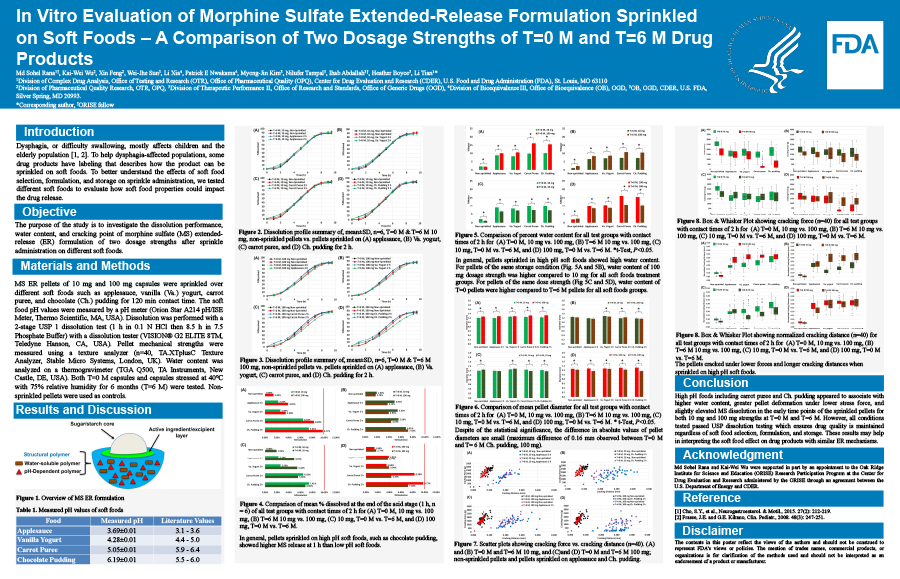
To investigate the dissolution performance, water content and cracking point of morphine sulfate (MS) extended-release (ER) formulation of two dosage strengths after sprinkle administration on different soft foods.
METHODS:
MS ER pellets of 10 mg and 100 mg capsules were sprinkled over different soft foods (applesauce, vanilla yogurt, carrot puree, and chocolate pudding, with pH 3.63, 4.34, 4.98, and 6.29, respectively) for 120 min contact time. Dissolution was performed with a 2-stage USP 1 dissolution test. Pellet cracking force and water content were analyzed using texture analyzer (n=40 pellets) and thermogravimeter, respectively. Both fresh capsules (T=0) and capsules stressed at 40℃ with 75% relative humidity for six months (T=6 M) were tested. Non-sprinkled pellets were used as controls.
RESULTS:
The mean percent MS-release at 1 h dissolution presented the highest variation among all tested groups and was higher in sprinkled groups than controls. Pellets sprinkled on high pH soft foods, such as chocolate pudding, showed higher MS-release than low pH soft foods for, both T=0 and T=6 M, all dosage strength pellets. The pellets cracked under lower forces and longer cracking distances when sprinkled on higher pH soft foods. T=0 pellets showed longer cracking distance than T=6 M pellets. Water content of T=0 pellets were higher compared to T=6 M pellets for all soft foods tested for each dosage strength. Higher pH soft foods showed higher water content within same dosage strength and storage condition.
CONCLUSION:
High pH foods appeared to associate with higher water content, greater pellet deformation under lower stress force, and slightly elevated MS dissolution in the early time points of the sprinkled pellets. However, all conditions tested passed USP dissolution testing which ensures drug quality is maintained even when sprinkled on soft food. These results may be useful in interpreting the soft food effect on bioequivalence determination of MS type products.