2021 FDA Science Forum
In Vitro Dynamic Hemolysis Testing of Blood Pumps: Updating the ASTM F1841 Testing Standard
- Authors:
- Center:
-
Contributing OfficeCenter for Devices and Radiological Health
Abstract
Background
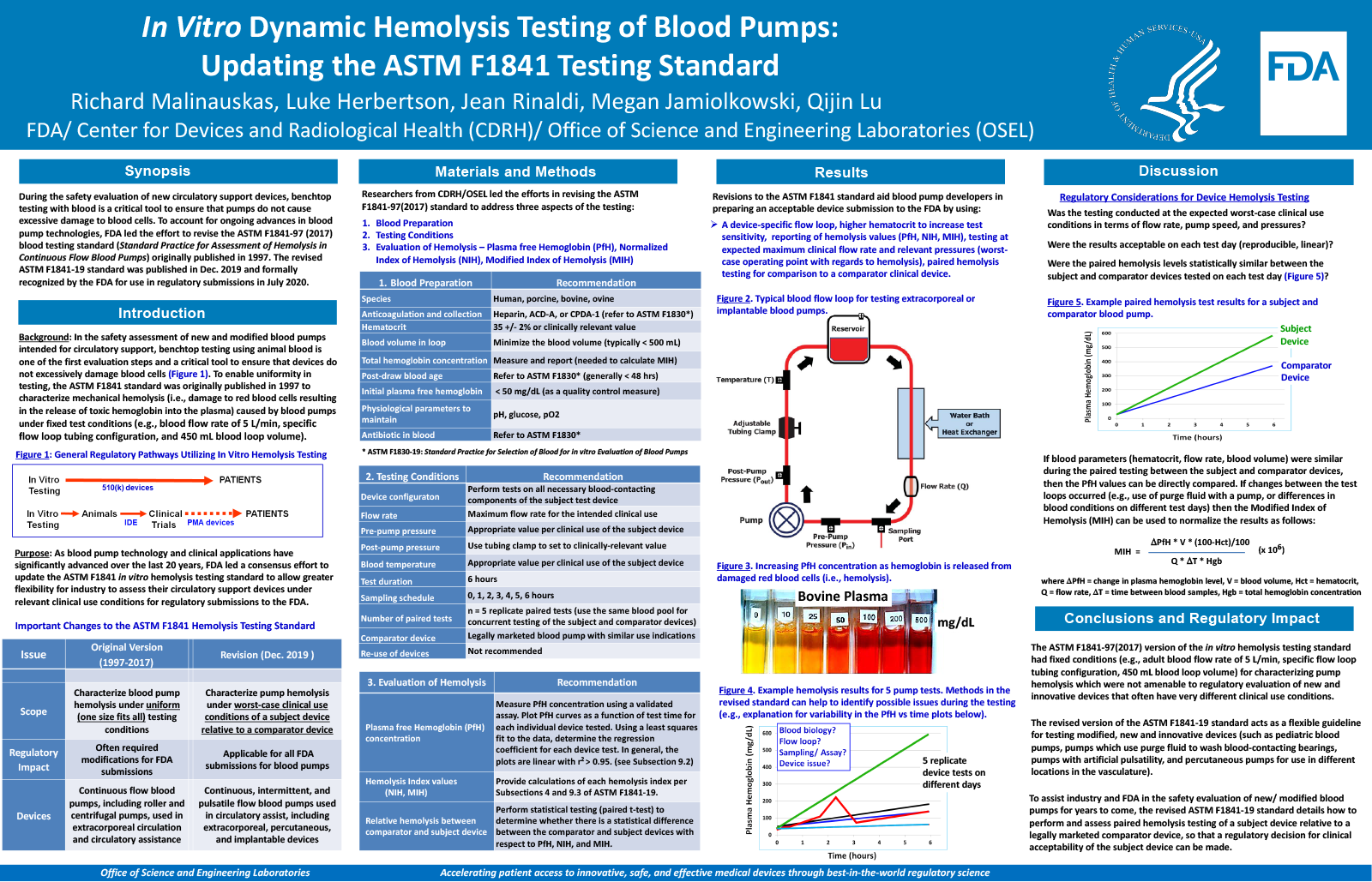
In the safety evaluation of new and modified blood pumps intended for circulatory support, benchtop testing using animal blood is a critical tool to ensure that devices do not excessively damage blood cells. To enable uniformity in testing, the ASTM F1841 testing standard was published in 1997 to assess device mechanical hemolysis (i.e., damage to red blood cells resulting in the release of toxic hemoglobin into the plasma).
Purpose
As pump technology and clinical applications have significantly advanced over the last 20 years, FDA led a consensus effort to update the ASTM F1841 testing standard to allow greater flexibility for industry to assess their circulatory support devices.
Methodology
Researchers from CDRH/Office of Science and Engineering Laboratories facilitated revisions to the ASTM F1841 standard. This was necessary as the standard previously only applied to extracorporeal and implantable continuous flow rotary blood pumps using a rigid protocol (e.g., limited to a blood flow rate of 5 L/min, a specific flow loop tubing configuration, and a 450 mL blood loop volume). Furthermore, while the standard characterized hemolysis in stand-alone pumps, it did not address how the results could be used to evaluate device safety.
Results
The revised standard provides flexibility to industry, as its expanded scope now includes continuous, intermittent, and pulsatile circulatory support pumps, and covers extracorporeal, percutaneous, and implantable devices. It also provides testing recommendations that include blood preparation, testing the new device concurrently with a legally marketed comparator device under expected clinical use conditions, and the evaluation and reporting of the hemolysis test results. These updates to the standard also accommodate the development of blood pumps for pediatric patients, as the prior testing standard was limited to adults.
Conclusion
Dynamic in vitro hemolysis testing is an essential component of the pre-clinical assessment of blood pumps, as it evaluates damage to red blood cells during operation of the devices under worst-case clinical use conditions. To assist industry and FDA in the safety evaluation of new and modified blood pumps for years to come, the revised ASTM F1841-19 standard provides flexible guidelines for performing testing relative to a clinical comparator device.