2023 FDA Science Forum
In vitro drug disintegration and dissolution testing of BCS class I drug midodrine hydrochloride under simulated food-induced viscous conditions
- Authors:
- Center:
-
Contributing OfficeCenter for Drug Evaluation and Research
Abstract
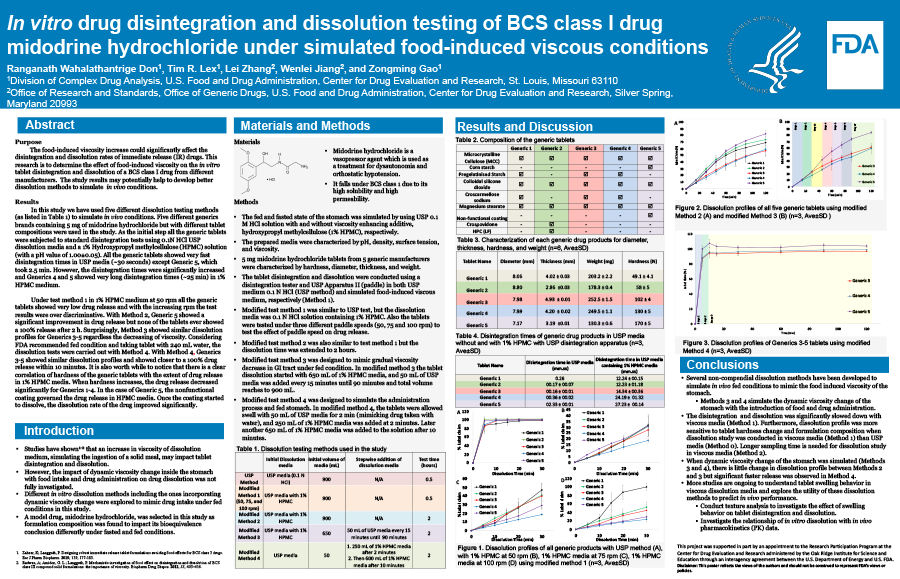
Five generic versions of a BCS class I drug product (5mg midodrine hydrochloride tablet) were characterized by hardness, diameter, thickness, and weight. The fed and fasted state of the stomach was simulated by using USP 0.1 M HCl solution with and without viscosity enhancing additive, hydroxypropyl methylcellulose (HPMC)). The disintegration and dissolution were conducted using a disintegration tester and USP Apparatus II (paddle) in both USP and simulated food-induced viscous media, respectively. In USP media, all the tablets showed almost a 100% drug release after 15 minutes. However, in viscous media, the drug release was decreased drastically for all regardless of the paddle speed. In 1% HPMC at 50 rpm, all the tablets showed a very low drug release after 30 minutes. When the paddle speed was increased to 75 rpm and 100 rpm, only Generic 1 showed a significant improvement in drug release. Generic 4 and 5 did not show any change of drug release with elevated paddle speed, while Generic 2 and 3 showing a slight improvement.
In disintegration tests, under USP media, all tablets showed a disintegration time closer to 30 seconds, except Generic 4, which was close to 2.5 minutes. When the media was changed to 1% HPMC, the disintegration times for all the tablets were increased significantly. When comparing the tablet compositions, Generic 4 did not contain any super disintegrant which may be the reason for the longer disintegration time in USP media.
With high viscous dissolution media at pH 1.0, the in vitro disintegration for all the generic midodrine hydrochloride tablets were significantly delayed, and the in vitro dissolution became incomplete and much slower, indicating that food-induced viscosity may play an important role in the disintegration and dissolution process. More future work is needed to correlate in vitro dissolution behavior with formulation composition and in vivo performance.