2021 FDA Science Forum
Improving the Genome Reference Assembly for E. Coli CFT073 and In Silico Detection of Potential Antibiotic Resistance Genes
- Authors:
- Center:
-
Contributing OfficeCenter for Drug Evaluation and Research
Abstract
Background
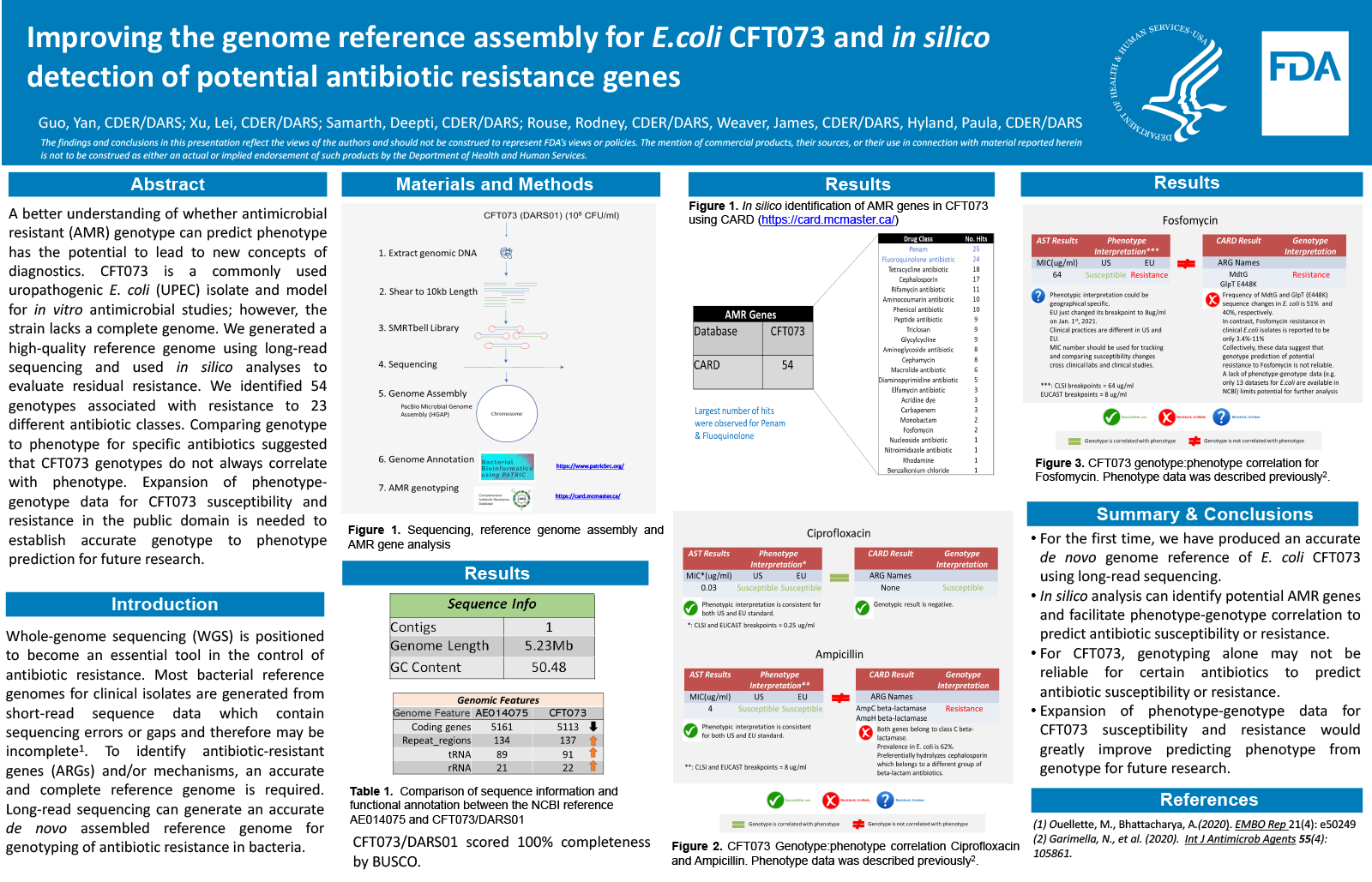
Following recent improvements in sequencing technologies, whole-genome sequencing (WGS) is positioned to become an essential tool in the control of antibiotic resistance, a major threat in modern healthcare. Most bacterial reference genomes for clinical isolates are generated from short-read sequence data which can contain sequencing errors or gaps and therefore may be incomplete. To identify antibiotic-resistant genes (ARGs) and/or mechanisms, an accurate and complete reference genome is required. Long-read sequencing can generate an accurate de novo assembled reference genome for genotyping of antibiotic resistance in bacteria.
Purpose
(i) To generate a long-read based de novo genome assembly of a laboratory- grown wild-type strain of E.coli CFT073; (ii) To evaluate and compare the de novo genome assembly to the published GenBank reference, AE014075; and (iii) To use the new reference assembly to confirm the susceptibility of CFT073 to Ciprofloxacin, Ampicillin and Fosfomycin based on genotyping.
Methodology
A chromosome-level reference genome was generated by employing the PacBio single molecule sequencing technique (SMRT). The genome sequences were assembled into one contig with a total length of 5.23 Mb. CARD and PATRIC antimicrobial resistance (AMR) gene databases were used to profile antibiotic susceptibility or potential for residual resistance based on genome sequences.
Results
The assembled E. Coli CFT073 genome characterized reduced ambiguities and errors compared to AE014075. Genome annotation identified less protein-coding (n=5113) and more noncoding (n=113) genes compared to AE014075. Based on in silico genotyping, 25 ARGs with potential to confer resistance to 23 antibiotic classes were identified using both databases. Phenotype-genotype correlation was observed for susceptibility to Ciprofloxacin alone, but not for Ampicillin and Fosfomycin, respectively, suggesting that genotyping alone is not reliable to predict antibiotic resistance.
Conclusion
For the first time, we have produced an accurate de novo genome reference of E. coli CFT073 using long-read sequencing. In silico analysis using publicly available data can identify potential AMR genes and facilitate phenotype-genotype correlation to predict antibiotic susceptibility or resistance. Expansion of phenotype-genotype data for CFT073 susceptibility and resistance would greatly improve predicting phenotype from genotype for future research.