2023 FDA Science Forum
Impact of Variations in Critical Quality Attributes of Brinzolamide Ophthalmic Suspensions on Preclinical Pharmacokinetics and Pharmacodynamics Following Once-Daily Topical Instillations
- Authors:
- Center:
-
Contributing OfficeCenter for Drug Evaluation and Research
Abstract
Background
Brinzolamide ophthalmic suspensions are indicated for treatment of elevated intraocular pressure (IOP), a major risk factor for optic nerve damage and glaucomatous visual field loss. Therefore, understanding the relationship between critical quality attributes (CQAs) of these ophthalmic suspensions and their pharmacokinetic/pharmacodynamic (PK/PD) performance is critical in furtherance of safe and effective generic products for treatment of IOP.
Purpose
To assess the potential impact of variations in CQAs (i.e., apparent viscosity and particle size distribution, PSD) on PK/PD of brinzolamide ophthalmic suspensions.
Methods
Multi-dose, parallel study with once-daily ophthalmic instillations of brinzolamide suspensions (0.5 mg/eye) for 14 days in rabbits. Test and reference formulations were characterized for PSD and apparent viscosity. IOP measurements were conducted via applanation tonometer, at the same time of day, for 5 days prior to dosing and up to 14 days of daily dosing. Relevant ocular tissues were harvested for processing and drug quantification on Days 7 and 14.
Results
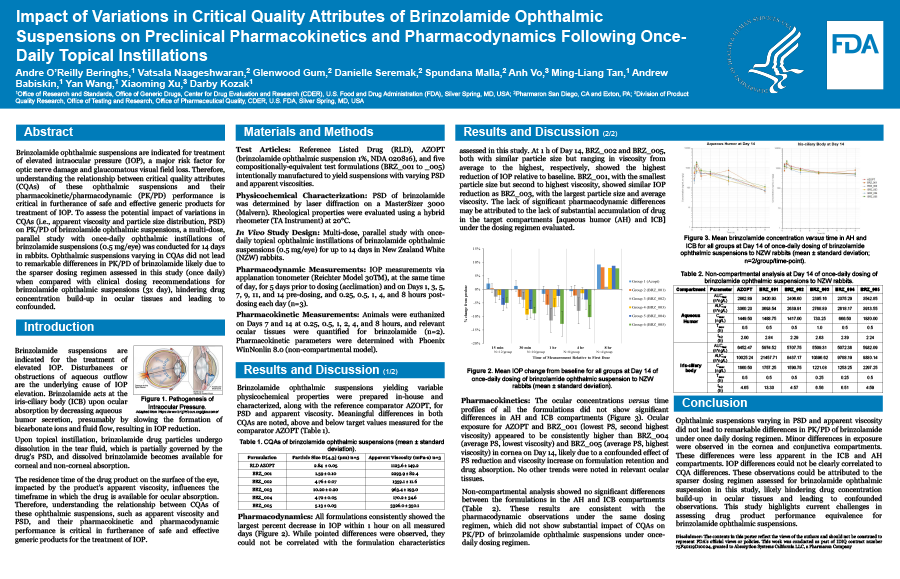
Differences in PK/PD could not be correlated with differences in CQAs. At 1 h of Day 14, BRZ_002 and BRZ_005, both with similar particle size but ranging in viscosity from average to the highest, respectively, showed the highest reduction of IOP relative to baseline. BRZ_001, with the smallest particle size but second to highest viscosity, showed similar IOP reduction as BRZ_003, with the largest particle size and average viscosity. In addition, differences in CQAs of all formulations did not lead to significant PK differences in the aqueous humor (AH) and iris-ciliary body (ICB) compartments. Minor trends were noted in cornea and conjunctiva, likely due to a confounded effect of PSD reduction and viscosity increase on formulation retention and drug absorption.
Conclusions
Ophthalmic suspensions varying in CQAs did not lead to remarkable differences in PK/PD of brinzolamide likely due to the sparser dosing regimen assessed in this study (once daily) when compared with clinical dosing recommendations for brinzolamide ophthalmic suspensions (3x day), hindering drug concentration build-up in ocular tissues and leading to confounded observations. This study highlights challenges in assessing drug product equivalence for brinzolamide ophthalmic suspensions.