2023 FDA Science Forum
Impact of External Factors on the Accuracy of Infrared Thermographs for Measuring Elevated Body Temperature
- Authors:
- Center:
-
Contributing OfficeCenter for Devices and Radiological Health
Abstract
Background:
Infrared thermographs (IRTs) have often been used for identifying febrile individuals in public during pandemics. Standardized approaches for performing IRT-based fever screening have been described in a recent document (ISO/TR13154). However, the scientific underpinnings of some aspects of this document remain unclear, as do the role of several potential confounding factors.
Objective:
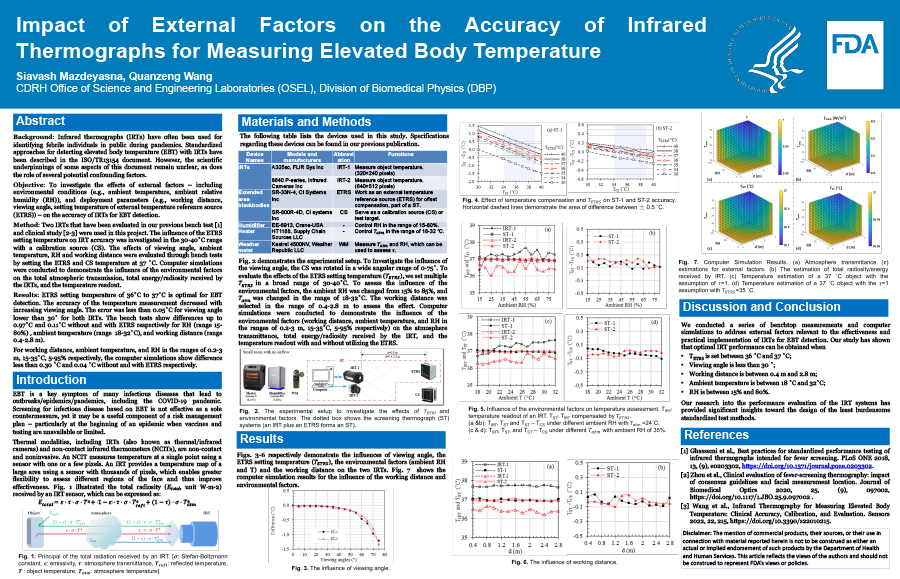
The purpose of this study is to investigate the effects of external factors – including environmental conditions (e.g., ambient temperature, ambient relative humidity (RH)), and deployment parameters (e.g., working distance, viewing angle, setting temperature of external temperature reference source (ETRS)) – on the accuracy of IRTs for elevated body temperature (EBT) detection.
Method:
The influence of the ETRS setting temperature on IRT accuracy was investigated in the 30-40˚C range with a calibration source (CS). The effects of ambient temperature, RH, working distance, and viewing angle were theoretically evaluated through bench tests by setting the ETRS and CS temperature at 37 ˚C. Computer simulations were conducted to demonstrate the influence of the environmental factors on the total atmospheric transmission, total energy/radiosity received by the IRT, and the temperature readout.
Results:
Results shows that ETRS setting temperature of 35˚C to 37˚C is the optimal for EBT screening. The accuracy of the temperature measurement decreased with increasing viewing angle. The error was less than 0.05˚C for viewing angle lower than 30-dgree for both IRTs. The influence of the ambient temperature, RH, and working distance within the ranges of 18-32˚C, 15-80%, and 0.4-2.8 m respectively were investigated. The bench tests show differences up to 0.97˚C and 0.11˚C without and with ETRS respectively. Considering working distance, ambient temperature, and RH in the ranges of 0.2-3 m, 15-35˚C, 5-95% respectively, the computer simulations show miscalculation less than 0.30 ˚C and 0.04 ˚C without and with ETRS respectively.
Conclusion:
Our research into the performance evaluation of the IRT systems has provided significant insights toward the design of the least burdensome standardized test methods. We conducted a series of benchtop measurements and computer simulations to address external factors relevant to the effectiveness and practical implementation of IRTs for EBT screening.