2023 FDA Science Forum
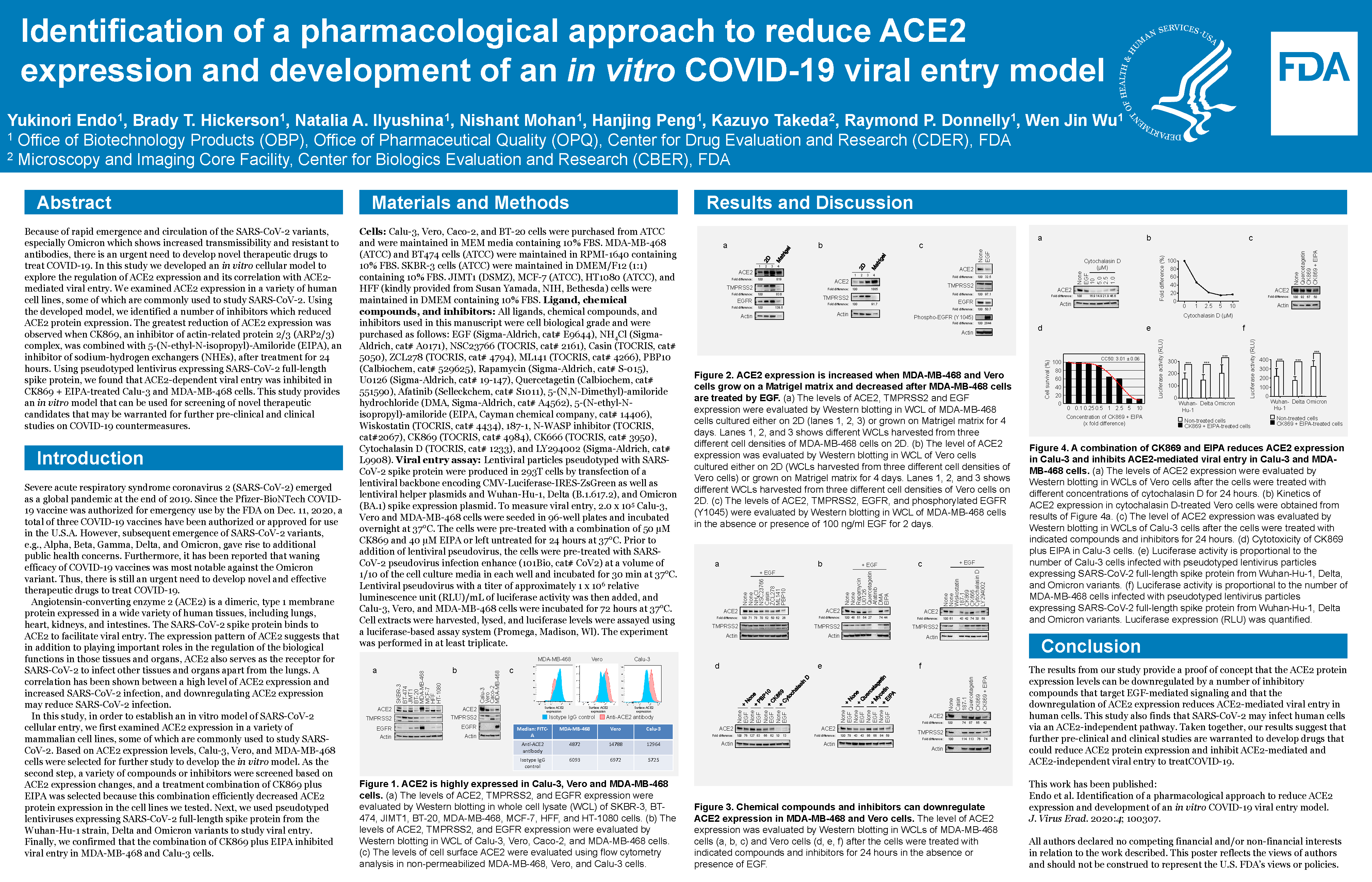
Identification of a pharmacological approach to reduce ACE2 expression and development of an in vitro COVID-19 viral entry model
- Authors:
- Center:
-
Contributing OfficeCenter for Drug Evaluation and Research
Abstract
Because of rapid emergence and circulation of the SARS-CoV-2 variants, especially Omicron which shows increased transmissibility and resistant to antibodies, there is an urgent need to develop novel therapeutic drugs to treat COVID-19. In this study we developed an in vitro cellular model to explore the regulation of ACE2 expression and its correlation with ACE2-mediated viral entry. We examined ACE2 expression in a variety of human cell lines, some of which are commonly used to study SARS-CoV-2. Using the developed model, we identified a number of inhibitors which reduced ACE2 protein expression. The greatest reduction of ACE2 expression was observed when CK869, an inhibitor of actin-related protein 2/3 (ARP2/3) complex, was combined with 5-(N-ethyl-N-isopropyl)-Amiloride (EIPA), an inhibitor of sodium-hydrogen exchangers (NHEs), after treatment for 24 hours. Using pseudotyped lentivirus expressing SARS-CoV-2 full-length spike protein, we found that ACE2-dependent viral entry was inhibited in CK869 + EIPA-treated Calu-3 and MDA-MB-468 cells. This study provides an in vitro model that can be used for screening of novel therapeutic candidates that may be warranted for further pre-clinical and clinical studies on COVID-19 countermeasures.