2021 FDA Science Forum
Human In Vitro Model for Preclinical Evaluation of Pulsed Electric Field-Based Non-Thermal Devices for Cardiac Ablation
- Authors:
- Center:
-
Contributing OfficeCenter for Devices and Radiological Health
Abstract
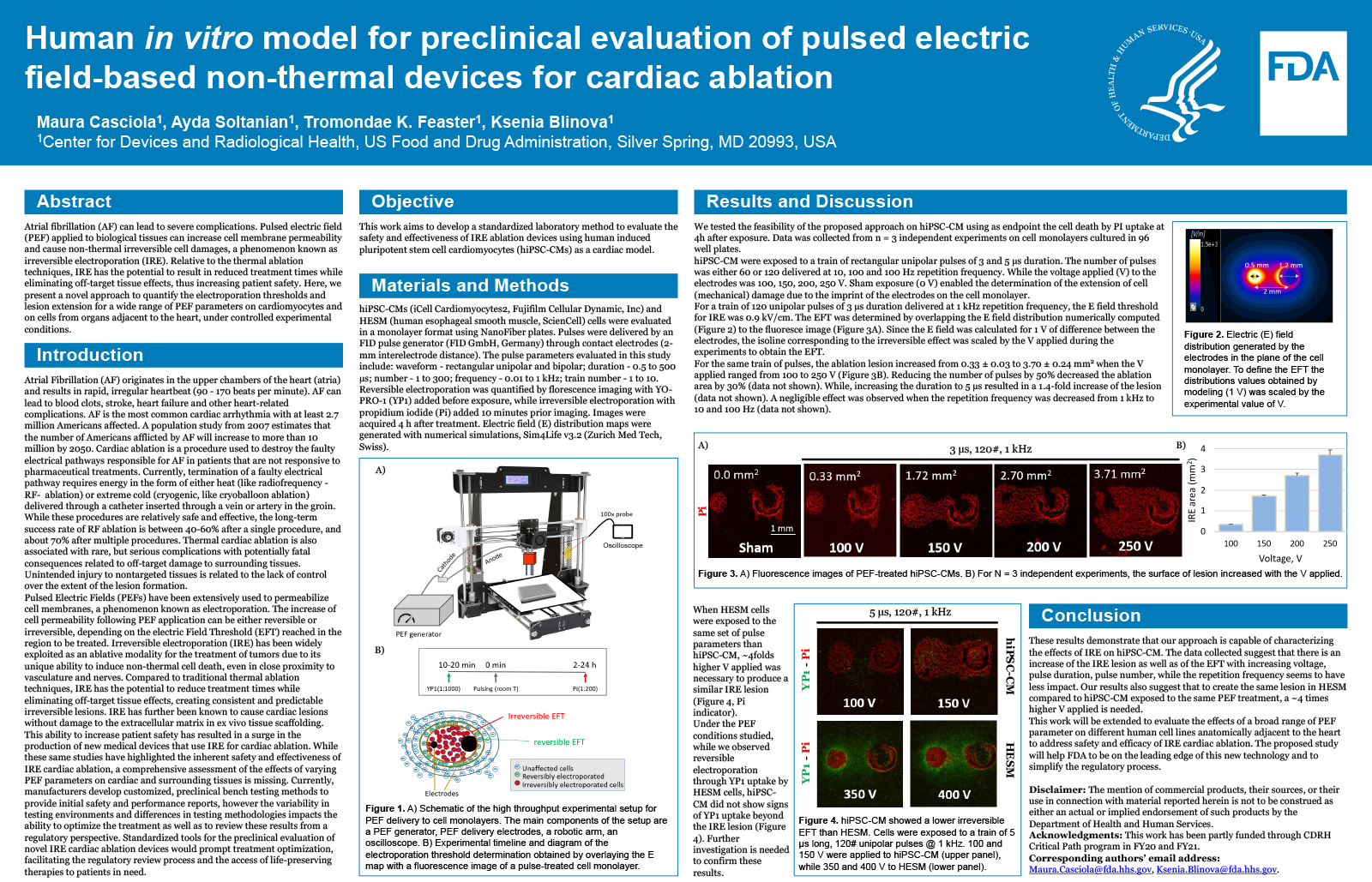
Pulsed electric field (PEF) applied to biological tissues can increase the cell membrane permeability and cause non-thermal irreversible cell damage, a phenomenon known as irreversible electroporation (IRE). In the last few years, several premarket applications of non-thermal PEF-based cardiac ablation devices to treat atrial fibrillation (AF) have been submitted to FDA. As compared to the thermal ablation techniques, IRE has the potential to result in shorter treatment times while sparing off-target tissues, thus increasing patient safety. This study aims to develop a standardized laboratory test to evaluate IRE ablation device safety and efficacy using human induced pluripotent stem cell cardiomyocytes (hiPSC-CM). Using a high-throughput assay that measures the extension of electroporation in hiPSC-CM monolayers, different pulse parameters (durations, amplitude, shape, repetition rate, and number) were assessed. PEFs were applied through a pulse generator via contact electrodes. Reversible and irreversible electroporation were quantified by fluorescence with YO-PRO-1 and Propidium dyes 1 and 4 hours after treatment, respectively. We tested and validated this assay with the Chinese Hamster Ovary (CHO) cell line. Electric field (E) distribution maps necessary to evaluate the electroporation threshold were obtained with numerical simulations using Sim4Life v3.2. The data collected on hiPSC-CM shows that there is an increase in irreversible electroporation lesion area and threshold with increasing voltage, pulse duration, and pulse number, while the repetition frequency has less impact. This work will be extended to include a broad range of pulse parameters on different human cell lines anatomically adjacent to the heart to address safety and efficacy of IRE cardiac ablation. This investigation will provide FDA with data and expertise to efficiently evaluate this promising technology.
Acknowledgments
This work has been partly funded through CDRH Critical Path program in FY20 and FY21.