2021 FDA Science Forum
House Dust Mite Proteins Reduce the Spread of Respiratory Syncytial Virus in the BEAS-2B Bronchial Epithelial Cell Line
- Authors:
- Center:
-
Contributing OfficeCenter for Biologics Evaluation and Research
Abstract
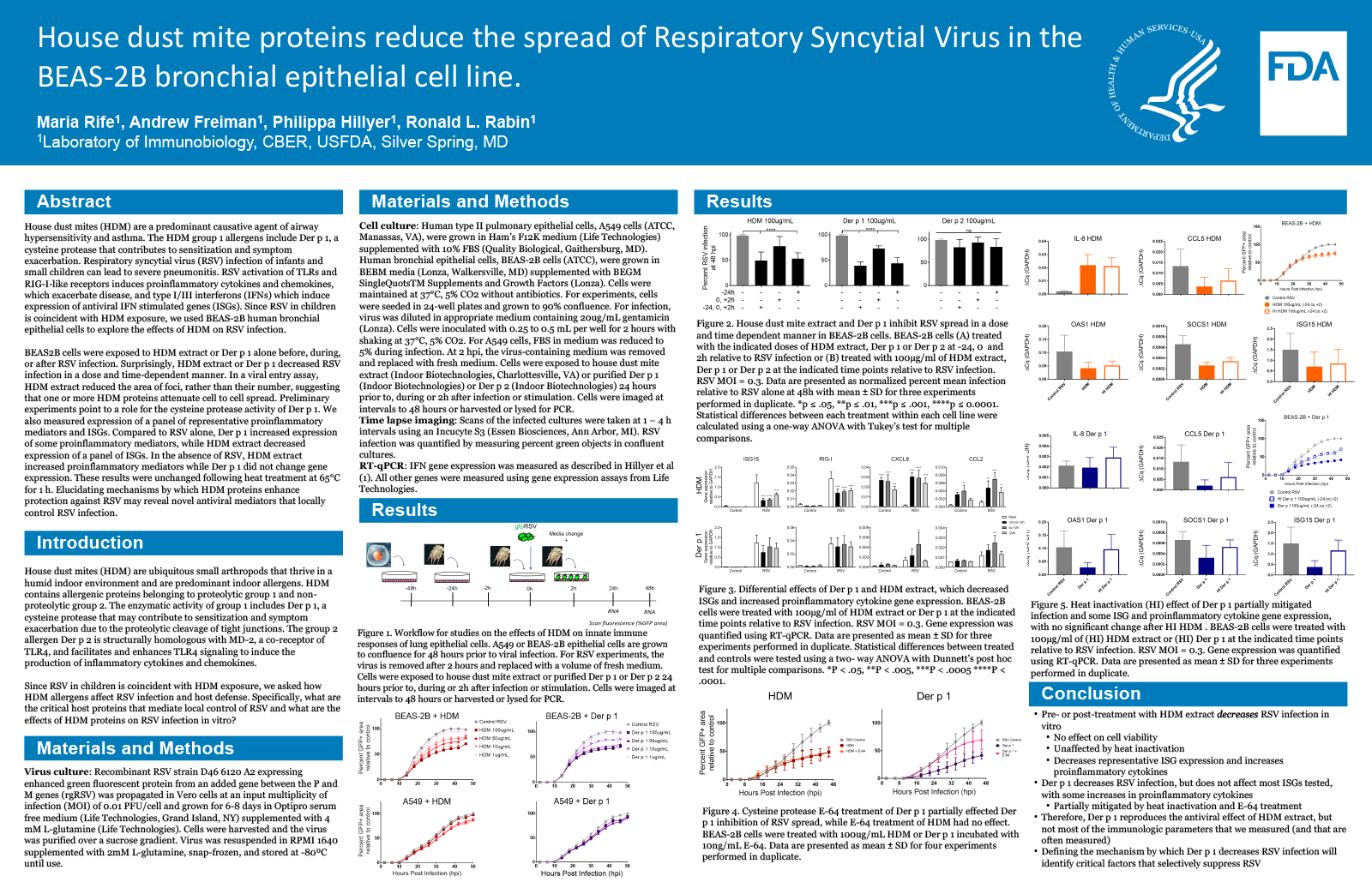
House dust mites (HDM) are a leading cause of airway hypersensitivity and asthma. The HDM allergens include Der p 1, a cysteine protease that contributes to sensitization and symptom exacerbation. Respiratory syncytial virus (RSV) infection of infants and small children can lead to bronchiolitis and pneumonia. Activation of TLRs and RIG-I-like receptors by RSV induces proinflammatory cytokines and chemokines, which exacerbate disease, and type I/III interferons (IFNs) which induce expression of antiviral IFN stimulated genes (ISGs). Since RSV in children is coincident with HDM exposure, we used BEAS-2B, a human bronchial epithelial cell line, to explore the effects of HDM on RSV infection.
BEAS2B cells were exposed to HDM extract or Der p 1 alone before, during, or after RSV infection. Surprisingly, HDM extract or Der p 1 decreased RSV infection in a dose and time-dependent manner. In a viral entry assay, HDM extract reduced the area of foci, rather than their number, suggesting that one or more HDM proteins attenuate cell to cell spread. Preliminary experiments point to a role for the cysteine protease activity of Der p 1. We also measured expression of a panel of representative proinflammatory mediators and ISGs. Compared to RSV alone, Der p 1 increased expression of some proinflammatory mediators, while HDM extract decreased expression of a panel of ISGs. In the absence of RSV, HDM extract increased proinflammatory mediators while Der p 1 did not change gene expression. These results were unchanged following heat treatment at 65°C for 1 h. Elucidating mechanisms by which HDM proteins enhance protection against RSV may reveal novel antiviral mediators that locally control RSV infection.