2023 FDA Science Forum
Have REMS Programs Reached Stable State 7 Years Post-Approval?
- Authors:
- Center:
-
Contributing OfficeCenter for Devices and Radiological Health
Abstract
Background:
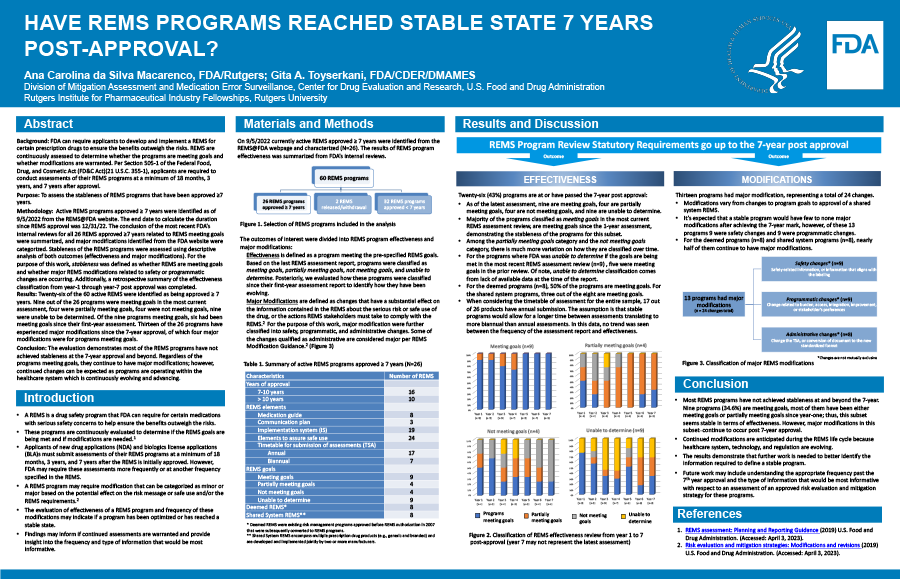
FDA can require applicants to implement Risk Evaluation and Mitigation Strategies (REMS) for certain prescription drugs to ensure the benefits outweigh the risks. REMS are continuously assessed to determine whether the programs are meeting goals and whether modifications are warranted. The Food and Drug Administration Amendments Act of 2007 (FDAAA) requires applicants to conduct assessment of their REMS programs at a minimum of 18 months, 3 years, and 7 years after approval. Purpose: To assess the stableness of REMS programs that have been approved ≥7 years. Methodology: Active REMS programs approved ≥ 7 years were identified as of 9/5/2022 from REMS@FDA website and used 12/31/22 as the end date to calculate the duration since approval. The conclusion of the FDA’s internal reviews for all 26 REMS approved ≥7 years related to REMS meeting goals were summarized, and major modifications identified from the FDA website were categorized. Stableness of the REMS programs were assessed using descriptive analysis. For this work, stableness was defined as whether REMS are meeting goals and whether major REMS modifications related to safety or programmatic changes are occurring. Results: Twenty-six of the 60 active REMS were identified as being approved ≥ 7 years. Eight out of the 26 programs were meeting goals, four were partially meeting goals, four were not meeting goals, eight were unable to be determined, and two were under review. Of the eight programs meeting goals, seven had been meeting goals since their first-year assessment. Thirteen of the 26 programs have experienced major modifications since the 7-year approval, of which four major modifications were for programs meeting goals. A subsequent analysis of the REMS programs modification will be completed to classify these changes as safety-related or program-related changes. Preliminary results showed program-related changes are the most common. Conclusion: The evaluation demonstrates most of the REMS programs have not achieved stableness at the 7-year approval and beyond. Regardless of the programs meeting goals, they continue to have major modifications; however, continued changes can be expected as programs are operating within the healthcare system which is continuously evolving and advancing.