2023 FDA Science Forum
Hand Sanitizer Safety and Efficacy During the COVID-19 Pandemic
- Authors:
- Center:
-
Contributing OfficeCenter for Drug Evaluation and Research
Abstract
Background:
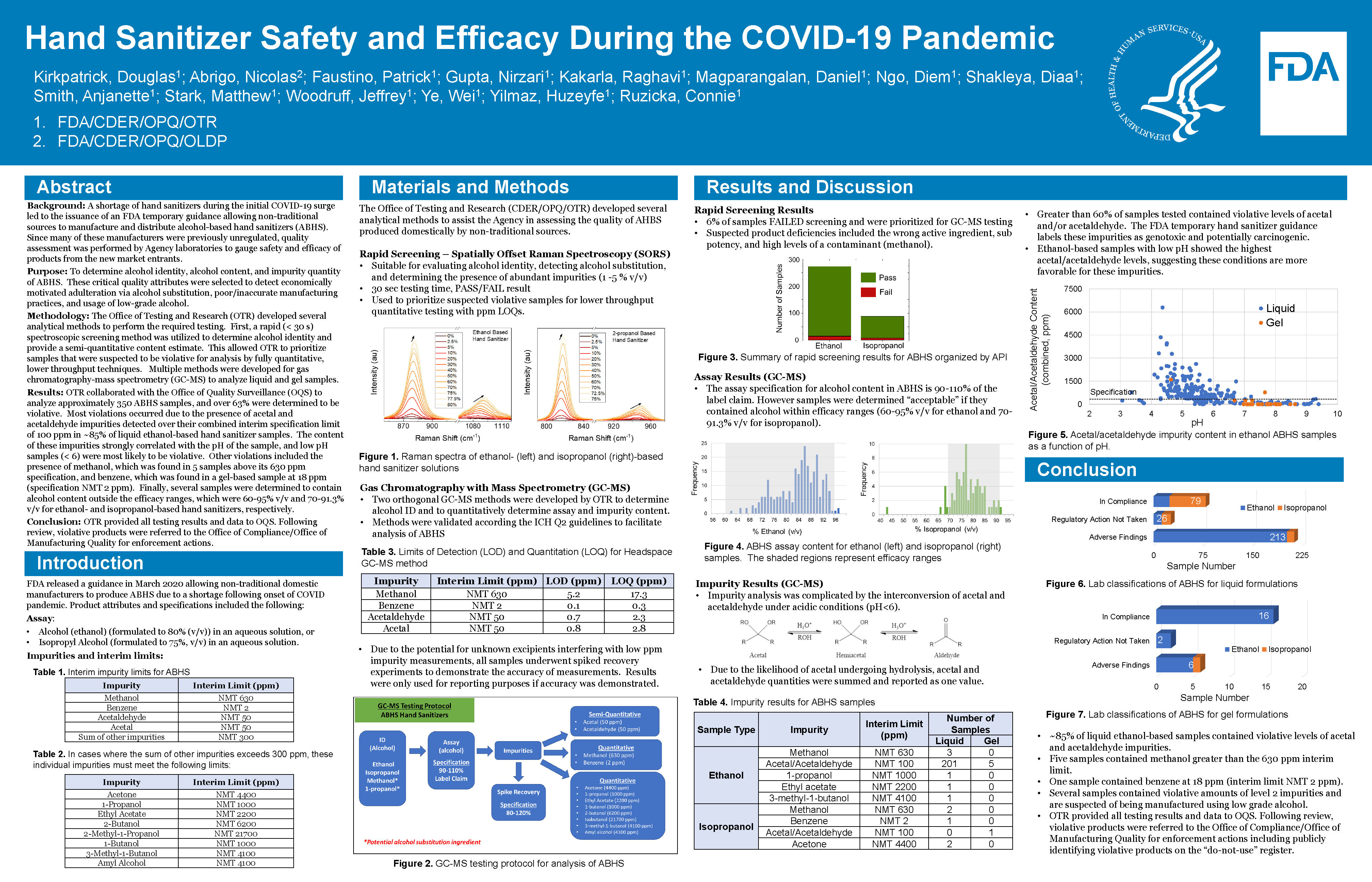
A shortage of hand sanitizers during the initial COVID-19 surge led to the issuance of an FDA temporary guidance allowing non-traditional sources to manufacture and distribute alcohol-based hand sanitizers (ABHS). Since many of these manufactures were previously unregulated, quality assessment was performed by Agency laboratories to gauge safety and efficacy of products from the new market entrants.
Purpose:
To determine alcohol identity, alcohol content, and impurity quantity of ABHS. These critical quality attributes were selected to detect economically motivated adulteration via alcohol substitution, poor/inaccurate manufacturing practices, and usage of low-grade alcohol.
Methodology:
The Office of Testing and Research (OTR) developed several analytical methods to perform the required testing. First, a rapid (< 30 s) spectroscopic screening method was utilized to determine alcohol identity and provide a semi-quantitative content estimate. This allowed OTR to prioritize samples that were suspected to be violative for analysis by fully quantitative, lower throughput techniques. Multiple methods were developed for gas chromatography-mass spectrometry (GC-MS) to analyze liquid and gel samples.
Results:
OTR collaborated with the Office of Quality Surveillance (OQS) to analyze approximately 350 ABHS samples, and over 63% were determined to be violative. Most violations occurred due to the presence of acetal and acetaldehyde impurities detected over their combined specification limit of 100 ppm in ~85% of liquid ethanol-based hand sanitizer samples. The content of these impurities strongly correlated with the pH of the sample, and low pH samples (< 6) were most likely to be violative. Other violations included the presence of methanol, which was found in 5 samples above its 630 ppm specification, and benzene, which was found in a gel-based sample at 18 ppm (specification NMT 2 ppm). Finally, several samples were determined to contain alcohol content outside the efficacy ranges, which were 60-95% v/v and 70-91.3% v/v for ethanol- and isopropanol-based hand sanitizers, respectively.
Conclusion:
OTR provided all testing results and data to OQS. Following review, violative products were referred to the Office of Compliance/Office of Manufacturing Quality who publicly identified them on a “do-not-use” register.