2023 FDA Science Forum
Genomic analysis of decreased susceptibility to azithromycin Salmonella isolated from food animals and retail meats in the U.S.
- Authors:
- Center:
-
Contributing OfficeCenter for Veterinary Medicine
Abstract
Introduction:
Azithromycin, a 15-membered ring macrolide antibiotic, is critically important to human medicine and can be used to treat Salmonella infections. Other macrolides with 14-, 15-, and 16-membered rings are commonly used in veterinary medicine.
Purpose:
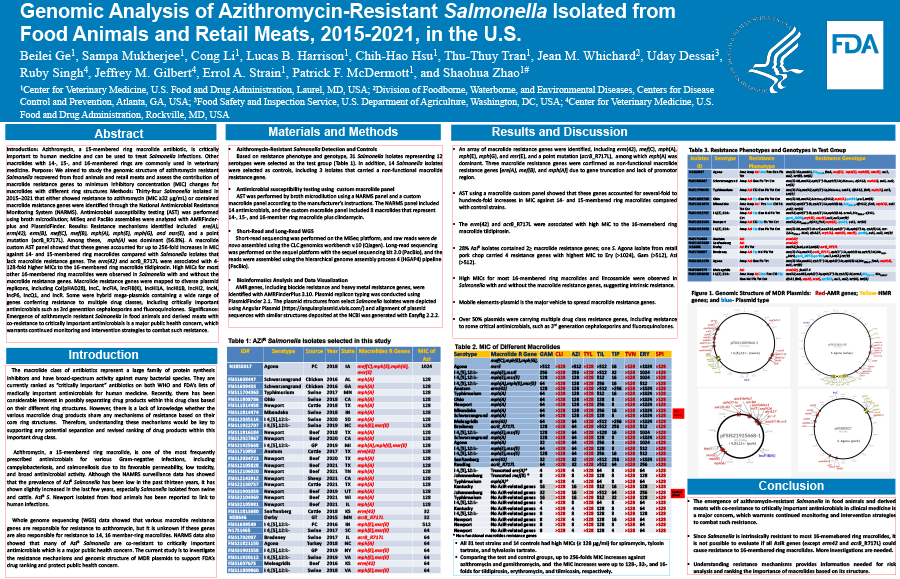
We aimed to study the genomic structure of decreased susceptibility to azithromycin (DSA) in Salmonella recovered from food animals and retail meats and assess the contribution of macrolide resistance genes to minimum inhibitory concentration (MIC) changes for macrolides with different ring structures
Methods:
Thirty-seven Salmonella isolated in 2015–2021 that either showed DSA (MIC ≥32 µg/mL) or contained macrolide resistance genes were identified through the National Antimicrobial Resistance Monitoring System. Antimicrobial susceptibility testing (AST) was performed using broth microdilution; MiSeq and PacBio assemblies were analyzed with AMRFinder-plus and PlasmidFinder.
Results:
Resistance mechanisms identified included ere(A), erm(42), erm(B), mef(C), mef(B), mph(A), mph(E), mph(G), and msr(E), and a point mutation (acrB_R717L). Among these, mph(A) was dominant (56.8%). A macrolide custom AST panel showed that these genes accounted for up to 256-fold increases in MIC against 14- and 15-membered macrolides compared with Salmonella isolates that lack macrolide resistance genes. The erm(42) and acrB_R717L were associated with 4-128-fold higher MICs to the 16-membered macrolide tildipirosin. High MICs for most other 16-membered macrolides were observed in Salmonella with and without the macrolide resistance genes. Macrolide resistance genes were mapped to diverse plasmid replicons, including Col(pHAD28), IncC, IncFIA, IncFIB(K), IncHI1A, IncHI1B, IncHI2, IncN, IncP6, IncQ1, and IncR. Some were hybrid mega-plasmids containing a wide range of genes conferring resistance to multiple drug classes, including critically important antimicrobials such as 3rd generation cephalosporins and fluoroquinolones.
Significance:
Emergence of DSA Salmonella in food animals and derived meats with co-resistance to critically important antimicrobials is a major public health concern, which warrants continued monitoring and intervention strategies to combat such resistance.