2021 FDA Science Forum
Genome-wide DNA Methylome Alterations Are Associated with Histological Severity of NAFLD-like Liver Injury Induced in Collaborative Cross Mice by an Obesogenic Diet
- Authors:
- Center:
-
Contributing OfficeNational Center for Toxicological Research
Abstract
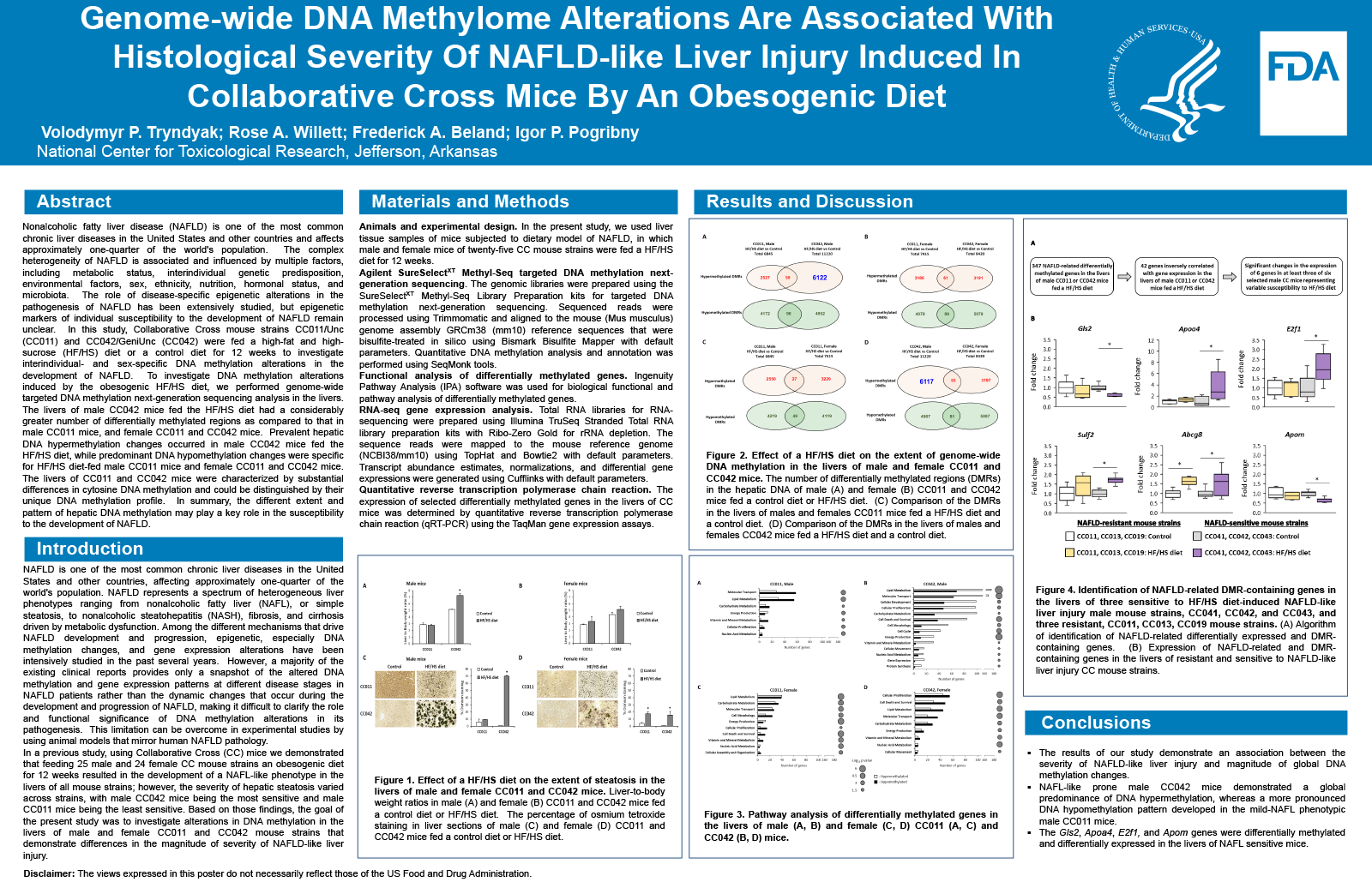
Nonalcoholic fatty liver disease (NAFLD) is one of the most common chronic liver diseases in the United States and other countries and affects approximately one-quarter of the world's population. The complex heterogeneity of NAFLD is associated and influenced by multiple factors, including metabolic status, interindividual genetic predisposition, environmental factors, sex, ethnicity, nutrition, hormonal status, and microbiota. The role of disease-specific epigenetic alterations in the pathogenesis of NAFLD has been extensively studied, but epigenetic markers of individual susceptibility to the development of NAFLD remain unclear. In this study, Collaborative Cross mouse strains CC011/Unc (CC011) and CC042/GeniUnc (CC042) were fed a high-fat and high-sucrose (HF/HS) diet or a control diet for 12 weeks to investigate interindividual- and sex-specific DNA methylation alterations in the development of NAFLD. To investigate DNA methylation alterations induced by the obesogenic HF/HS diet, we performed genome-wide targeted DNA methylation next-generation sequencing analysis in the livers. Feeding CC011 and CC042 mice the obesogenic HF/HS diet resulted in the development of a NAFL-like phenotype in both mouse strains, with male CC042 mice being the most sensitive and male CC011 mice being the least sensitive. The livers of male CC042 mice fed the HF/HS diet had a considerably greater number of differentially methylated regions as compared to that in male CC011 mice, and female CC011 and CC042 mice. Prevalent hepatic DNA hypermethylation changes occurred in male CC042 mice fed the HF/HS diet, while predominant DNA hypomethylation changes were specific for HF/HS diet-fed male CC011 mice and female CC011 and CC042 mice. The livers of CC011 and CC042 mice were characterized by substantial differences in cytosine DNA methylation and could be distinguished by their unique DNA methylation profile. In summary, the different extent and pattern of hepatic DNA methylation may play a key role in the susceptibility to the development of NAFLD.