2023 FDA Science Forum
FDA and NIST collaboration to evaluate assays and control materials for characterizing animal biotechnology products generated by genome editing
- Authors:
- Center:
-
Contributing OfficeCenter for Veterinary Medicine
Abstract
Genome editing technology has revolutionized the ability to make targeted changes to an animal’s genome (intentional genomic alterations or IGAs), offering exciting promise for the development of animal biotechnology products that address animal and public health needs. Characterization of these IGAs is an important part of the regulatory process to ensure that the intended edit is made to the animal and to identify any unintended changes. However, there are currently no validated measurements and standards for characterizing unintended genomic alterations in animals.
To address these needs, FDA CVM has established a collaboration with the U.S. National Institute of Standards and Technology (NIST) that will generate resources including standardized measurements for characterizing both intended and unintended alterations in animal biotechnology products resulting from genome editing. These resources will provide animal biotechnology product developers and FDA regulators with example characterization approaches that they could use as part of the development and regulatory process for IGAs in animals as well as for validating methods, materials and/or data. Here, we present preliminary outcomes of this NIST-FDA CVM collaboration.
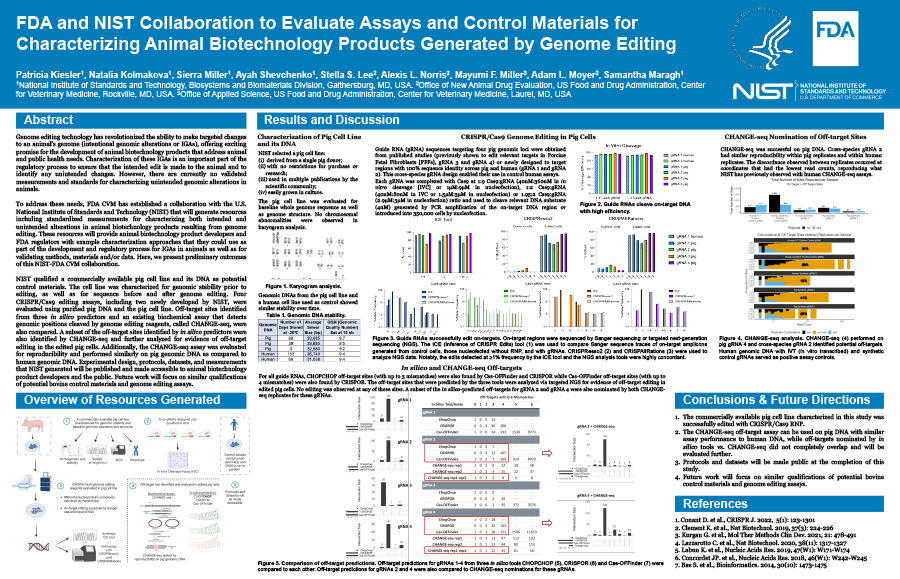
NIST qualified a commercially available pig cell line and its DNA as potential control materials. The cell line was characterized for genomic stability prior to editing, as well as for sequence before and after genome editing. Four CRISPR/Cas9 editing assays, including two newly developed by NIST, were evaluated using purified pig DNA and the pig cell line. Off-target sites identified from three in silico predictors and an existing biochemical assay that detects genomic positions cleaved by genome editing reagents, called CHANGE-seq, were also compared. A subset of the off-target sites identified by in silico predictors were also identified by CHANGE-seq and further analyzed for evidence of off-target editing in the edited pig cells. Additionally, the CHANGE-seq assay was evaluated for reproducibility and performed similarly on pig genomic DNA as compared to human genomic DNA. Experimental design, protocols, datasets, and measurements that NIST generated will be published and made accessible to animal biotechnology product developers and the public. Future work will focus on similar qualifications of potential bovine control materials and genome editing assays.