2021 FDA Science Forum
Fatigue-to-Fracture Testing to Accelerate the Development of Nitinol Implants
- Authors:
- Center:
-
Contributing OfficeCenter for Devices and Radiological Health
Abstract
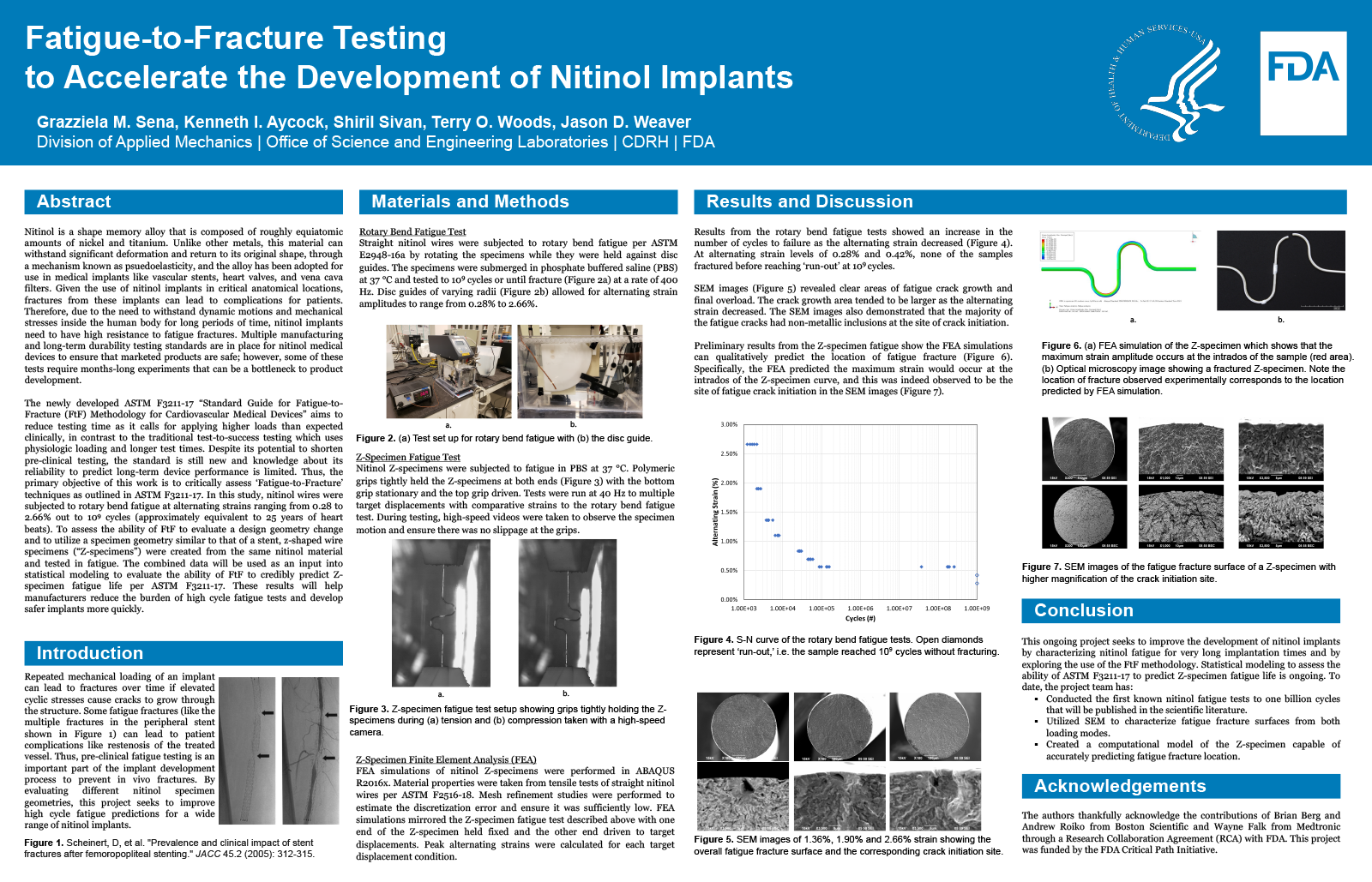
Nitinol is a shape memory alloy that is composed of roughly equiatomic amounts of nickel and titanium. Unlike other metals, this material can withstand significant deformation and return to its original shape, through a mechanism known as psuedoelasticity, and the alloy has been adopted for use in medical implants like vascular stents, heart valves, and vena cava filters. Given the use of nitinol implants in critical anatomical locations, fractures from these implants can lead to complications for patients. Therefore, due to the need to withstand dynamic motions and mechanical stresses inside the human body for long periods of time, nitinol implants need to have high resistance to fatigue fractures. Multiple manufacturing and long-term durability testing standards are in place for nitinol medical devices to ensure that marketed products are safe; however, some of these tests require months-long experiments that can be a bottleneck to product development.
The newly developed ASTM F3211-17 “Standard Guide for Fatigue-to-Fracture (FtF) Methodology for Cardiovascular Medical Devices” aims to reduce testing time as it calls for applying higher loads than expected clinically, in contrast to the traditional test-to-success testing which uses physiologic loading and longer test times. Despite its potential to shorten pre-clinical testing, the standard is still new and knowledge about its reliability to predict long-term device performance is limited. Thus, the primary objective of this work is to critically assess ‘Fatigue-to-Fracture’ techniques as outlined in ASTM F3211-17. In this study, nitinol wires were subjected to rotary bend fatigue at alternating strains ranging from 0.28 to 2.66% out to 109 cycles (approximately equivalent to 25 years of heart beats). To assess the ability of FtF to evaluate a design geometry change and to utilize a specimen geometry similar to that of a stent, z-shaped wire specimens (“z-specimens”) were created from the same nitinol material and tested in fatigue. The combined data will be used as an input into statistical modeling to evaluate the ability of FtF to credibly predict z-specimen fatigue life per ASTM F3211-17. These results will help manufacturers reduce the burden of high cycle fatigue tests and develop safer implants more quickly.