2023 FDA Science Forum
Exploration to enhance Predictive Bioequivalence: Comparison of Methods to Incorporate in vitro Dissolution Data, Using Surface pH Instead of Bulk pH, for Pharmacokinetic Modeling of BCS Class II Acidic Drugs
- Authors:
- Center:
-
Contributing OfficeCenter for Drug Evaluation and Research
Abstract
Background
BCS Class II drug substances are highly permeable but have low solubility. BCS Class II acidic (IIa) drugs, more specifically, behave like BCS Class I drugs at intestinal pH in the gastrointestinal tract, despite having low solubility at gastric pH values.
Purpose
The purpose of this project is to optimize the in vitro dissolution input approach for predicting pharmacokinetic area under the curve (AUC) and maximum concentration (Cmax) values that render a BCS Class IIa drug bioequivalent and thus potentially expanding eligibility for biowaiver considerations.
Methods
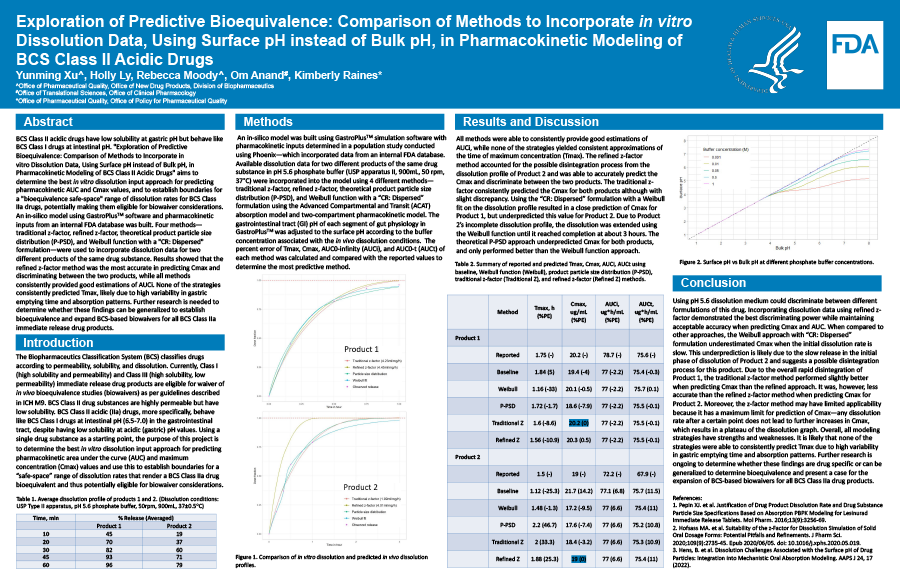
An in-silico model was built using GastroPlus v9.8.3 with gut physiology adjusted to surface pH in each segment accordingly, and pharmacokinetic inputs determined in a population study conducted using Phoenix—which incorporated data from an internal FDA database. Available dissolution data for two products of the same drug substance in USP pH 5.6 phosphate buffer were incorporated into the model using 4 different methods—traditional z-factor, refined z-factor, theoretical product particle size distribution (P-PSD), and Weibull function with a “CR: Dispersed” formulation. The percent error for each in vitro dissolution input approach was calculated and compared with the reported values to determine the most predictive method.
Result
Adjustments to surface pH slightly lowered predicted Cmax for all strategies and have negligible effect on AUC and Tmax. The refined z-factor method accounted for the possible disintegration process from the dissolution profile of Product 2 and was able to accurately predict the Cmax and discriminate between the two products. The traditional z-factor consistently predicted the Cmax for both products with slight discrepancy. Using the “CR: Dispersed” formulation with a Weibull fit on the dissolution profile resulted in a close prediction of Cmax for Product 1, but underpredicted this value for Product 2. The P-PSD approach underpredicted Cmax for both products, and only performed better than Weibull function. None of the strategies yielded consistent approximations of Tmax.
Conclusion
All modeling strategies have strengths and weaknesses. Further research is ongoing to determine whether these findings can be generalized to predict bioequivalence and present a case for expansion of BCS-based biowaivers for all BCS Class IIa drug products.