2021 FDA Science Forum
Expedited Approval Pathways and Potential Impact on Drug Postmarketing Safety Findings: A Review of the Literature
- Authors:
- Center:
-
Contributing OfficeCenter for Drug Evaluation and Research
Abstract
Background
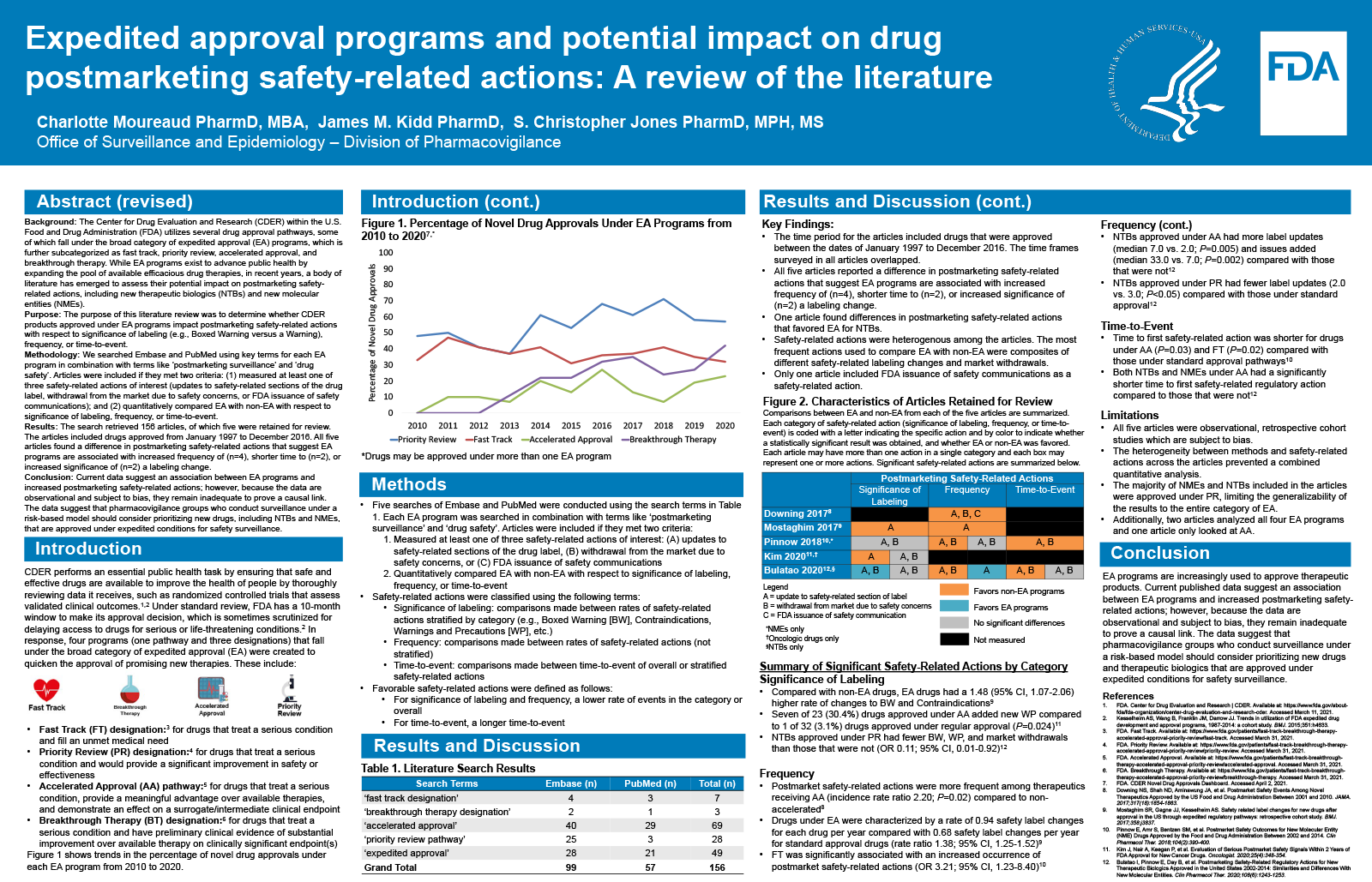
The Center for Drug Evaluation and Research (CDER) within the U.S. Food and Drug Administration (FDA) utilizes several drug approval pathways, some of which fall under the broad category of expedited approval (EA), which is further subcategorized as fast track, priority review, accelerated approval, and breakthrough therapy. While EA pathways exist to advance public health by expanding the pool of available efficacious drug therapies, in recent years, a body of literature has emerged to assess the potential impact of EA on postmarketing drug safety findings, including new therapeutic biologics (NTB) and new molecular entities (NME).
Purpose
The purpose of this literature review was to determine whether CDER products approved under EA impact postmarketing safety findings with respect to significance of labeling (e.g., Boxed Warning versus a Warning), frequency, or time-to-events.
Methodology
We searched Embase and PubMed using key terms for each approval pathway in combination with terms like ‘postmarketing surveillance’ and ‘drug safety’. Articles were included if they met two criteria: (1) measured at least one of the three outcomes of interest (updates to safety-related sections of the drug label, withdrawal from the market due to safety concerns, or FDA issuance of safety communications); and (2) quantitatively compared EA with non-EA with respect to significance of labeling, frequency, or time-to-events.
Results
The search retrieved 156 articles, of which five were retained for review. The articles included drugs approved from January 1997 to December 2016. All five articles found a difference in postmarketing safety outcomes that suggest EA is associated with increased frequency of (n=4), shorter time to (n=2), or increased significance of a labeling change (n=2).
Conclusion
Current data suggest an association between EA and increased postmarketing safety findings; however, because the data are observational and subject to bias, they remain inadequate to prove a causal link. The data suggest that pharmacovigilance groups who conduct surveillance under a risk-based model should consider prioritizing new drugs, including NTB and NME, that are approved under expedited conditions for safety surveillance.