2021 FDA Science Forum
Evaluation of Salmonella Resistance Trends Based on MICs Mixture Distributions in NARMS Retail Meat Data
- Authors:
- Center:
-
Contributing OfficeCenter for Veterinary Medicine
Abstract
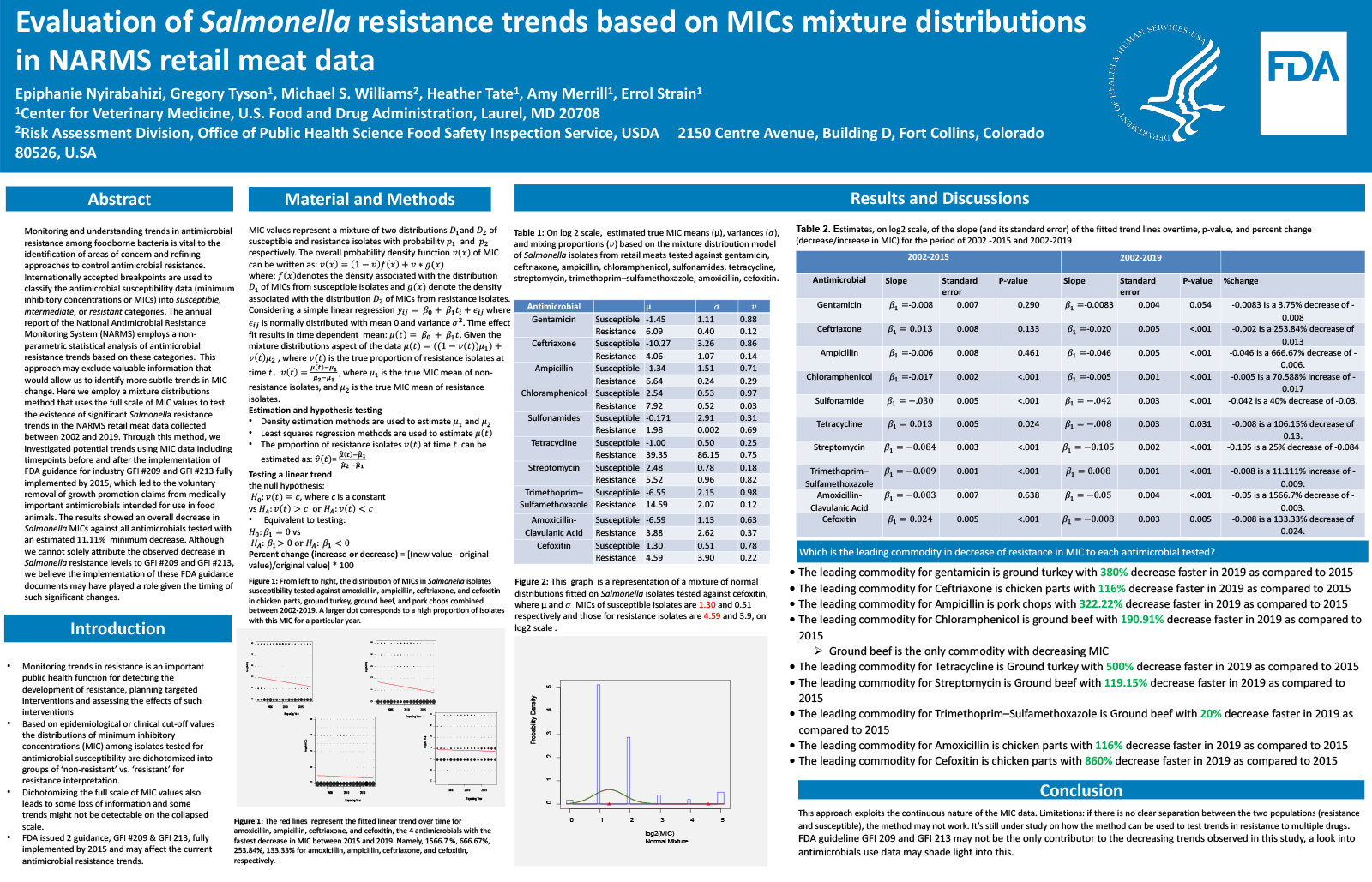
Monitoring and understanding trends in antimicrobial resistance among foodborne bacteria is vital to the identification of areas of concern and refining approaches to control antimicrobial resistance. Internationally accepted breakpoints are used to classify the antimicrobial susceptibility data (minimum inhibitory concentrations or MICs) into susceptible, intermediate, or resistant categories. The annual report of the National Antimicrobial Resistance Monitoring System (NARMS) employs a non-parametric statistical analysis of antimicrobial resistance trends based on these categories. This approach may exclude valuable information that would allow us to identify more subtle trends in MIC change. Here we employ a statistical method that uses the full scale of MIC values, and their mixture distributions, to test the existence of significant Salmonella resistance trends in the NARMS retail meat data collected between 2002 and 2019. Through this method, we investigated potential trends using MIC data including timepoints before and after the implementation of FDA guidance for industry GFI #209 and GFI #213, which led to the voluntary removal of growth promotion claims from medically important antimicrobials intended for use in food animals. The results showed an overall decrease in Salmonella MICs against all antimicrobials tested. Although we cannot solely attribute the observed decrease in Salmonella resistance levels to GFI #209 and GFI #213, we believe the implementation of these FDA guidance documents may be playing a role given the timing of such significant changes.