2021 FDA Science Forum
Evaluation of Maternal Toxicity in CF-1 Mice Following Gestational Opioid Exposure
- Authors:
- Center:
-
Contributing OfficeNational Center for Toxicological Research
Abstract
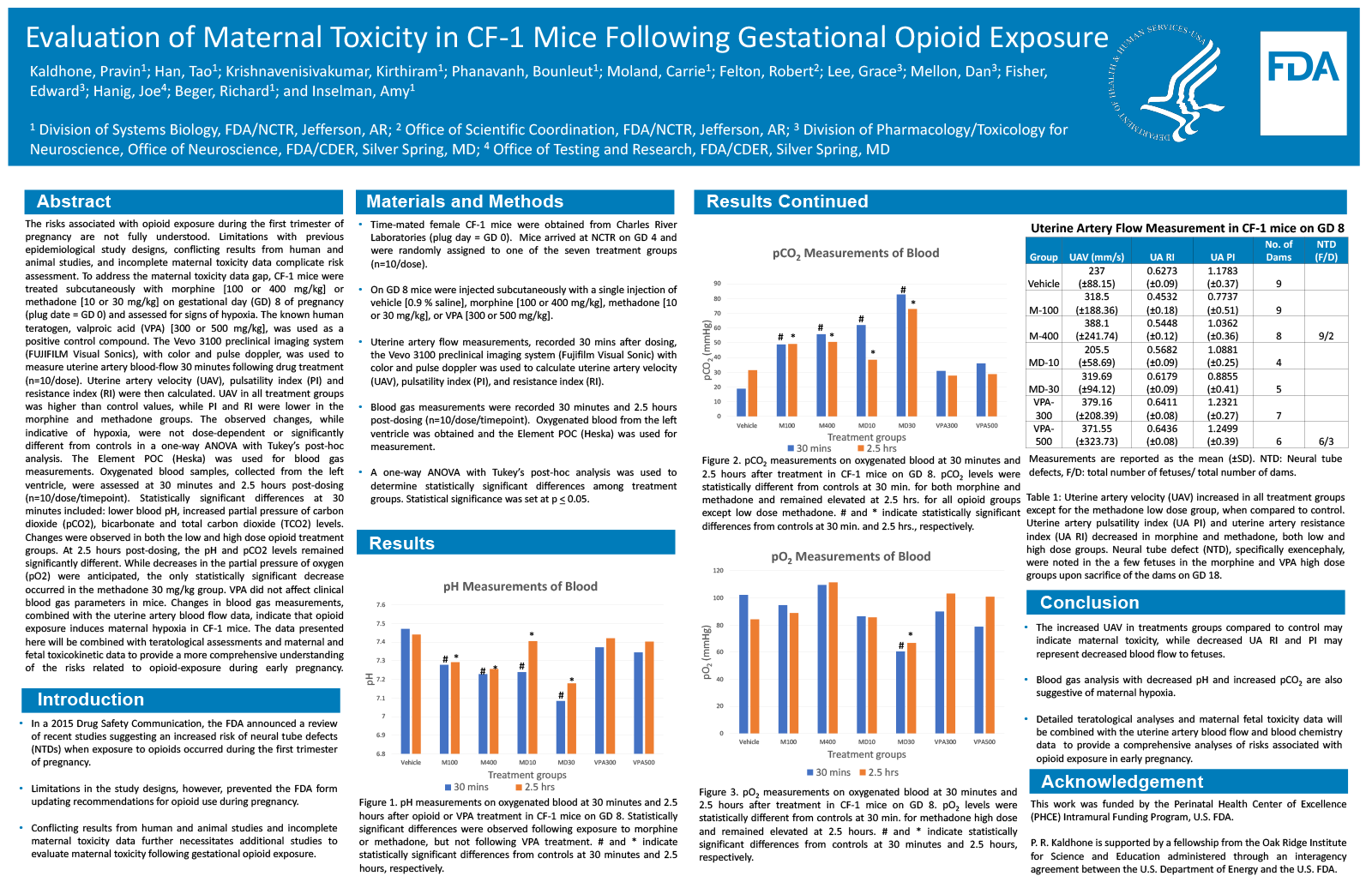
The risks associated with opioid exposure during the first trimester of pregnancy are not fully understood. Limitations with previous epidemiological study designs, conflicting results from human and animal studies, and incomplete maternal toxicity data complicate risk assessment. To address the maternal toxicity data gap, CF-1 mice were treated subcutaneously with morphine [100 or 400 mg/kg] or methadone [10 or 30 mg/kg] on gestational day (GD) 8 of pregnancy (plug date = GD 0) and assessed for signs of hypoxia. The known human teratogen, valproic acid (VPA) [300 or 500 mg/kg], was used as a positive control compound. The Vevo 3100 preclinical imaging system (FUJIFILM Visual Sonics), with color and pulse doppler, was used to measure uterine artery blood-flow 30 minutes following drug treatment (n=10/dose). Uterine artery velocity (UAV), pulsatility index (PI) and resistance index (RI) were then calculated. UAV in all treatment groups was higher than control values, while PI and RI were lower in the morphine and methadone groups. The observed changes, while indicative of hypoxia, were not dose-dependent or significantly different from controls in a one-way ANOVA with Tukey’s post-hoc analysis. The Element POC (Heska) was used for blood gas measurements. Oxygenated blood samples, collected from the left ventricle, were assessed at 30 minutes and 2.5 hours post-dosing (n=10/dose/timepoint). Statistically significant differences at 30 minutes included: lower blood pH, increased partial pressure of carbon dioxide (pCO2), bicarbonate and total carbon dioxide (TCO2) levels. Changes were observed in both the low and high dose opioid treatment groups. At 2.5 hours post-dosing, the pH and pCO2 levels remained significantly different. While decreases in the partial pressure of oxygen (pO2) were anticipated, the only statistically significant decrease occurred in the methadone 30 mg/kg group. VPA did not affect clinical blood gas parameters in mice. Changes in blood gas measurements, combined with the uterine artery blood flow data, indicate that opioid exposure induces maternal hypoxia in CF-1 mice. The data presented here will be combined with teratological assessments and maternal and fetal toxicokinetic data to provide a more comprehensive understanding of the risks related to opioid-exposure during early pregnancy.