2021 FDA Science Forum
Evaluation of the Effect of a Panel of Adjuvants on Immune Response to Norovirus Virus-Like Particle Vaccine in Mice
- Authors:
- Center:
-
Contributing OfficeCenter for Biologics Evaluation and Research
Abstract
Background
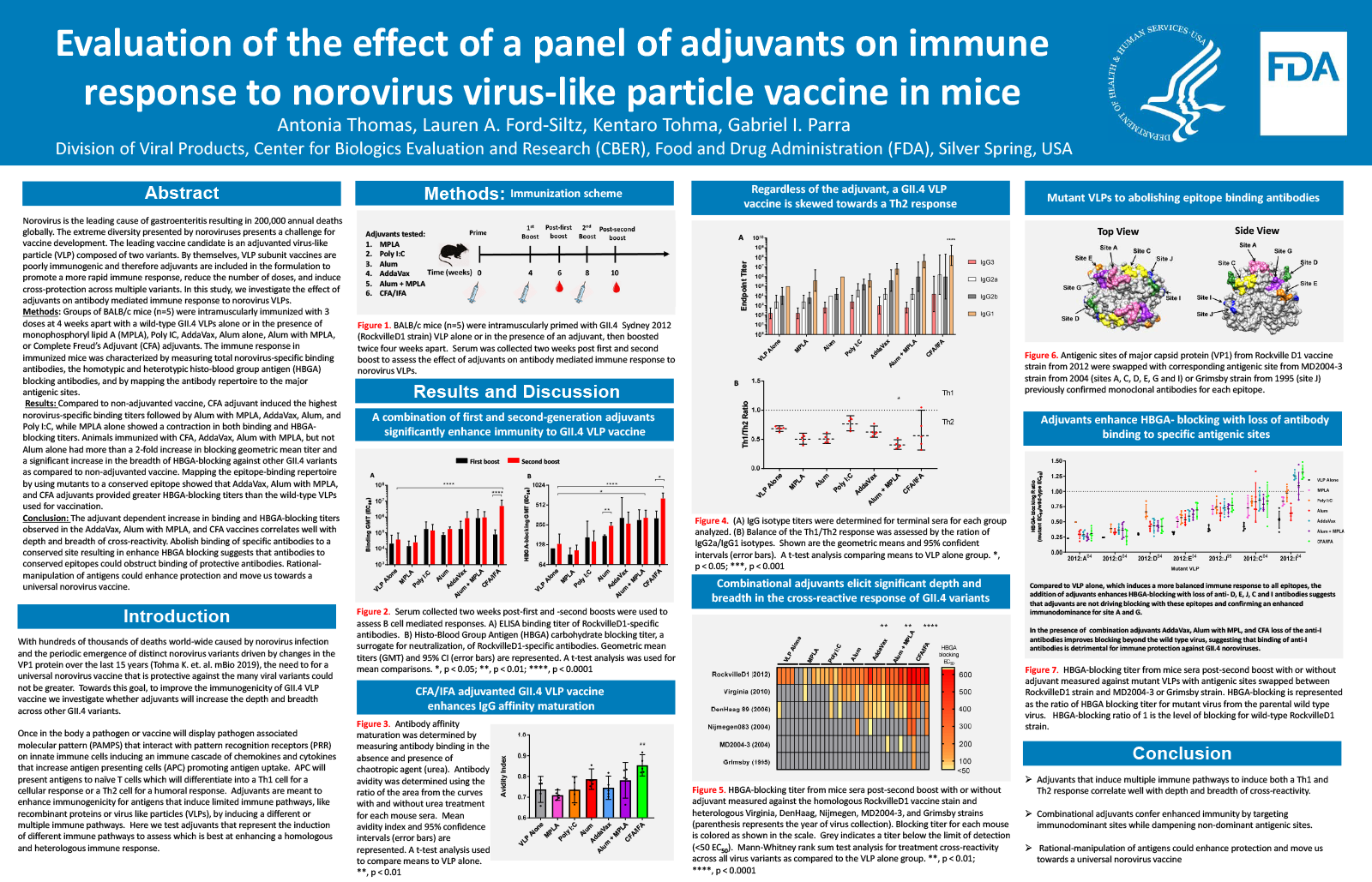
Norovirus is the leading cause of gastroenteritis resulting in 200,000 annual deaths globally. The extreme diversity presented by noroviruses presents a challenge for vaccine development. The leading vaccine candidate is an adjuvanted virus-like particle (VLP) composed of two variants. By themselves, VLP subunit vaccines are poorly immunogenic and therefore adjuvants are included in the formulation to promote a more rapid immune response, reduce the number of doses, and induce cross-protection across multiple variants. In this study, we investigate the effect of adjuvants on antibody mediated immune response to norovirus VLPs.
Methods
Groups of BALB/c mice (n=5) were intramuscularly immunized with 3 doses at 4 weeks apart with a wild-type GII.4 VLPs alone or in the presence of monophosphoryl lipid A (MPLA), Poly IC, AddaVax, Alum alone, Alum with MPLA, or Complete Freud’s Adjuvant (CFA) adjuvants. The immune response in immunized mice was characterized by measuring total norovirus-specific binding antibodies, the homotypic and heterotypic histo-blood group antigen (HBGA) blocking antibodies, and by mapping the antibody repertoire to the major antigenic sites.
Results
Compared to non-adjuvanted vaccine, CFA adjuvant induced the highest norovirus-specific binding titers followed by Alum with MPLA, Addavax, Alum, and PolyIC, while MPLA alone showed a contraction in both biding and HBGA-blocking titers. Animals immunized with CFA, Addavax, Alum with MPL, but not Alum alone had more than a 2-fold increase in blocking geometric mean titer and a significant increase in the breadth of HBGA-blocking against other GII.4 variants as compared to non-adjuvanted vaccine. Mapping the epitope-binding repertoire by using mutants to a conserved epitope showed that Addavax, Alum with MPLA, and CFA adjuvants provided greater HBGA-blocking titers than the wild-type VLPs used for vaccination.
Conclusion
The adjuvant dependent increase in binding and HBGA-blocking titers observed in the Addavax, Alum with MPL, and CFA vaccines correlates well with depth and breadth of cross-reactivity. Abolish binding of specific antibodies to a conserved site resulting in enhance HBGA blocking suggests that antibodies to conserved epitopes could obstruct binding of protective antibodies. Rational-manipulation of antigens could enhance protection and move us towards a universal norovirus vaccine.