2023 FDA Science Forum
Evaluation of Developmental Neurotoxicity of Toxic Elements Using Human Embryonic Stem Cell-Derived Neural Stem Cells as in vitro Models
- Authors:
- Center:
-
Contributing OfficeCenter for Food Safety and Applied Nutrition
Abstract
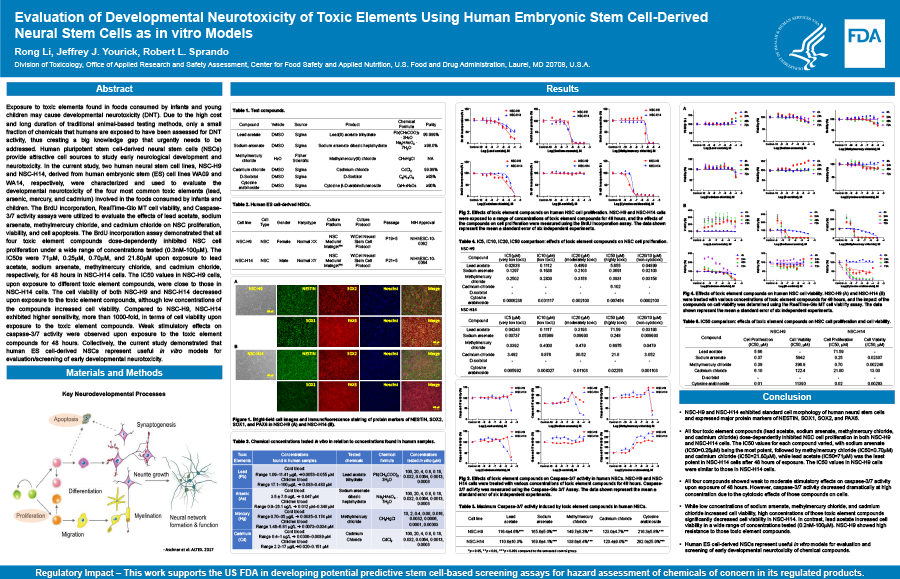
Exposure to toxic elements found in foods consumed by infants and young children can cause developmental neurotoxicity (DNT). Due to the high cost and long duration of traditional animal-based testing methods, only a small fraction of chemicals that humans are exposed to have been assessed for DNT activity, thus creating a big knowledge gap that urgently needs to be addressed. Human pluripotent stem cell-derived neural stem cells (NSCs) provide attractive cell sources to study early neurological development and neurotoxicity. In the current study, two human neural stem cell lines, NSC-H9 and NSC-H14, derived from human embryonic stem (ES) cell lines WA09 and WA14, respectively, were characterized and used to evaluate the developmental neurotoxicity of the four most common toxic elements (lead, arsenic, mercury, and cadmium) involved in the foods consumed by infants and children. The BrdU incorporation, RealTime MT cell viability, and Caspase-3/7 activity assays were utilized to evaluate the effects of lead acetate, sodium arsenate, methylmercury chloride, and cadmium chloride on NSC proliferation, viability, and cell apoptosis. The BrdU incorporation assay demonstrated that all four toxic element compounds dose-dependently inhibited NSC cell proliferation under a wide range of concentrations tested (0.2 nM-100 uM). The IC50s were 71 uM, 0.25 uM, 0.70 uM, and 21.80 uM upon exposure to lead acetate, sodium arsenate, methylmercury chloride, and cadmium chloride, respectively, in NSC-H14 cells. The IC50s in NSC-H9 cells, upon exposure to different toxic element compounds, were close to those in NSC-H14 cells. The cell viability of both NSC-H9 and NSC-H14 decreased upon exposure to the toxic element compounds, although low concentrations of the compounds increased cell viability. Compared to NSC-H9, NSC-H14 exhibited much higher sensitivity, more than 1000-fold, in terms of cell viability upon exposure to the toxic element compounds. Weak stimulatory effects on caspase-3/7 activity were observed upon exposure to the toxic element compounds for 48 hours. Collectively, the current study demonstrated that human ES cell-derived NSCs represent useful in vitro models for evaluation/screening of early developmental neurotoxicity. NSC-H14 may represent a more sensitive neural stem cell model than the NSC-H9 line.