2021 FDA Science Forum
Evaluating Performance of EEG Data-Driven Machine Learning for Traumatic Brain Injury Classification
- Authors:
- Center:
-
Contributing OfficeCenter for Devices and Radiological Health
Abstract
Background
Traumatic brain injury (TBI) presents a significant challenge affecting an estimated 2.5 million people annually. Current clinical scores can classify TBI by severity but not with enough sensitivity to detect mild TBI or monitor progression. Therefore, efforts are ongoing to seek for alternative clinical assessment tools for TBI. EEG has advantages of being non-invasive, easy-to-use, portable and cost effective. However, when applied to TBI research, EEG yields mixed results in the literature with some studies showing significant differences in EEG-based power spectra data between mild TBI and normal groups, while others report no such distinction. Due to the inherent complexity of TBI, including the absence of consensus on biomarkers, underlying relationships between data, and patient-to-patient variability, big data analytics have the potential to make determinations about population characteristics that would otherwise be too difficult/impossible to manually identify.
Purpose
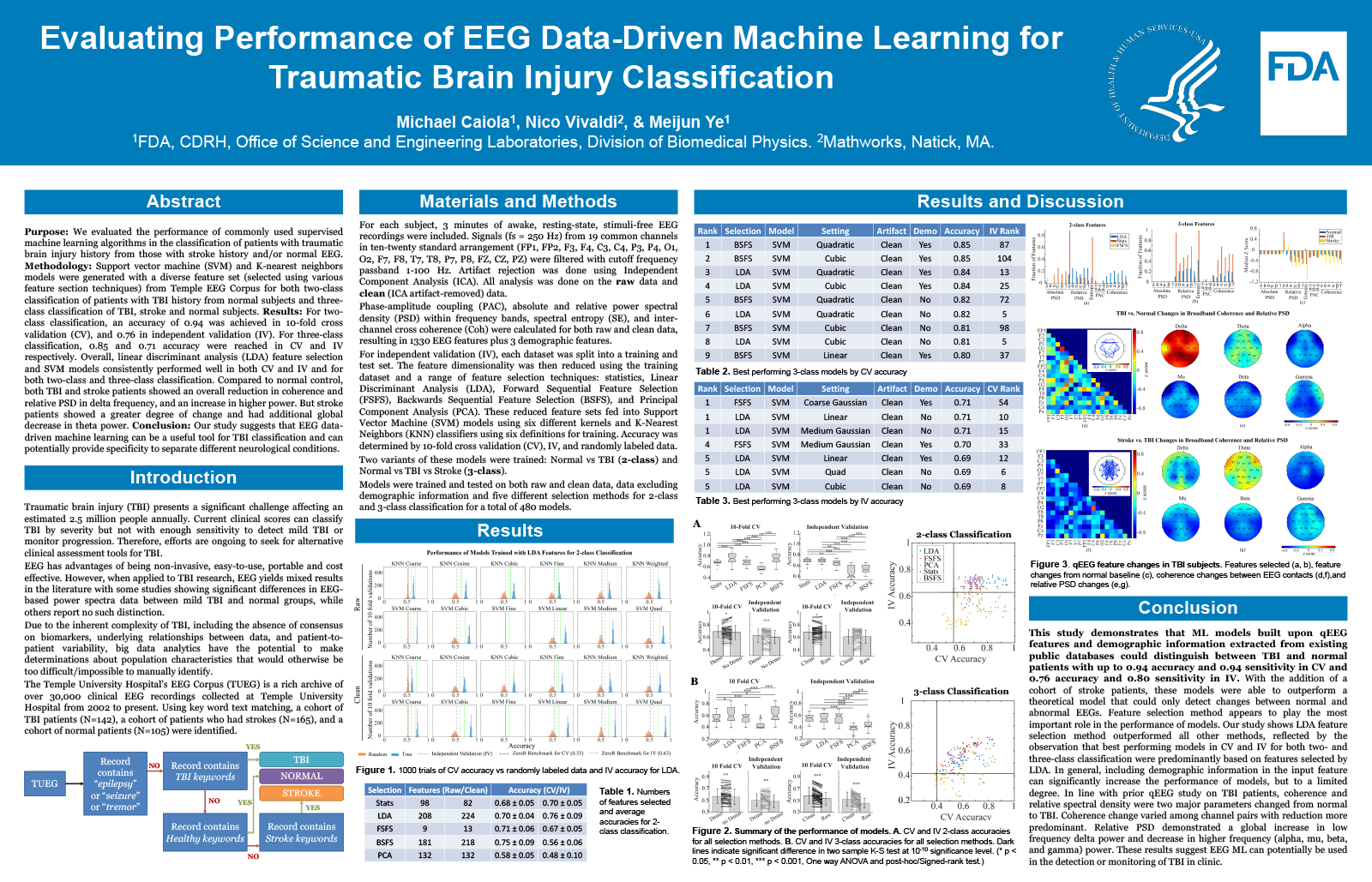
We evaluated the performance of commonly used supervised machine learning algorithms in the classification of patients with TBI history (N=142) from those with stroke history (N=165) and/or normal EEG (N=105).
Methodology
Support vector machine (SVM) and K-nearest neighbors models were generated with a diverse feature set (selected using various feature section techniques) from Temple EEG Corpus for both two-class classification of patients with TBI history from normal subjects and three-class classification of TBI, stroke and normal subjects.
Results
For two-class classification, an accuracy of 0.94 was achieved in 10-fold cross validation (CV), and 0.76 in independent validation (IV). For three-class classification, 0.85 and 0.71 accuracy were reached in CV and IV respectively. Overall, linear discriminant analysis (LDA) feature selection and SVM models consistently performed well in both CV and IV and for both two-class and three-class classification. Compared to normal control, both TBI and stroke patients showed an overall reduction in coherence and relative PSD in delta frequency, and an increase in higher power. But stroke patients showed a greater degree of change and had additional global decrease in theta power.
Conclusion
Our study suggests that EEG data-driven machine learning can be a useful tool for TBI classification and can potentially provide specificity to separate different neurological conditions.