2023 FDA Science Forum
Establishing quality control metrics for B cell receptor analysis using the next generation sequencing technologies
- Authors:
- Center:
-
Contributing OfficeCenter for Drug Evaluation and Research
Abstract
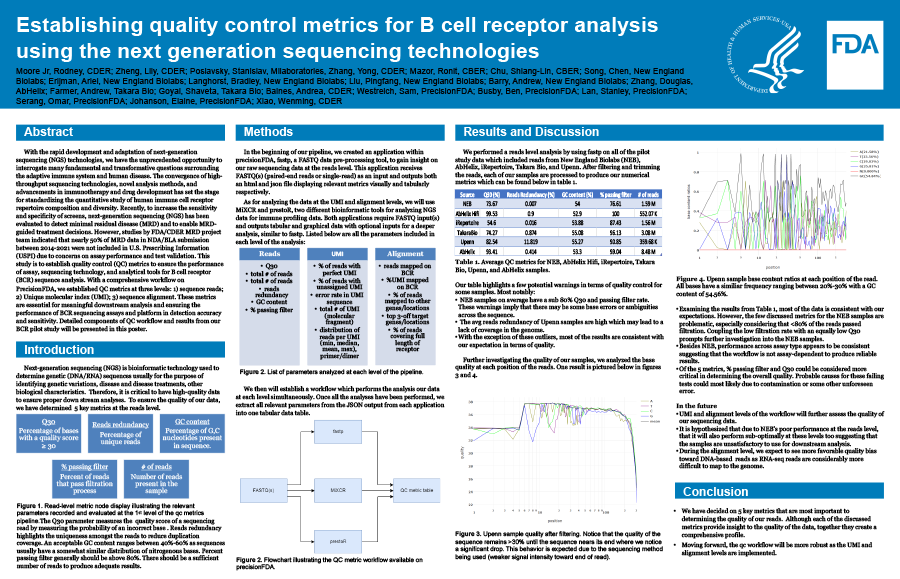
With the rapid development and adaptation of next generation sequencing (NGS) technologies, we have the unprecedented opportunity to interrogate many fundamental and transformative questions surrounding the adaptive immune system and human disease. The convergence of high-throughput sequencing technologies, novel analysis methods, and advancements in immunotherapy and drug development has set the stage for standardizing the quantitative study of human immune cell receptor repertoire composition and diversity. Recently, to increase the sensitivity and specificity of screens, next-generation sequencing (NGS) has been evaluated to detect minimal residual disease (MRD) and to enable MRD-guided treatment decisions. However, study by FDA/CDER MRD project team indicated that nearly 50% of MRD data in NDA/BLA submission between 2014-2021 were not included in U.S. Prescribing Information (USPI) due to concerns on assay performance and test validation. This study is to establish quality control (QC) metrics to ensure the performance of assay, sequencing technology, and analytical tools for B cell receptor (BCR) sequence analysis. With a comprehensive workflow on PrecisionFDA, we established QC metrics at three levels: 1) sequence reads; 2) Unique molecular index (UMI); 3) sequence alignment. These metrics are essential for meaningful downstream analysis and ensuring the performance of BCR sequencing assay and platform in detection accuracy and sensitivity. Detail components of QC workflow and results from our BCR pilot study will be presented in this poster.