2021 FDA Science Forum
Enhancing the Incorporation of Patient Preferences and Perspectives into the Total Product Lifecycle
- Authors:
- Center:
-
Contributing OfficeCenter for Drug Evaluation and Research
Abstract
Background
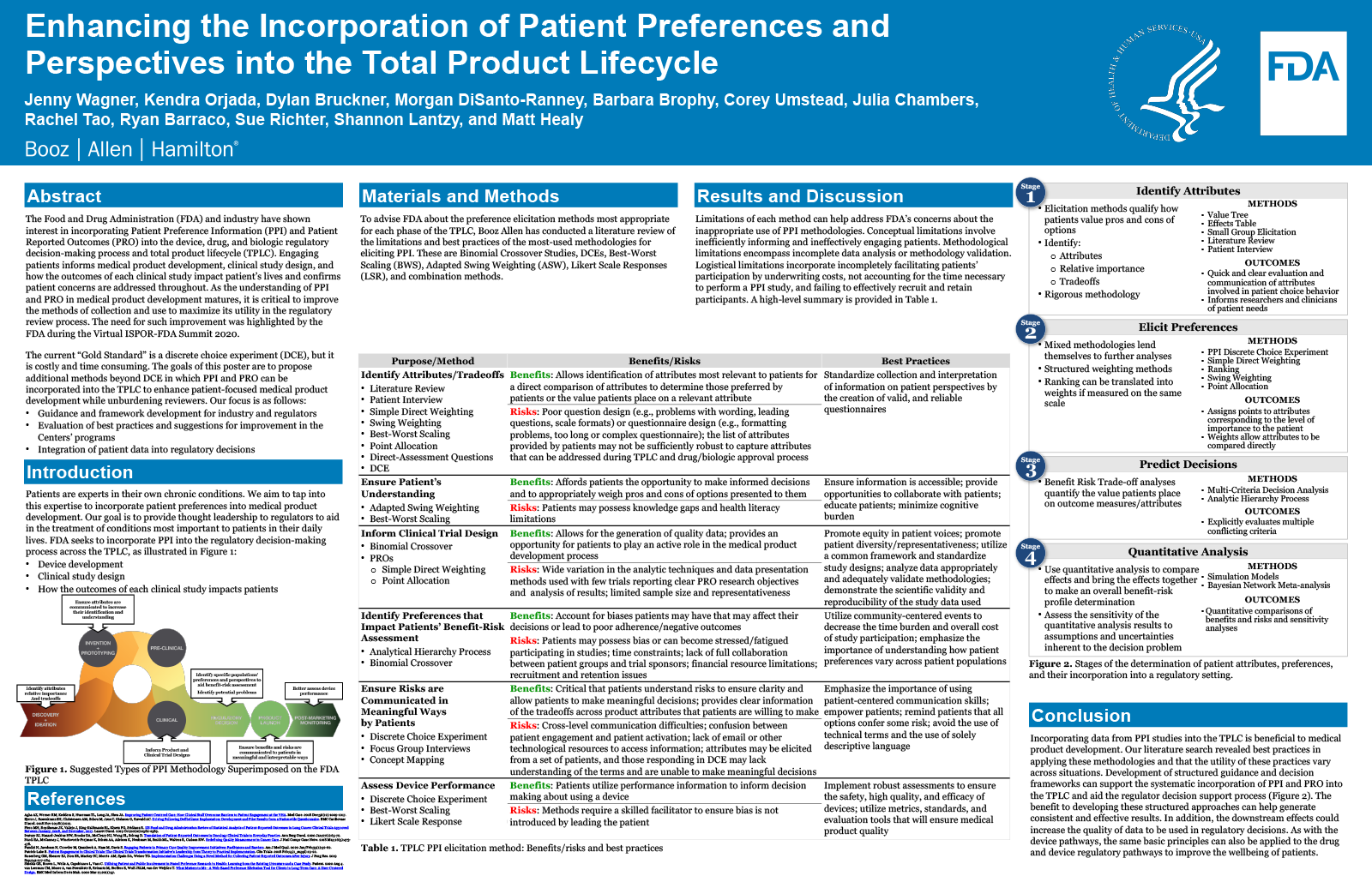
FDA has committed to incorporating Patient Preference Information (PPI) and Patient Reported Outcomes (PRO) into the regulatory decision-making process and total product life cycle. In doing so, FDA informs medical product development, clinical study design, and how the outcomes of each clinical study impacts patients, ensuring that patient concerns are truly addressed and respected throughout. As the understanding of PPI in medical product development matures, the intricacies of its collection and use may limit its utility in the regulatory review process unless done properly. During the Virtual ISPOR-FDA Summit 2020, FDA highlighted misappropriations of PPI and PRO across the total product lifecycle.
Purpose and Methodology
To address FDA’s concerns, Booz Allen has conducted an extensive literature review of the limitations and best practices of the most used methodologies for preference elicitations. These are: Binomial Crossover Studies, Discrete Choice Experiments (DCE), Best-Worst Scaling (BWS), Adapted Swing Weighting (ASW), Likert Scale Responses (LSR), and combination methods.
Results
Limitations can be divided into three categories: 1) conceptual, 2) methodological, and 3) logistical. Conceptual limitations involve inefficiently informing and ineffectively engaging patients. Methodological limitations encompass incomplete data analysis or methodology validation. Logistical limitations incorporate incompletely facilitating patients’ participation by underwriting costs, not accounting for the time necessary to perform a PPI study, and failing to effectively recruit and retain participants.
Conclusion
Incorporating data from PPI studies into the total product life cycles is beneficial to medical product development. Our literature search revealed best practices when applying these methodologies, and which have more utility in particular situations than others. Development of structured guidance and decision framework can support the systematic incorporation of PPI and PRO into the total product life cycle as well as the regulator decision support process. Booz Allen has applied this type of solution to similar issues faced by FDA with successful results. Ultimately, the goal is to provide more efficient and effective support for sponsors, manufacturers, regulators, and patients required to appropriately treat conditions most important to patients in their daily lives.