2021 FDA Science Forum
Elucidating the Mechanism of Fentanyl Binding to Mu-Opioid Receptor
- Authors:
- Center:
-
Contributing OfficeCenter for Drug Evaluation and Research
Abstract
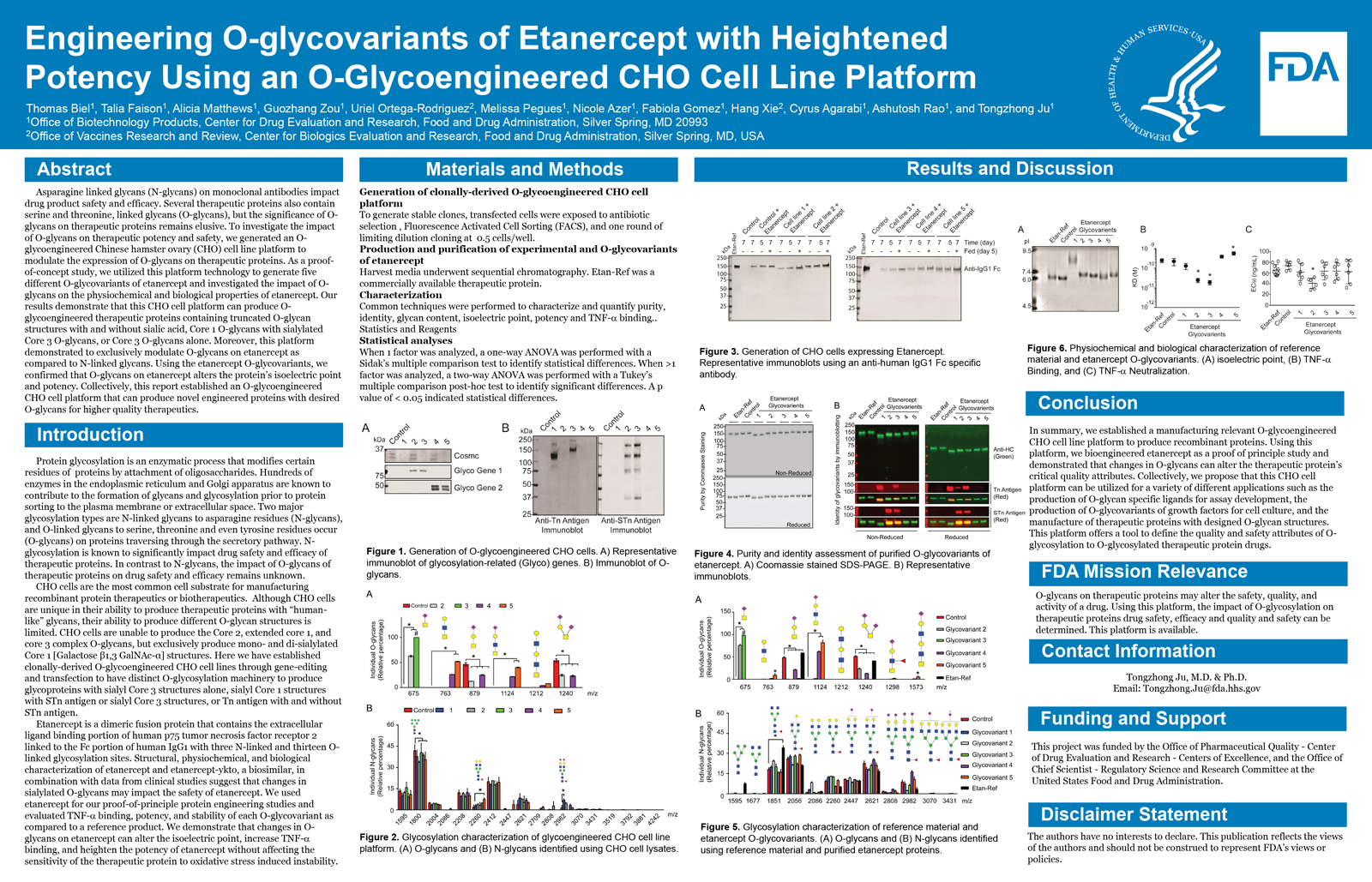
Asparagine linked glycans (N-glycans) on monoclonal antibodies impact drug product safety and efficacy. Several therapeutic proteins also contain serine and threonine, linked glycans (O-glycans), but the significance of O-glycans on therapeutic proteins remains elusive. To investigate the impact of O-glycans on therapeutic potency and safety, we generated an O-glycoengineered Chinese hamster ovary (CHO) cell line platform to modulate the expression of O-glycans on therapeutic proteins. As a proof of concept study, we utilized this platform technology to generate five different O-glycovariants of etanercept and investigated the impact of O-glycans on the physiochemical and biological properties of etanercept. Our results demonstrate that this CHO cell platform can produce O-glycoengineered therapeutic proteins containing truncated O-glycan structures with and without sialic acid, Core 1 O-glycans with sialylated Core 3 O-glycans, or Core 3 O-glycans alone. Moreover, this platform demonstrated to exclusively modulate O-glycans on etanercept as compared to N-linked glycans. Using the etanercept O-glycovariants, we confirmed that O-glycans on etanercept alters the protein’s isoelectric point and potency. Collectively, this report established an O-glycoengineered CHO cell platform that can produce engineered proteins with desired O-glycans for higher quality therapeutics.