2021 FDA Science Forum
Efficient Differentiation of Homogeneous Functional Hepatocytes from Human-Induced Pluripotent Stem Cells
- Authors:
- Center:
-
Contributing OfficeCenter for Food Safety and Applied Nutrition
Abstract
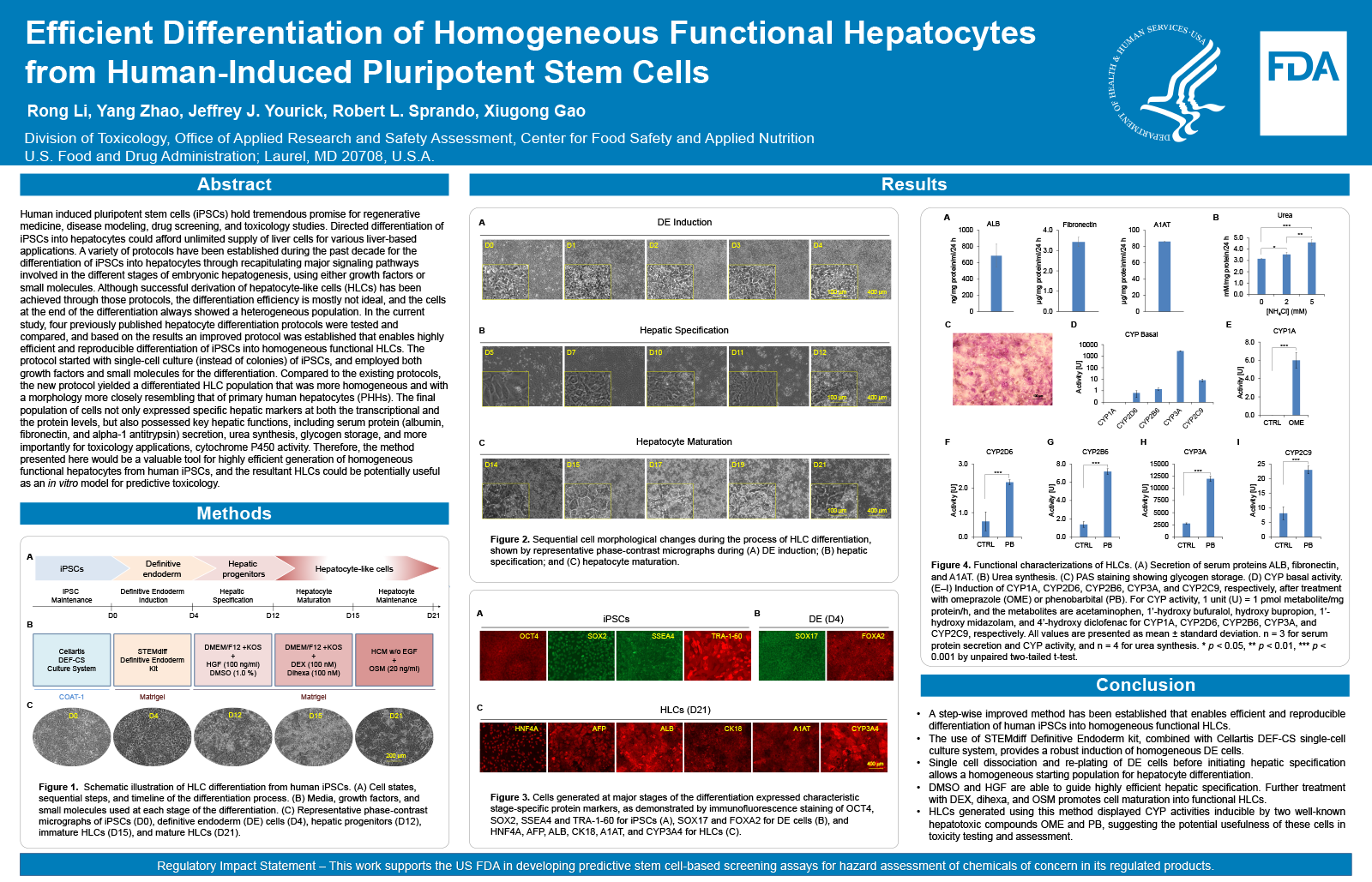
Human induced pluripotent stem cells (iPSCs) hold tremendous promise for regenerative medicine, disease modeling, drug screening, and toxicology studies. Directed differentiation of iPSCs into hepatocytes could afford unlimited supply of liver cells for various liver-based applications. A variety of protocols have been established during the past decade for the differentiation of iPSCs into hepatocytes through recapitulating major signaling pathways involved in the different stages of embryonic hepatogenesis, using either growth factors or small molecules. Although successful derivation of hepatocyte-like cells (HLCs) has been achieved through those protocols, the differentiation efficiency is mostly not ideal, and the cells at the end of the differentiation always showed a heterogeneous population. In the current study, four previously published hepatocyte differentiation protocols were tested and compared, and based on the results an improved protocol was established that enables highly efficient and reproducible differentiation of iPSCs into homogeneous functional HLCs. The protocol started with single-cell culture (instead of colonies) of iPSCs, and employed both growth factors and small molecules for the differentiation. Compared to the existing protocols, the new protocol yielded a differentiated HLC population that was more homogeneous and with a morphology more closely resembling that of primary human hepatocytes (PHHs). The final population of cells not only expressed specific hepatic markers at both the transcriptional and the protein levels, but also possessed key hepatic functions, including serum protein (albumin, fibronectin, and alpha-1 antitrypsin) secretion, urea synthesis, glycogen storage, and more importantly for toxicology applications, cytochrome P450 activity. Therefore, the method presented here would be a valuable tool for highly efficient generation of homogeneous functional hepatocytes from human iPSCs, and the resultant HLCs could be potentially useful as an in vitro model for predictive toxicology.