2023 FDA Science Forum
Efficacy of Dry Heat Treatment in Reducing Salmonella Contamination on Sprout Seeds
- Authors:
- Center:
-
Contributing OfficeCenter for Food Safety and Applied Nutrition
Abstract
Introduction:
The Produce Safety Rule requires that seeds for sprouting be treated to reduce pathogens. Dry-heat treatment can be an option for seed suppliers as it is scalable and avoid the need for a post-treatment drying step. Decontamination of seeds by dry heat has been examined, but with inconsistent results among published studies. Research is needed to understand factors that may affect treatment efficacy.
Purpose:
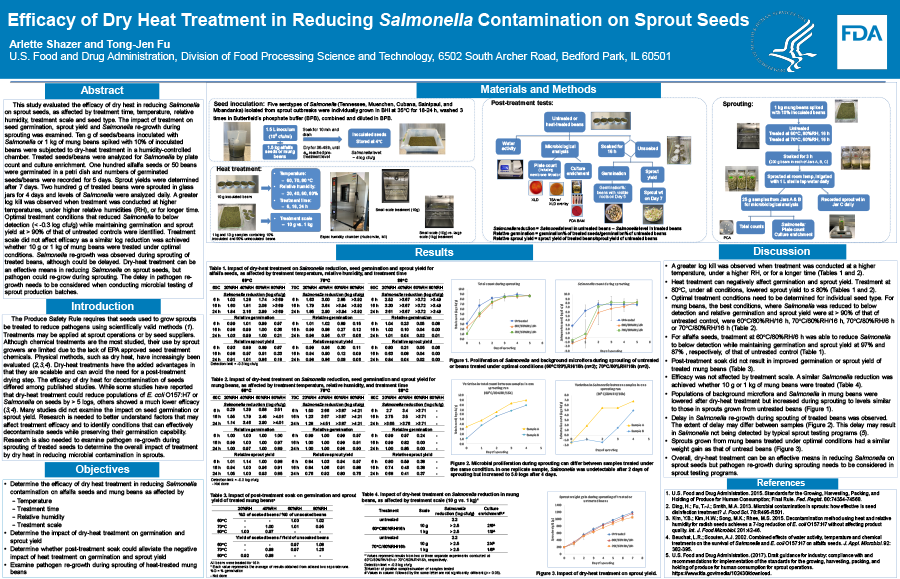
Evaluate the efficacy of dry heat in reducing Salmonella on alfalfa seeds and mung beans, as affected by treatment time (6, 16, 24 h), temperature (60, 70, 80°C), relative humidity (20-80%), treatment scale (10 g, 1 kg). Determine the impact on germination, sprout yield and Salmonella re-growth during sprouting.
Methods:
Ten g of seeds or beans inoculated with Salmonella or 1 kg of mung beans spiked with 10% of inoculated beans were subjected to dry heat treatment in a humidity-controlled chamber. Treated seeds or beans were analyzed for Salmonella by plate count and culture enrichment. One hundred seeds or 50 beans were germinated in a petri dish and percent germination was recorded for 5 days. Sprout yields were determined after 7 days. Two hundred g of treated beans were sprouted in glass jars for 4 days and levels of Salmonella were analyzed daily.
Results:
A greater log kill was observed when treatment was conducted at higher temperatures, under higher relative humidities (RH), or for longer time. Optimal treatment conditions that reduced Salmonella to below detection (< 0 log cfu/g) while maintaining germination and sprout yield at > 90% were identified (60C/80%RH/16h or 70C/60%RH/16h for mung beans; 60C/80%RH/6h or 80C/20%RH/24h for alfalfa seeds). A similar log kill was achieved whether 10 g or 1 kg of mung beans were treated under optimal conditions. Salmonella re-growth was observed during sprouting of treated beans, although could be delayed. In one trial where mung beans were treated at 60C/80%RH/16h, Salmonella was undetectable after 2 days of sprouting but increased to 5.0 logs after 4 days.
Significance:
Dry heat treatment could reduce Salmonella on seeds to below detection, but pathogen re-growth could occur during sprouting and may not be detected.