2021 FDA Science Forum
Effects of Vaccination Routes on Generating Innate Immune Memory
- Authors:
- Center:
-
Contributing OfficeCenter for Biologics Evaluation and Research
Abstract
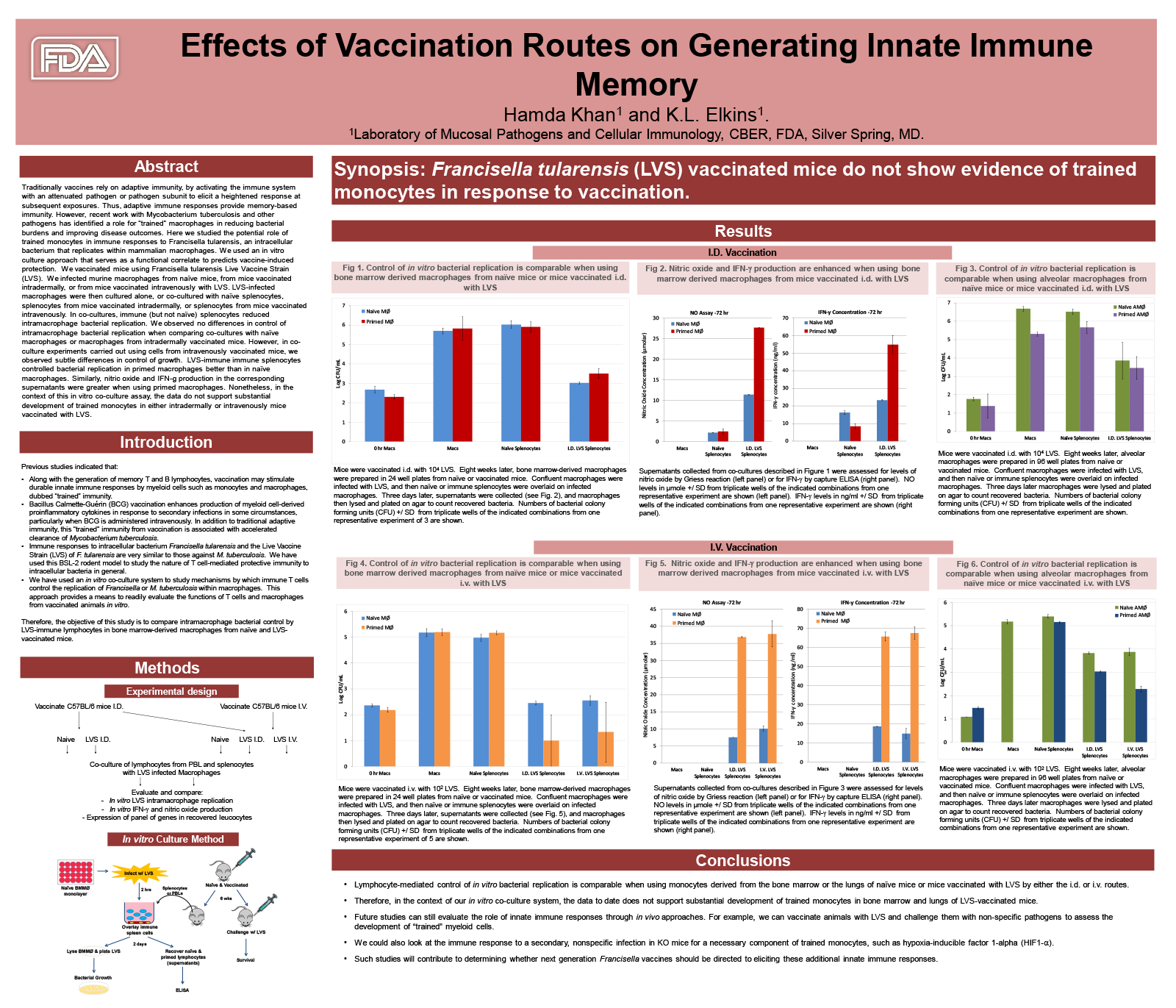
Traditionally vaccines rely on adaptive immunity, by activating the immune system with an attenuated pathogen or pathogen subunit to elicit a heightened response at subsequent exposures. Thus, adaptive immune responses provide memory-based immunity. However, recent work with Mycobacterium tuberculosis and other pathogens has identified a role for “trained” macrophages in reducing bacterial burdens and improving disease outcomes. Here we studied the potential role of trained monocytes in immune responses to Francisella tularensis, an intracellular bacterium that replicates within mammalian macrophages. We used an in vitro culture approach that serves as a functional correlate to predicts vaccine-induced protection. We vaccinated mice using Francisella tularensis Live Vaccine Strain (LVS). We infected murine macrophages from naïve mice, from mice vaccinated intradermally, or from mice vaccinated intravenously with LVS. LVS-infected macrophages were then cultured alone, or co-cultured with naïve splenocytes, splenocytes from mice vaccinated intradermally, or splenocytes from mice vaccinated intravenously. In co-cultures, immune (but not naïve) splenocytes reduced intramacrophage bacterial replication. We observed no differences in control of intramacrophage bacterial replication when comparing co-cultures with naïve macrophages or macrophages from intradermally vaccinated mice. However, in co-culture experiments carried out using cells from intravenously vaccinated mice, we observed subtle differences in control of growth. LVS-immune immune splenocytes controlled bacterial replication in primed macrophages better than in naïve macrophages. Similarly, nitric oxide and IFN-g production in the corresponding supernatants were greater when using primed macrophages. Nonetheless, in the context of this in vitro co-culture assay, the data do not support substantial development of trained monocytes in either intradermally or intravenously mice vaccinated with LVS.