2021 FDA Science Forum
Effects of Key RNA-Sequencing Technical Elements on Toxicity Assessment Using Three Biological Replicates
- Authors:
- Center:
Abstract
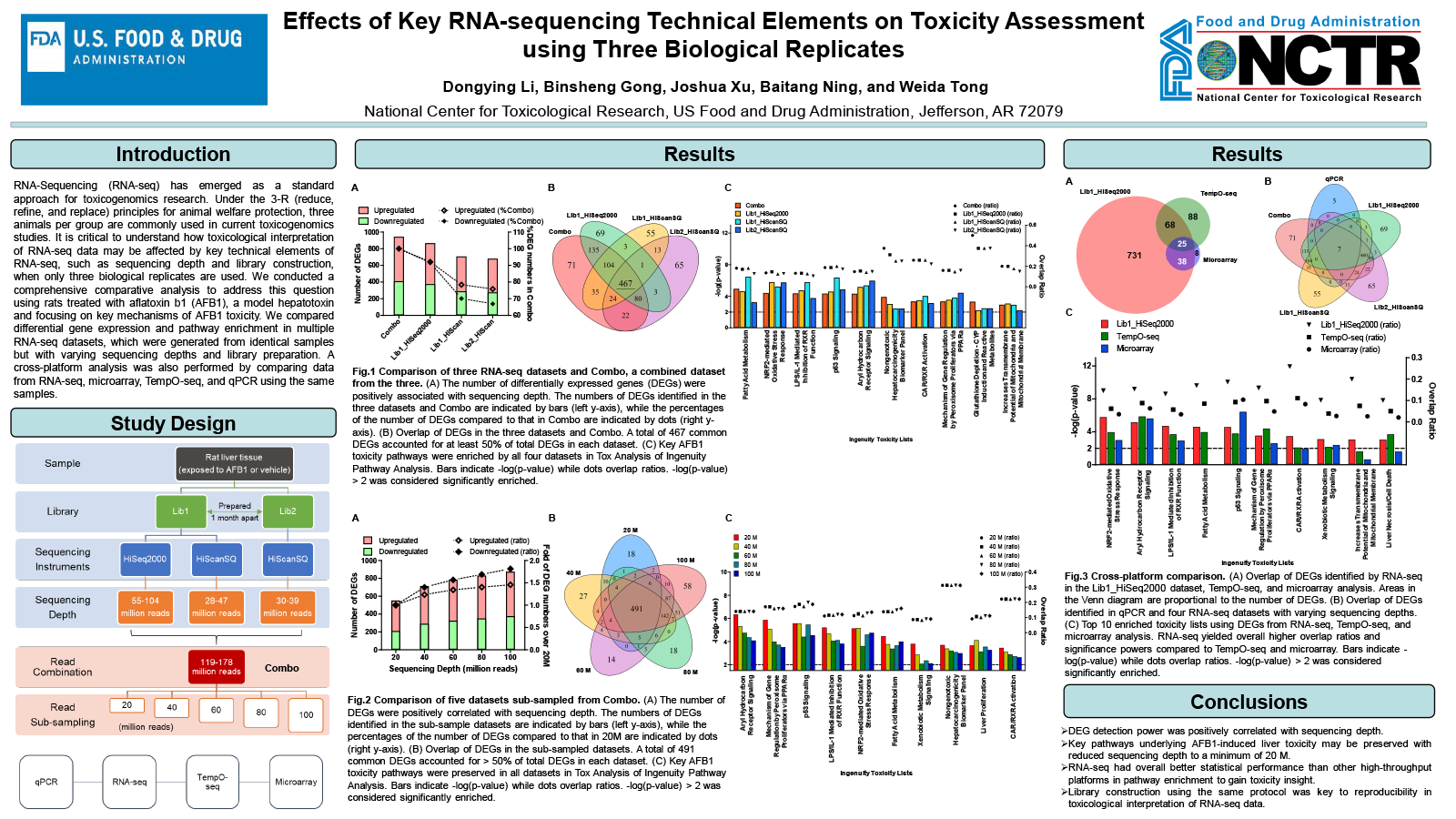
Under the 3-R principles for animal welfare protection, three animals per group are commonly used in toxicological research, particularly in animal studies during preclinical drug development. RNA-Sequencing (RNA-seq) has emerged as a standard approach in toxicogenomics studies, however, its full potential in gaining toxicological insights is unclear when only three biological replicates are used. Sequencing depth (the total number of reads in an experiment) and library preparation are critical elements in RNA-seq for data resolution, integrity, and interpretation. We used aflatoxin b1 (AFB1), a model liver toxicant, to investigate the effects of sequencing depth and library preparation on toxicity assessment in the “three-sample” scenario. We also compared different gene profiling platforms using identical samples. Well-established mechanisms of AFB1 toxicity served as ground truth for our comparative analyses. We found that a minimum of 20 million reads was sufficient to elicit key toxicity functions and pathways underlying AFB1-induced liver toxicity using three replicates, and that identification of differentially expressed genes was positively associated with sequencing depth. Further, our results showed that RNA-seq revealed toxicological insights from pathway enrichment analyses with overall higher statistical power compared to other platforms. Moreover, library preparation using the same methods and materials was critical to data reproducibility in toxicological assessment.