2021 FDA Science Forum
Effects of Formulation and Actuator Design on Spray Pattern and Plume Geometry of Mometasone Furoate Metered Dose Inhalers (MDIs)
- Authors:
- Center:
-
Contributing OfficeCenter for Drug Evaluation and Research
Abstract
Background
Spray pattern and plume geometry analyses are used in the product quality and in vitro bioequivalence assessment of MDIs but their utility in detecting changes in formulation is poorly understood.
Purpose
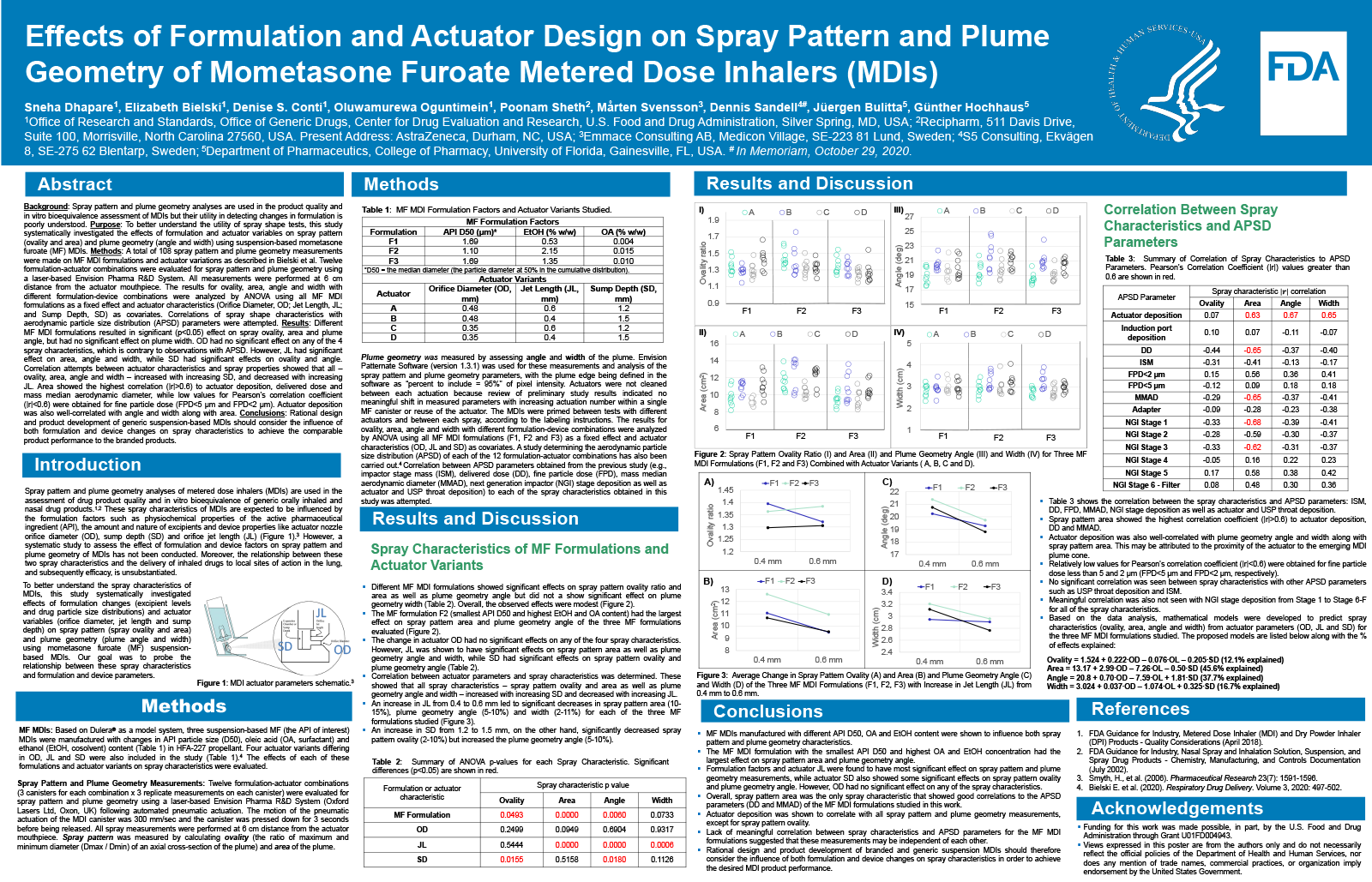
To better understand the utility of spray shape tests, this study systematically investigated the effects of formulation and actuator variables on spray pattern (ovality and area) and plume geometry (angle and width) using suspension-based mometasone furoate (MF) MDIs.
Methods
A total of 108 spray pattern and plume geometry measurements were made on MF MDI formulations and actuator variations as described in Bielski et al. Twelve formulation-actuator combinations were evaluated for spray pattern and plume geometry using a laser-based Envision Pharma R&D System. All measurements were performed at 6 cm distance from the actuator mouthpiece. The results for ovality, area, angle and width with different formulation-device combinations were analyzed by ANOVA using all MF MDI formulations as a fixed effect and actuator characteristics (Orifice Diameter, OD; Jet Length, JL; and Sump Depth, SD) as covariates. Correlations of spray shape characteristics with aerodynamic particle size distribution (APSD) parameters were attempted.
Results
Different MF MDI formulations resulted in significant (p<0.05) effect on spray ovality, area and plume angle, but had no significant effect on plume width. OD had no significant effect on any of the 4 spray characteristics, which is contrary to observations with APSD. However, JL had significant effect on area, angle and width, while SD had significant effects on ovality and angle. Correlation attempts between actuator characteristics and spray properties showed that all – ovality, area, angle and width – increased with increasing SD, and decreased with increasing JL. Area showed the highest correlation (|r|>0.6) to actuator deposition, delivered dose and mass median aerodynamic diameter, while low values for Pearson’s correlation coefficient (|r|<0.6) were obtained for fine particle dose (FPD<5 µm and FPD<2 µm). Actuator deposition was also well-correlated with angle and width along with area.
Conclusions
Rational design and product development of generic suspension-based MDIs should consider the influence of both formulation and device changes on spray characteristics to achieve the comparable product performance to the branded products.