2021 FDA Science Forum
Effects of Emulsifiers on Intestinal Barrier Integrity and Exposure to Food Allergens
- Authors:
- Center:
-
Contributing OfficeCenter for Food Safety and Applied Nutrition
Abstract
Introduction
Enhancement of food allergic responses could be related to cellular membrane effects from certain emulsifiers. Consequently, the interactions among the food matrix components are of importance for risk characterization purposes.
Purpose
Exploring how emulsifiers (e.g. Polysorbate [P]-80 or Lecithin [LE]) might affect intestinal barrier integrity and transport of allergenic proteins such as the egg allergen ovalbumin (OA).
Methods
We challenged monolayers of Caco-2 cells, an in vitro model of human epithelial tight junctions with 0.01, 0.05, 0.1, and 0.5% of P-80 or LE alone, and OA alone (0.1, 1, and 10 mg/ml) or in combination (0.5 mg/ml) with emulsifiers (0.2%). We measured toxicity, cellular viability, Lucifer Yellow (LY) penetration, Trans-Epithelial Electrical Resistance (TEER), and expression of tight junction molecules by gene-expression and immunofluorescence assays. An in-house ELISA determined the rate of transport of OA, with or without emulsifiers, to basolateral media.
Results
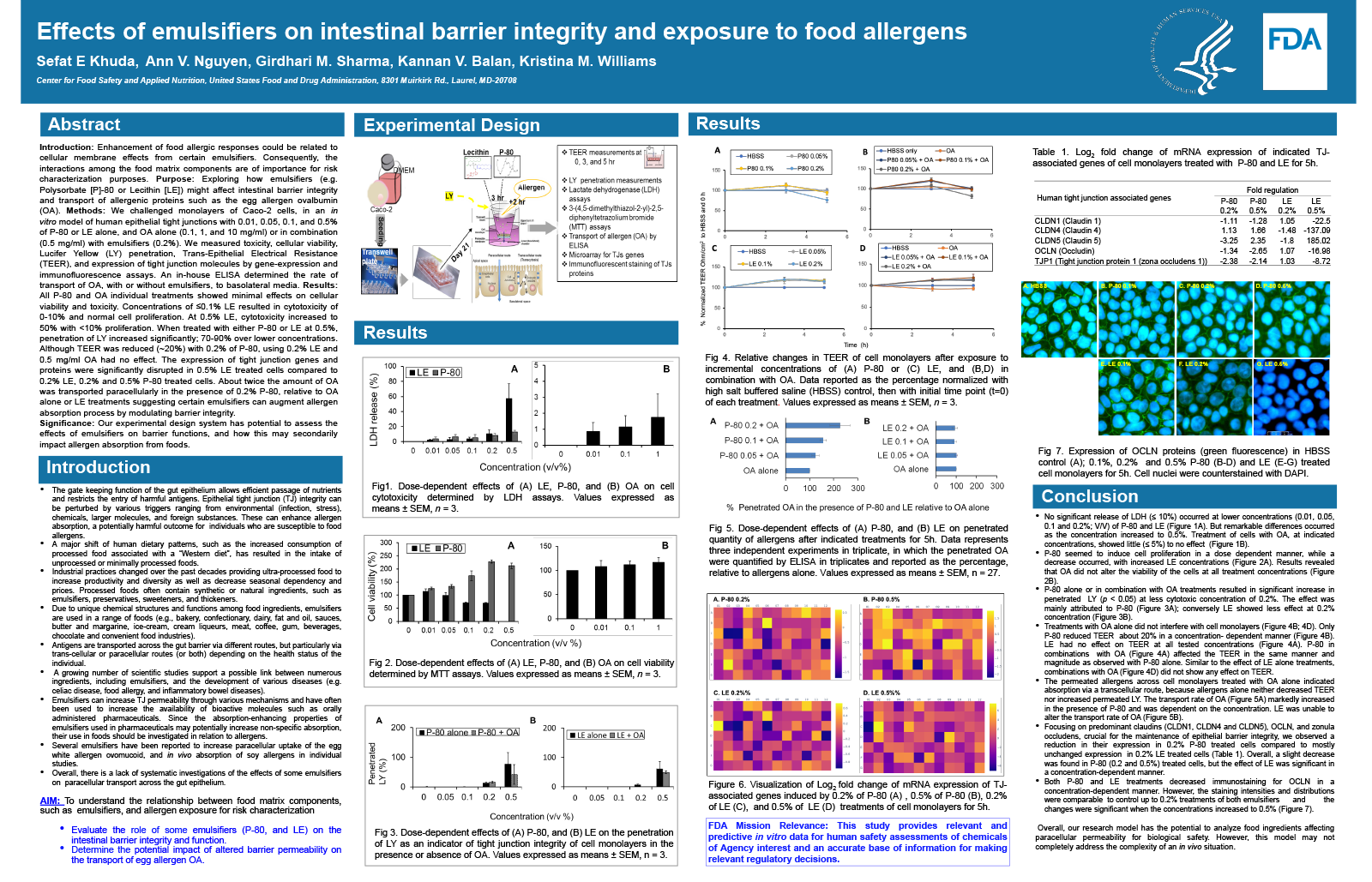
All P-80 and OA individual treatments showed minimal effects on cellular viability and toxicity. Concentrations of ?0.1% LE resulted in cytotoxicity of 0-10% and normal cell proliferation. At 0.5% LE, cytotoxicity increased to 50% with <10% proliferation. When treated with either P-80 or LE at 0.5%, penetration of LY increased significantly; 70-90% over lower concentrations. Although TEER was reduced (~20%) with 0.2% of P-80, using 0.2% LE and 0.5 mg/ml OA had no effect. The expression of tight junction genes and proteins were significantly disrupted in 0.5% LE treated cells compared to 0.2% LE, 0.2% and 0.5% P-80 treated cells. About twice the amount of OA was transported paracellularly in the presence of 0.2% P-80, relative to OA alone or LE treatments suggesting certain emulsifiers can augment allergen absorption process by modulating barrier integrity.
Significance
Our experimental design system has potential to assess the emulsifier effects on barrier functions, and how this may secondarily impact allergen absorption from foods.