2023 FDA Science Forum
Effect of Test Parameters on Material-mediated Hemolysis Using the ASTM F756-17 Standard Test Method
- Authors:
- Center:
-
Contributing OfficeCenter for Devices and Radiological Health
Abstract
Background:
To ensure the safety of blood-contacting medical devices (e.g., catheters, blood pumps), FDA works with industry to develop standard procedures for pre-market hemocompatibility testing.
Purpose:
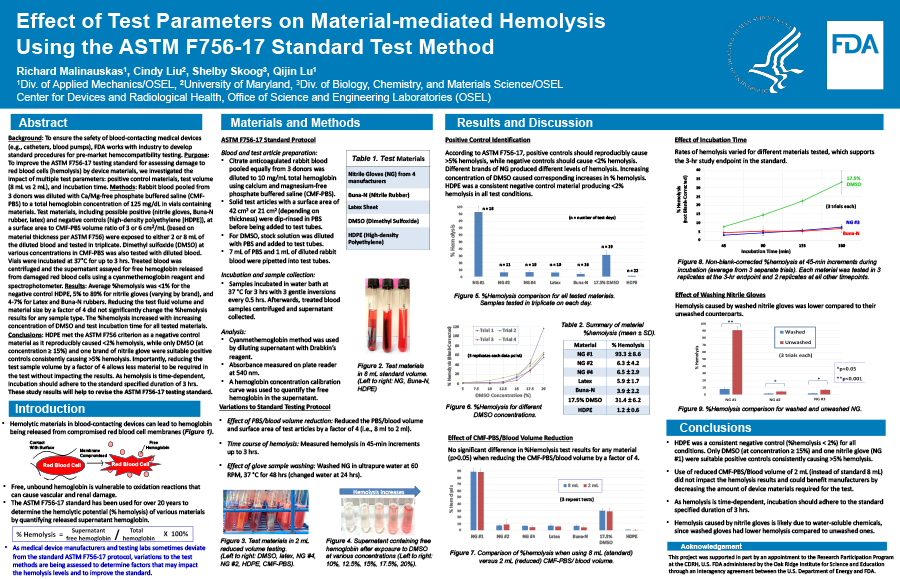
To improve the ASTM F756-17 testing standard for assessing damage to red blood cells (hemolysis) by device materials, we investigated the impact of multiple test parameters: positive control materials, test volume (8 mL vs 2 mL), and incubation time.
Methods:
Rabbit blood pooled from 3 donors was diluted with Ca/Mg-free phosphate buffered saline (CMF-PBS) to a total hemoglobin concentration of 125 mg/dL in vials containing materials. Test materials, including possible positive (nitrile gloves, Buna-N rubber, latex) and negative controls (high-density polyethylene [HDPE]), at a surface area to CMF-PBS volume ratio of 3 or 6 cm2/mL (based on material thickness per ASTM F756) were exposed to either 2 or 8 mL of the diluted blood and tested in triplicate. Dimethyl sulfoxide (DMSO) at various concentrations in CMF-PBS was also tested with diluted blood. Vials were incubated at 37°C for up to 3 hrs. Treated blood was centrifuged and the supernatant assayed for free hemoglobin released from damaged red blood cells using a cyanmethemoglobin reagent and spectrophotometer.
Results:
Average %hemolysis was less than 1% for the negative control HDPE, 5% to 89% for nitrile gloves (varying by brand), and 4-7% for Latex and Buna-N rubbers. Reducing the test fluid volume and material size by a factor of 4 did not significantly change the %hemolysis results for any sample type. The %hemolysis increased with increasing concentration of DMSO and test incubation time for all tested materials.
Conclusions:
HDPE met the ASTM F756 criterion as a negative control material as it reproducibly caused < 2% hemolysis, while only DMSO (at concentration ≥ 15%) and one brand of nitrile glove were suitable positive controls consistently causing >5% hemolysis. Importantly, reducing the test sample volume by a factor of 4 allows less material to be required in the test without impacting the results. As hemolysis is time-dependent, incubation should adhere to the standard specified duration of 3 hrs. These study results will help to revise the ASTM F756-17 testing standard.