2023 FDA Science Forum
The Effect of Material Property Variability on Additively Manufactured Medical Device Static Performance Tests
- Authors:
- Center:
-
Contributing OfficeCenter for Devices and Radiological Health
Abstract
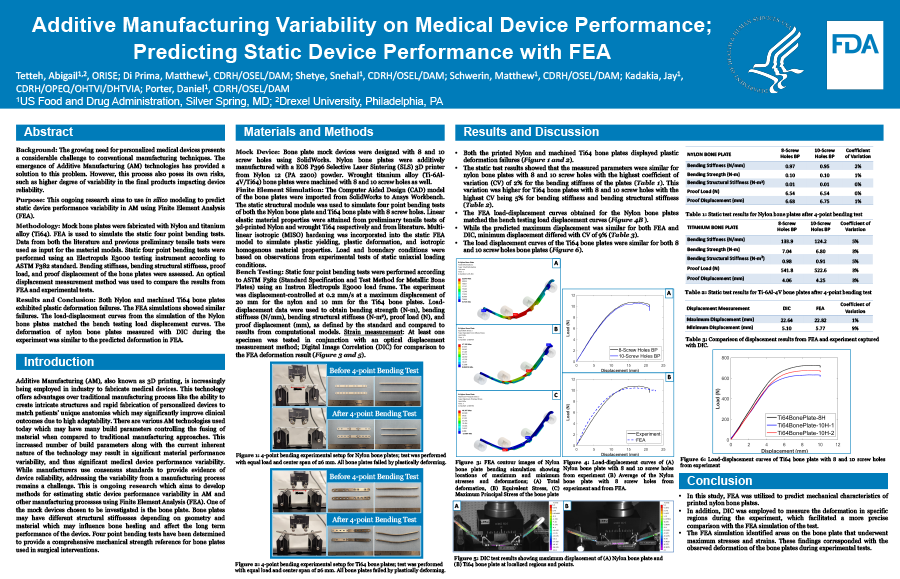
Current medical device review processes focus on bulk material properties, and while manufacturers use consensus standards to provide evidence of device reliability, addressing the variability from the additive manufacturing process remains a challenge. Additive Manufacturing (AM), also known as 3D printing, is increasingly being employed in industry to fabricate medical devices. However, the AM process may have more build parameters when compared to traditional manufacturing approaches. The increased number of build parameters may result in greater medical device performance variability. This research aims to develop methods for estimating static device performance variability in AM. Aim 1 investigated and characterized the intrinsic structural and static mechanical properties of wrought and AM titanium alloy. This will help determine a proposed range for titanium alloy material performance when predicting static device performance. Aim 2 uses in silico modeling to predict the static performance of devices with the material model data from Aim 1.
The materials used in this study were Ti6Al4V (Ti64) supplied by six wrought and seven AM manufacturers. The wrought sample set comprised of Ti64-ELI (grade 23) and Ti64 (grade 5) of the alloy. Some wrought specimens underwent post-processing treatments: Solution Treated and Aged (STA) or Annealing. The M290, M280, EOS 400, and GE M2 powder bed fusion systems were used in fabricating the AM samples. Some AM specimens underwent Hot Isostatic Pressing (HIP) post-processing treatment. To accomplish Aim 1 of the study, mechanical properties such as modulus of elasticity, yield strength, tensile strength, and elongation were measured and compared between the different sample groups following the ASTM E8/E8m-16a (Standard Test Methods for Tension Testing of Metallic Materials) standard. Other material characterization tests included microhardness testing, Scanning Electron Microscopy (SEM) to determine fractured surface microstructure differences, and chemical analysis to determine differences in material composition. For Aim 2, two mock devices; a bone plate and a spinal cage have been chosen to evaluate a computational method using Finite Element Analysis (FEA) for medical device performance tests. Experimental results from static four-point bending according to ASTM F382 (Standard Specification and Test Method for Metallic Bone Plates) for the bone plate were then compared to metrics obtained from computational models to assess model credibility.