2021 FDA Science Forum
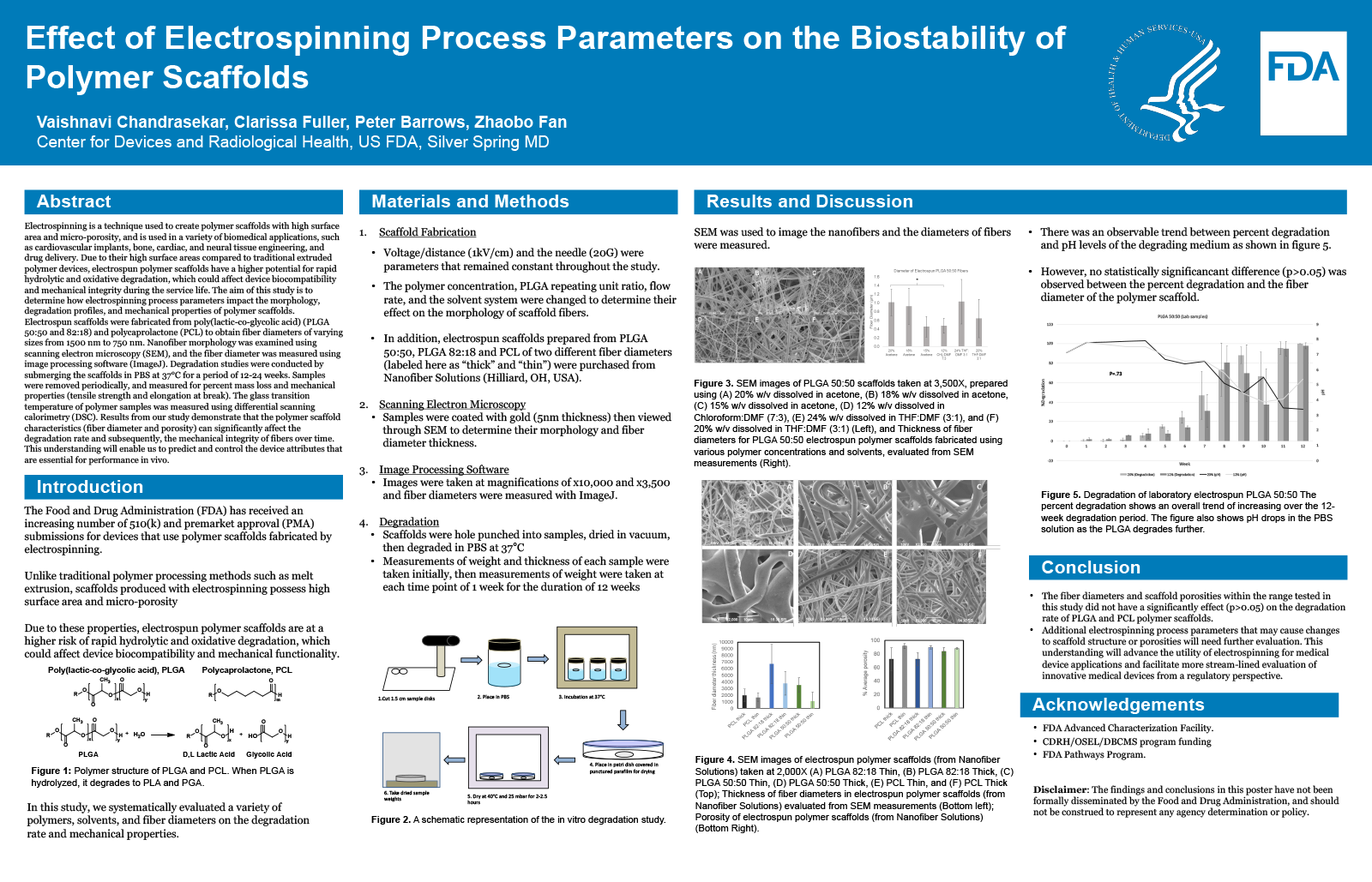
Effect of Electrospinning Process Parameters on the Biostability of Polymer Scaffolds
- Authors:
- Center:
-
Contributing OfficeCenter for Devices and Radiological Health
Abstract
Electrospinning is a technique used to create polymer scaffolds with high surface area and micro-porosity, and is used in a variety of biomedical applications, such as cardiovascular implants, bone, cardiac, and neural tissue engineering, and drug delivery. Due to their high surface areas compared to traditional extruded polymer devices, electrospun polymer scaffolds have a higher potential for rapid hydrolytic and oxidative degradation, which could affect device biocompatibility and mechanical integrity during the service life. The aim of this study is to determine how electrospinning process parameters impact the morphology, degradation profiles, and mechanical properties of polymer scaffolds. Electrospun scaffolds were fabricated from poly(lactic-co-glycolic acid) (PLGA 50:50 and 82:18) and polycaprolactone (PCL) to obtain fiber diameters of varying sizes from 1500 nm to 750 nm. Nanofiber morphology was examined using scanning electron microscopy (SEM), and the fiber diameter was measured using image processing software (ImageJ). Degradation studies were conducted by submerging the scaffolds in PBS at 37°C for a period of 12-24 weeks. Samples were removed periodically, and measured for percent mass loss and mechanical properties (tensile strength and elongation at break). The glass transition temperature of polymer samples was measured using differential scanning calorimetry (DSC). Results from our study demonstrate that the polymer scaffold characteristics (fiber diameter and porosity) can significantly affect the degradation rate and subsequently, the mechanical integrity of fibers over time. This understanding will enable us to predict and control the device attributes that are essential for performance in vivo.