2021 FDA Science Forum
Effect of Changes in Fermentation Conditions on the Selection of Appropriate Calibrants for the Quantitation of Gluten in Fermented-Hydrolyzed Foods
- Authors:
- Center:
-
Contributing OfficeCenter for Food Safety and Applied Nutrition
Abstract
Background
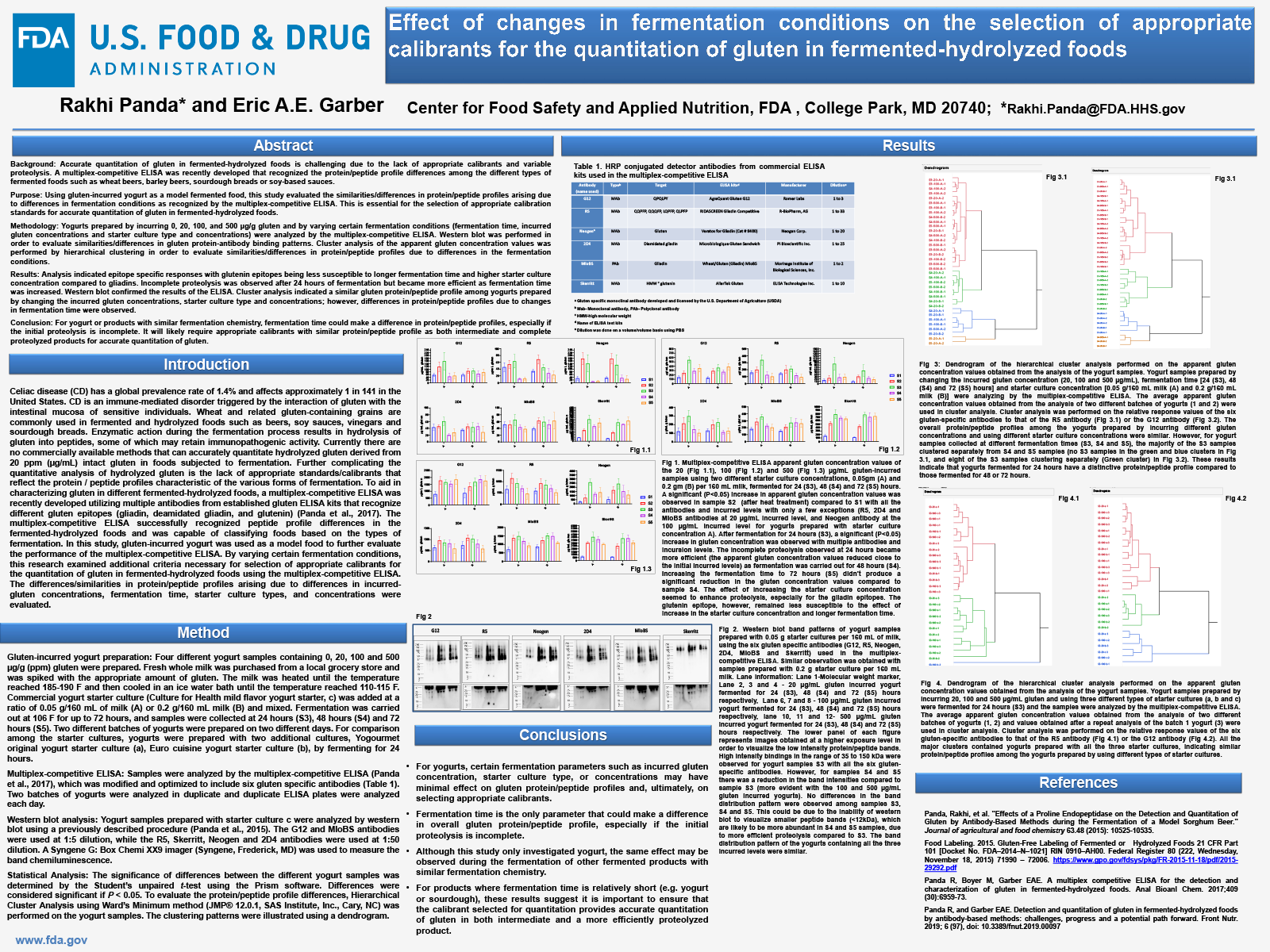
Accurate quantitation of gluten in fermented-hydrolyzed foods is challenging due to the lack of appropriate calibrants and variable proteolysis. A multiplex-competitive ELISA was recently developed that recognized the protein/peptide profile differences among the different types of fermented foods such as wheat beers, barley beers, sourdough breads or soy-based sauces.
Purpose
Using gluten-incurred yogurt as a model fermented food, this study evaluated the similarities/differences in protein/peptide profiles arising due to differences in fermentation conditions as recognized by the multiplex-competitive ELISA. This is essential for the selection of appropriate calibration standards for accurate quantitation of gluten in fermented-hydrolyzed foods.
Methodology
Yogurts prepared by incurring 0, 20, 100, and 500 µg/g gluten and by varying certain fermentation conditions (fermentation time, incurred gluten concentrations and starter culture type and concentrations) were analyzed by the multiplex-competitive ELISA. Western blot was performed in order to evaluate similarities/differences in gluten protein-antibody binding patterns. Cluster analysis of the apparent gluten concentration values was performed by hierarchical clustering in order to evaluate similarities/differences in protein/peptide profiles due to differences in the fermentation conditions.
Results
Analysis indicated epitope specific responses with glutenin epitopes being less susceptible to longer fermentation time and higher starter culture concentration compared to gliadins. Incomplete proteolysis was observed after 24 hours of fermentation, but became more efficient as fermentation time was increased. Western blot confirmed the results of the ELISA. Cluster analysis indicated a similar gluten protein/peptide profile among yogurts prepared by changing the incurred gluten concentrations, starter culture type and concentrations; however, differences in protein/peptide profiles due to changes in fermentation time were observed.
Conclusion
For yogurt or products with similar fermentation chemistry, fermentation time could make a difference in protein/peptide profiles, especially if the initial proteolysis is incomplete. It will likely require appropriate calibrants with similar protein/peptide profile as both intermediate and complete proteolyzed products for accurate quantitation of gluten.