2023 FDA Science Forum
Dynamic headspace GC-MS method to detect volatile extractables from medical device materials
- Authors:
- Center:
-
Contributing OfficeCenter for Devices and Radiological Health
Abstract
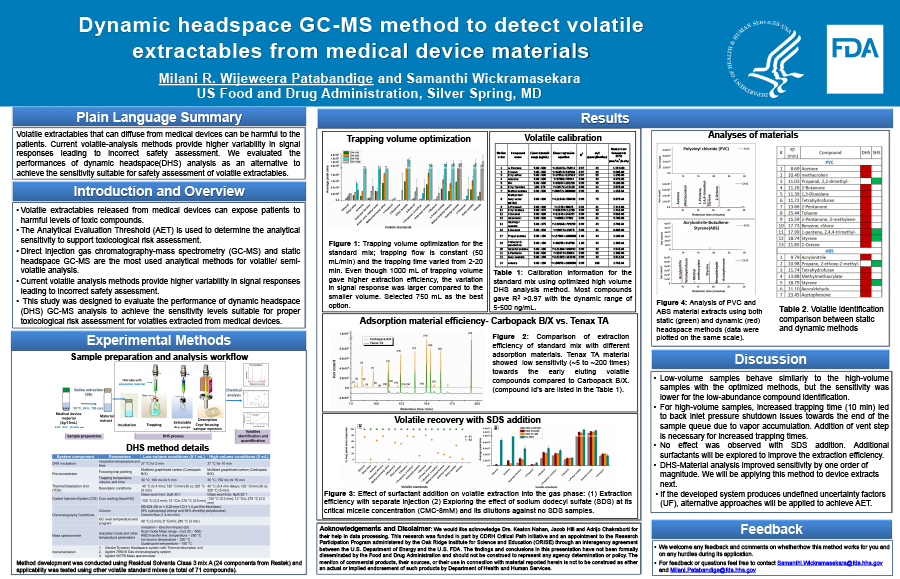
Volatile extractables, released from medical devices during use, are a concern as they may expose patients to harmful levels of toxic compounds. According to ISO 10993-18:2020, the Analytical Evaluation Threshold (AET) is used to determine the analytical sensitivity required to detect extractables from medical devices. Compounds, at or above the AET, need to be reported for toxicological risk assessment. Currently, volatile analysis by static headspaces is used as a supplementary technique for medical device or material extracts. Variation of signal response in static headspace led to undefined AET for the volatile analysis method. Therefore, investigating new technologies that generate reproducible data for volatile quantification is needed for improved hazards identification. This study was designed to evaluate the performance of dynamic headspace (DHS) gas chromatography-mass spectrometric (GC-MS) analysis to achieve the sensitivity levels suitable for proper toxicological risk assessment for volatiles extracted from medical devices.
DHS method development was conducted using residual solvents class 3 - mix A standard and the initial method development and analyses were done using GERSTEL MPS attached to Agilent GC-MS system. Two different methods were designed to address both volatile and semi volatile compounds. The efficiency of DHS extraction was optimized based on incubation temperature, trapping volume/ time, adsorbent type (Carbopack B/ Carbopack X (Carbopack B/X) and Tenax TA), and drying time for low volume samples. Method performance was compared with commonly used static headspace GC-MS analysis. To further improve the headspace concentration of more water-soluble compounds such as alcohols, and ketones, the effect of surfactants addition to the sample matrix was also investigated. Application of developed methods were tested using saline extracts of various medical device materials such as ABS, Buna and PVC. Preliminary results showed improved efficiency in detecting volatile extractable in ABS material extracts with semi volatile method with increased peak area responses compared to the volatile method. This sensitive dynamic headspace GC-MS method may facilitate improved toxicological risk assessment for the volatiles detected in medical devices.