2021 FDA Science Forum
Dynamic Adaptive Response of Pseudomonas Aeruginosa to Clindamycin/Rifampicin-Impregnated Catheters
- Authors:
- Center:
-
Contributing OfficeNational Center for Toxicological Research
Abstract
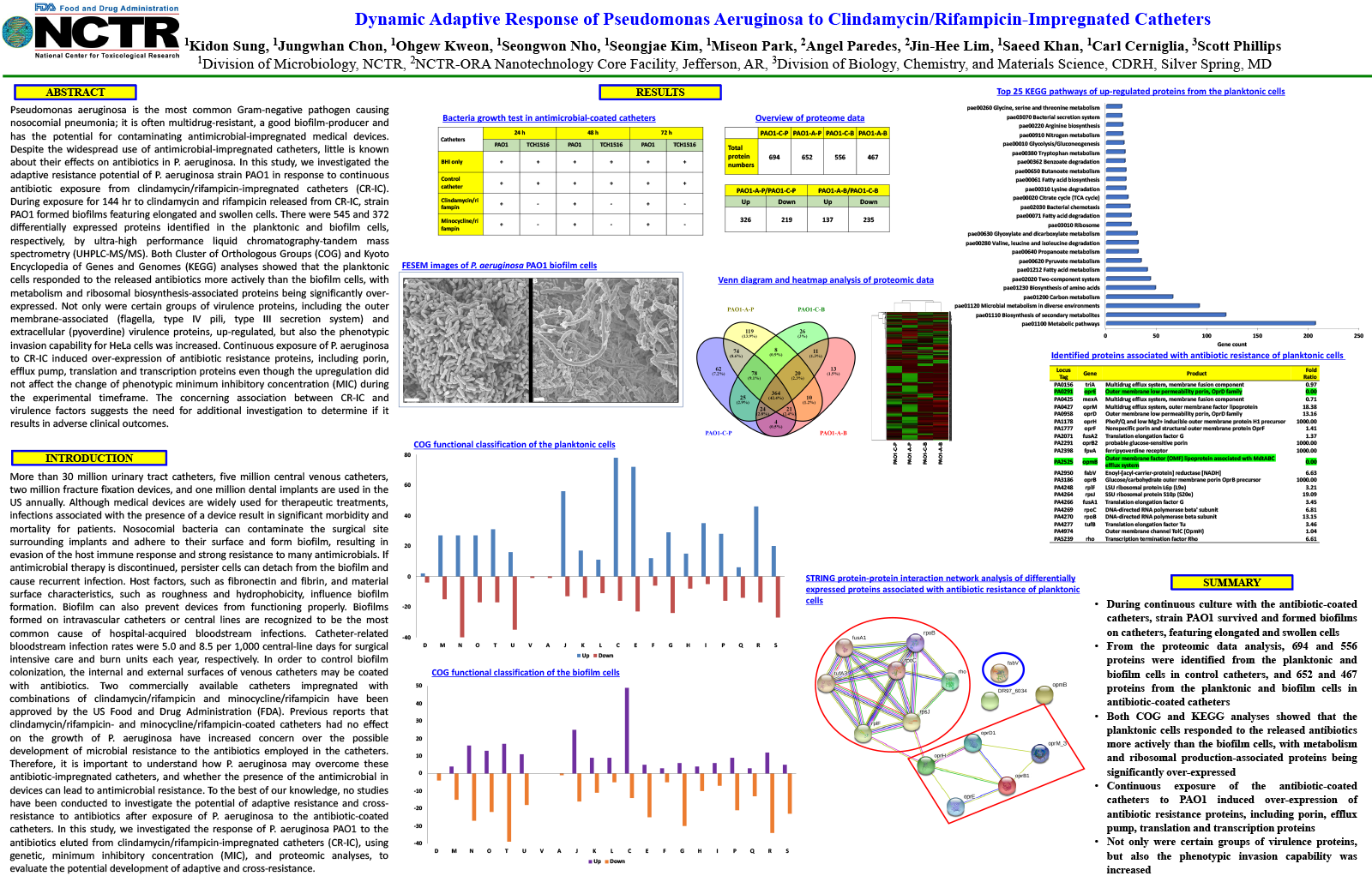
Pseudomonas aeruginosa is the most common Gram-negative pathogen causing nosocomial pneumonia; it is often multidrug-resistant, a good biofilm-producer and has the potential for tainting antimicrobial-impregnated medical devices. Despite the widespread use of antimicrobial-impregnated catheters, little is known about their effects on antibiotics in P. aeruginosa. In this study, we investigated adaptive resistance potential of P. aeruginosa strain PAO1 in response to continuous antibiotic exposure from clindamycin/rifampicin-impregnated catheters (CR-IC). During exposure for 144 hr to clindamycin and rifampicin released from CR-IC, strain PAO1 formed biofilms on catheters featuring elongated and swollen cells. There were 545 and 372 differentially expressed proteins identified in the planktonic and the biofilm cells, respectively, by an ultra-high performance liquid chromatography-tandem mass spectrometry (UHPLC-MS/MS). Both Cluster of Orthologous Groups (COG) and Kyoto Encyclopedia of Genes and Genomes (KEGG) analyses showed that the planktonic cells responded to the released antibiotics more actively than the biofilm cells, with metabolism and ribosomal biosynthesis-associated proteins being significantly over-expressed. Not only were certain groups of virulence proteins, including the outer membrane-associated (flagella, type IV pili, type III secretion system) and extracellular (pyoverdine) virulence factors, up-regulated, but also the phenotypic invasion capability to HeLa cells was increased, raising concern about the potential risk for CR-IC. Continuous exposure of CR-IC to P. aeruginosa induced over-expression of antibiotic resistance proteins, including porin, efflux pump, translation and transcription proteins even though the changes did not affect the phenotypic minimum inhibitory concentration (MIC).