2023 FDA Science Forum
Doxorubicin HCl release from Liposomal Doxorubicin Formulations – Autonomous Capillary Electrophoretic (CE) in-vitro Release Test (IVRT) Method
- Authors:
- Center:
-
Contributing OfficeOffice of Regulatory Affairs
Abstract
Background
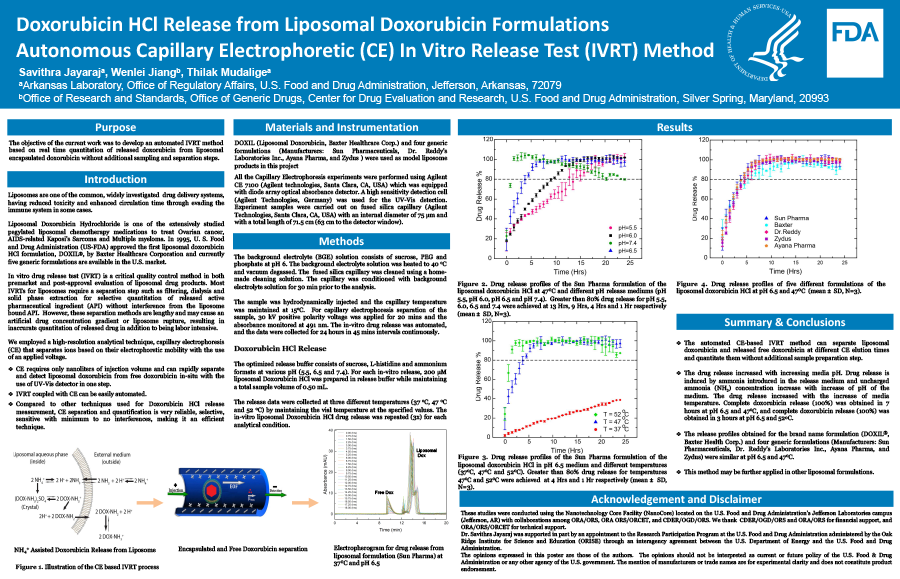
A considerable amount of research has been conducted over the past six decades on the use of liposomes as drug delivery systems. In vitro drug release test (IVRT) is a critical quality control method in both premarket and post-approval evaluation of liposomal drug products. Most IVRTs for liposomes require a separation step such as dialysis or solid phase extraction to quantitate released active pharmaceutical ingredient (API) without interference from the liposome bound API. However, these separation methods are lengthy and may cause an artificial drug concentration gradient or liposome rupture, resulting in inaccurate quantitation of released drug. Purpose The objective of the current work was to develop a new IVRT method to acquire accurate real-time release of doxorubicin from liposomal encapsulated doxorubicin hydrochloride formulations without additional separation steps. Method We developed an automated capillary electrophoresis (CE) based method to determine the release of API from liposomal doxorubicin formulations. CE experiments were carried out on fused silica capillary and doxorubicin was detected using a high sensitivity UV-VIS detection cell. The release study was conducted at different temperatures (370C, 470C and 520C) and pH (5.5, 6.0, 6.5 and 7.4) conditions in release media containing 20 mM histidine, 200 mM ammonium formate, 5% sucrose. 500 µL release sample was taken to subject for CE analysis. Results The automated CE-based IVRT method can elute liposomal doxorubicin and released free doxorubicin at different time and quantitate them without additional sample preparation. . It was observed that the drug release increased with the increase of media pH and temperature. Complete doxorubicin release (100%) was obtained in 7 hours at pH 6.5 and 470C, and in less than 3 hours at pH 6.5 and 520C. The release profiles obtained for the brand name drug and four generic drugs were similar at pH 6.5 and 470C. Conclusion The new CE-based approach delivers a better IVRT method, i.e., fully automated, use of small amount of release samples, continuous sampling and no additional separation step, for liposomal formulations containing doxorubicin hydrochloride with real-time analysis of the released API. This CE-based method can be applied for in vitro release profiling of other liposome drug products.