2021 FDA Science Forum
Development of In Vitro Predictive Models for Abuse-Deterrent Opioid Safety Assessment
- Authors:
- Center:
-
Contributing OfficeCenter for Drug Evaluation and Research
Abstract
Background
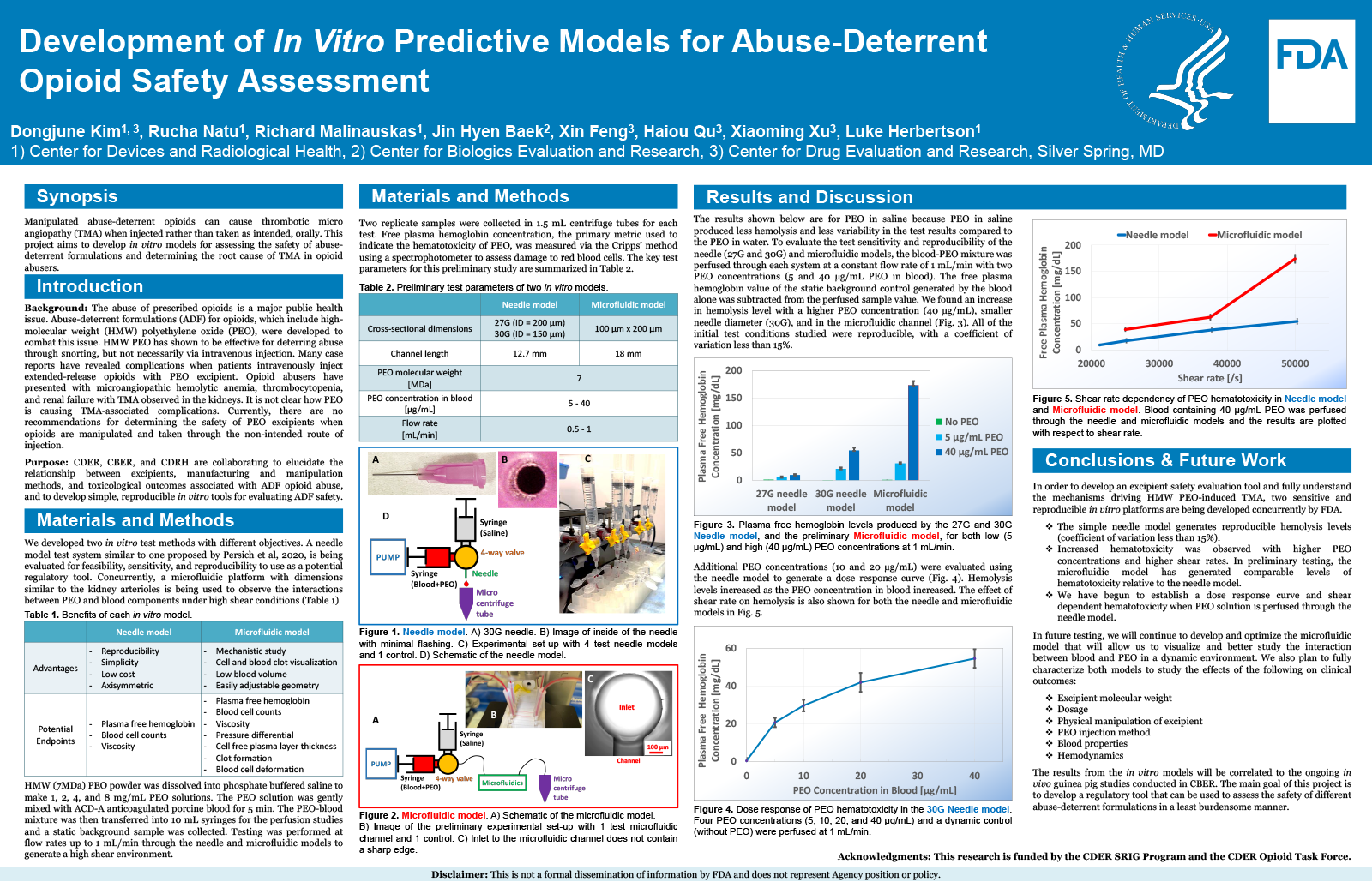
The abuse of prescribed opioids is a major public health issue. Abuse-deterrent formulations (ADF) for opioids, which include high-molecular weight (HMW) polyethylene oxide (PEO), were developed to address this issue. HMW PEO has shown to be effective for deterring abuse through snorting, but not necessarily via intravenous injection. Many case reports have revealed complications when patients intravenously inject extended release opioids with PEO excipient. Patients have presented with microangiopathic hemolytic anemia, thrombocytopenia, and renal failure with thrombotic microangiopathy (TMA) observed in the kidneys. It is not clear why or how PEO is causing TMA-associated complications. Currently, there are no recommendations for determining the safety of PEO excipients when opioids are manipulated and taken through the non-intended route of injection.
Purpose
CDER, CBER, and CDRH are collaborating to elucidate the relationship between excipients, manufacturing and manipulation methods, and toxicological outcomes associated with ADF opioid abuse, and to develop simple, reproducible in vitro tools for evaluating ADF safety.
Methodology
Different molecular weight formulations of PEO were tested in CBER using a guinea pig model. To correlate with the in vivo studies and to provide a least burdensome method for assessing PEO safety, in vitro test methods are being developed. Plasma free hemoglobin levels and platelet aggregation will be quantified to assess hematotoxicity and the TMA potential.
Results
The animal study showed that HMW PEO in opioid tablets can cause hematotoxicity, TMA, and kidney injury when administered via acute intravenous injection. Two distinct in vitro models are being optimized to reproduce user effects. A needle model was developed to evaluate for simplicity, reproducibility and sensitivity as a regulatory tool. Concurrently, a microfluidic system was designed with dimensions representative of kidney arterioles to enable visualization of the PEO-blood interactions and microthrombi formation.
Conclusion
In order to develop an excipient safety evaluation tool and fully understand the mechanisms driving HMW PEO-induced TMA, two in vitro platforms are being developed and optimized at FDA. This study focuses on the relationships between excipient type and size, manufacturing process, tablet manipulation, and blood safety using newly developed in vitro tools validated by in vivo animal studies.