2021 FDA Science Forum
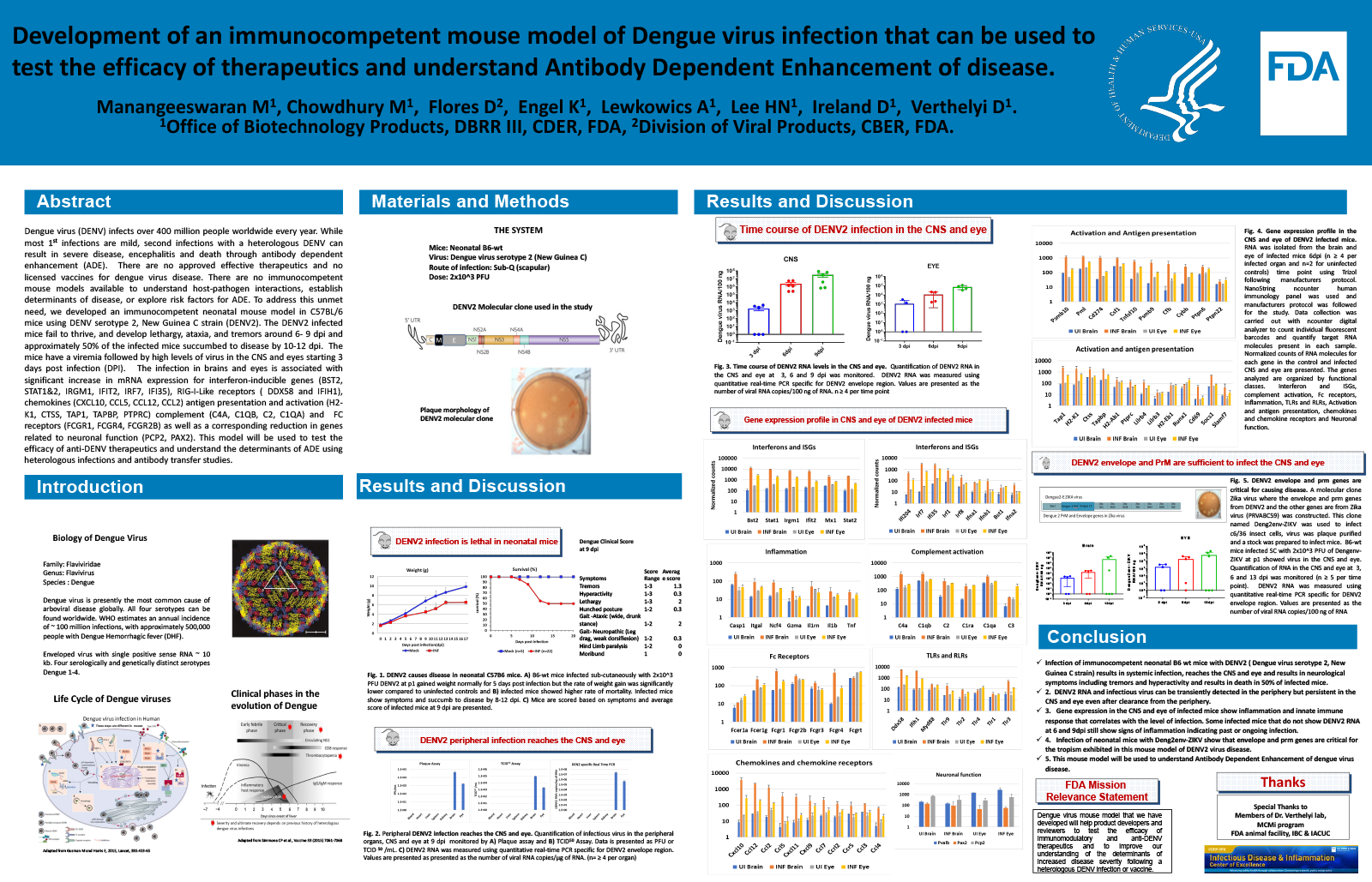
Development of an Immunocompetent Mouse Model of Dengue Virus Infection that Can Be Used to Test the Efficacy of Therapeutics and Understand Antibody Dependent Enhancement of Disease.
- Authors:
- Center:
-
Contributing OfficeCenter for Drug Evaluation and Research
Abstract
Dengue virus (DENV) is an arboviral disease that has one of the highest disease burdens and is estimated to infect 400 million people worldwide every year. There are no approved effective therapeutics and no licensed vaccines for dengue virus disease. There are no immunocompetent mouse models available to understand host-pathogen interactions and determinants of disease. To address this unmet need, we developed an immunocompetent neonatal mouse model in C57BL/6 mice using DENV serotype 2, New Guinea C strain (DENV2). Using this peripheral DENV2 infection model, we show that DENV2 infected mice stopped gaining weight after 6 days post infection (dpi), showed lethargy, gait and tremors around 6- 9 dpi and approximately 50% of the infected mice succumbed to disease by 10-12 dpi. DENV2 RNA and infectious virus can be detected in the CNS and eye starting 3 dpi and increases along the course of the disease. Brains from infected mice compared to uninfected controls revealed significant increase in expression of genes for ISGs(BST2, STAT1&2, IRGM1, IFIT2, IRF7, IFI35), RIG-I-Like receptors ( DDX58 and IFIH1), Chemokines (CXCL10, CCL5, CCL12, CCL2) antigen presentation and activation (H2-K1, CTSS, TAP1, TAPBP, PTPRC) Complement (C4A, C1QB, C2, C1QA) and FC receptors ( FCGR1, FCGR4, FCGR2B), as well as a reduction in the expression of genes related to neuronal function (PCP2, PAX2). Gene expression analysis of the infected eye revealed a similar profile. Even the brain and eye samples with undetectable DENV2 RNA showed increased gene expression reflecting residual inflammation and prior infection. Flow cytometry and Immunohistochemistry data also support DENV infection and infiltration in the CNS. This model will be used to test the efficacy of anti-DENV therapeutics and understand the determinants of ADE using heterologous infections and antibody transfer studies.