2023 FDA Science Forum
Development of a cell-based AP-1 gene reporter potency assay for anti-anthrax toxin therapeutics
- Authors:
- Center:
-
Contributing OfficeCenter for Drug Evaluation and Research
Abstract
Anthrax is a life-threatening disease caused by infection with Bacillus anthracis. The pXO1 virulence plasmid of B. anthracis expresses a binary anthrax toxin comprising protective antigen (PA) and two enzymatic moieties, edema factor (EF) and lethal factor (LF). PA binds surface receptors on the host cells, mediating the translocation of the enzymatic moieties into the cytoplasm of the host cells. LF is a zinc-dependent metalloprotease with specific activity to cleave mitogen-activated protein kinase kinases (MKKs) and, in certain mouse and rat strains, NACHT leucine-rich repeat protein 1 (NALP1), a protein involved in cell death pathways.
EF is a Ca2+ and calmodulin dependent adenylate cyclase that increases the level of cAMP in the host cell, disrupting water homeostasis, the intracellular signaling pathways and macrophage function. Given the role of PA in mediating entry of the enzymatic moieties into the host cells, anti-PA monoclonal antibodies have been developed as therapeutic for prophylaxis and treatment of inhaled anthrax. The available assays for the potency test of anti-PA antibodies include methods that were developed based on either LT-induced NALP1-mediated cell death or EF-induced increase in the level of c-AMP. These assays do not fully reflect and/or capture the pathological functions of anthrax toxin in humans, because LT does not cleave human NALP1, and ET may play a less important role than LT in the pathogenesis following infection with Bacillus anthracis.
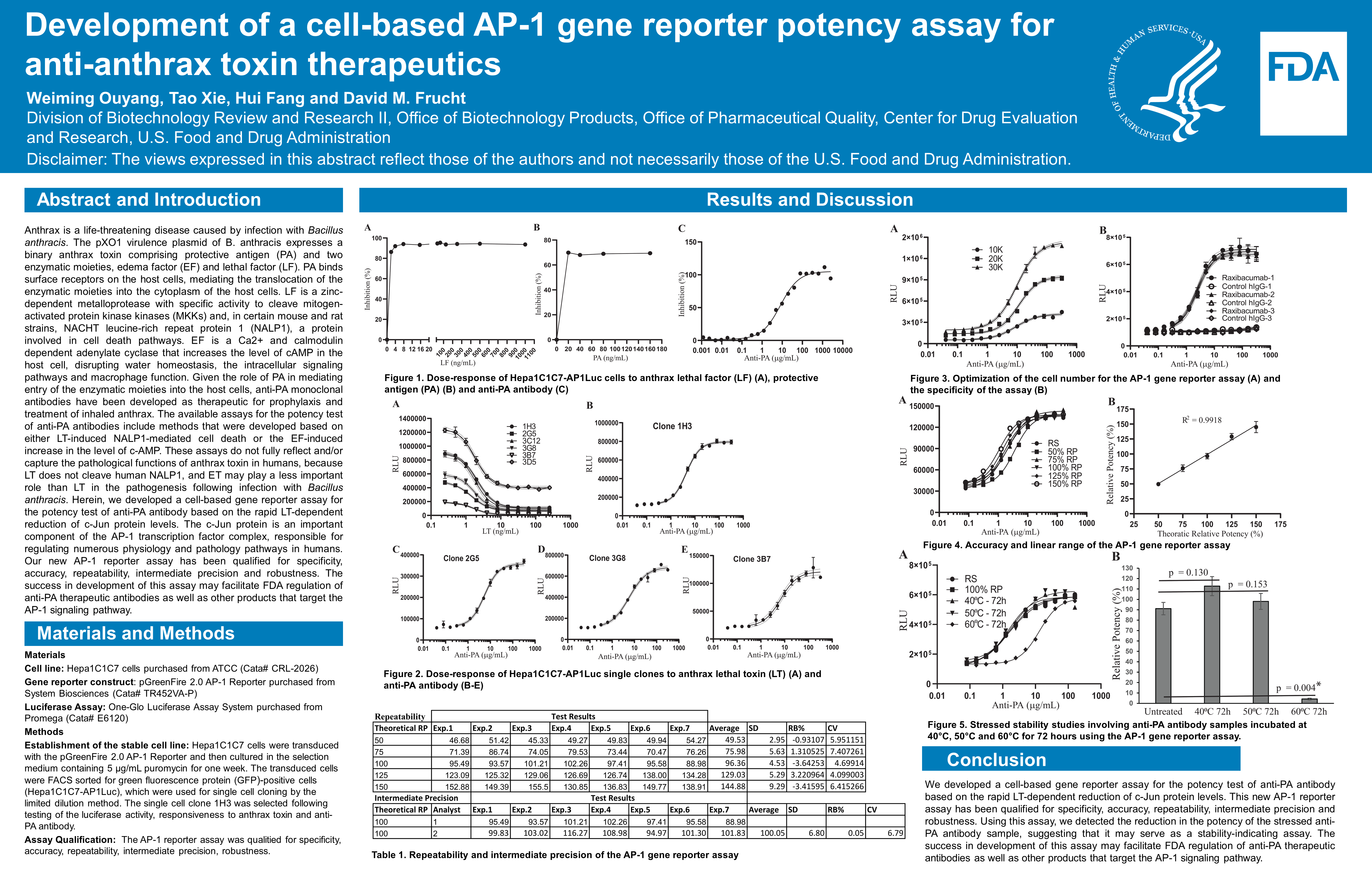
Herein, we developed a cell-based gene reporter assay for the potency test of anti-PA antibody based on the rapid LT-dependent reduction of c-Jun protein levels. The c-Jun protein is an important component of the AP-1 transcription factor complex, responsible for regulating numerous physiology and pathology pathways in humans. Our new AP-1 reporter assay has been qualified for specificity, accuracy, repeatability, intermediate precision and robustness. The success in development of this assay may facilitate FDA regulation of anti-PA therapeutic antibodies as well as other products that target the AP-1 signaling pathway.