2023 FDA Science Forum
Development of Artificial Intelligence Based Predictive Controller for a Continuous Pharmaceutical Manufacturing Process
- Authors:
- Center:
-
Contributing OfficeCenter for Drug Evaluation and Research
Abstract
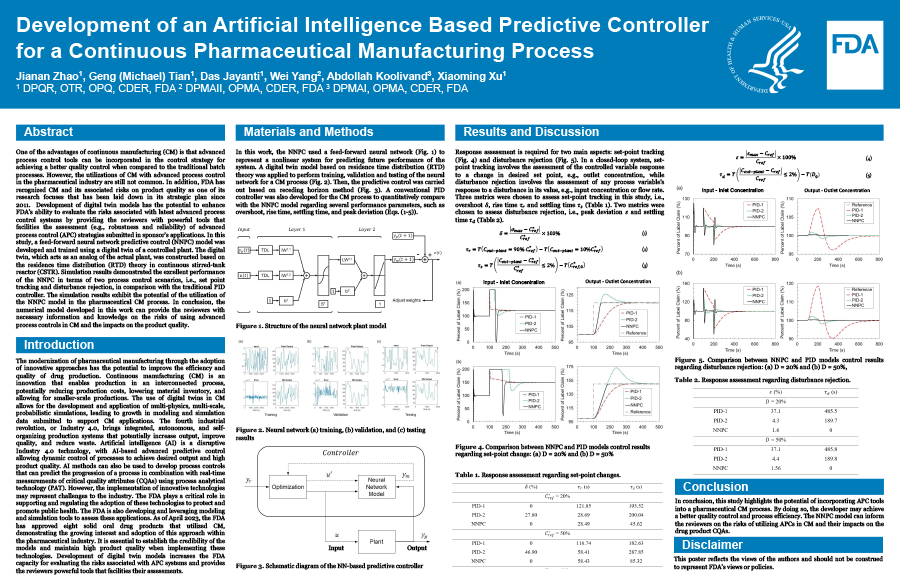
Background: The adoption of pharmaceutical continuous manufacturing (CM) has been a driving force for the growing utilization of modeling and simulation in product quality risk management. As a result, emerging manufacturing technologies, process models, Process Analytical Technology (PAT) tools, and advanced process control strategies have been developed to design, analyze, and control CM processes. Artificial intelligence (AI) model-based approaches are among the latest advances for the development and control of pharmaceutical processes. Such approaches have the advantage of providing actionable insights and predictions about processes and operations, as well as adjusting processes to maintain optimal operating conditions, mainly because they account for the large amount of data set collected during a production run. The FDA is increasingly utilizing modeling tools to support application assessment and to ensure product quality. Due to the increasing complexity and evolving nature of data set collected during manufacturing, establishing regulatory standards for AI-based models such as their credibility and impact on product quality can be challenging. Purpose and methodology: In this work, a digital twin model based on residence time distribution (RTD) theory was applied to train an artificial neural network predictive control (NNPC) model for a CM process. The NNPC used a neural network model to represent a nonlinear system for predicting future performance of the system. Then, the predictive control was carried out based on receding horizon method. A conventional PID controller was also developed for the CM process to quantitatively compare with the NNPC model regarding several performance parameters, i.e., overshoot, rise time, settling time, and peak deviation. Results and conclusion: The simulation results demonstrate the excellent performance of the NNPC in terms of both set-point tracking (±20% and ±50% label claim) and disturbance rejection scenarios when compared to the PID controller. A general procedure for training, verification and validation of the NNPC model is discussed. The simulation results support the potential utilization of NNPC models in the pharmaceutical CM processes. The NNPC model has the potential to advance the utilization of modeling and simulation tools to support regulatory quality assessment.