2023 FDA Science Forum
Development and Comparison of Two Rapid Screening Methods using DART-MS for the Detection of Designer Benzodiazepines in Violative Drug Products
- Authors:
- Center:
-
Contributing OfficeOffice of Regulatory Affairs
Abstract
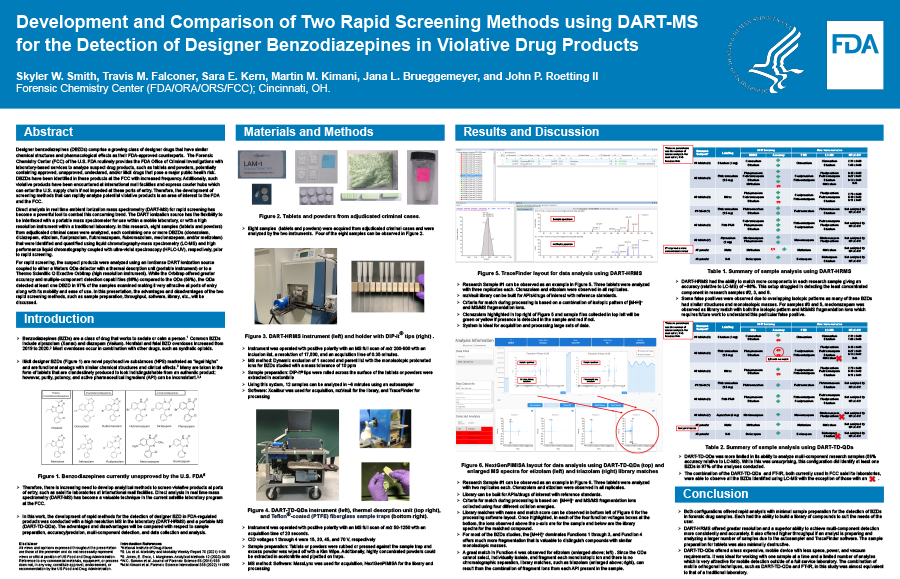
Designer benzodiazepines (DBZDs) comprise a growing class of designer drugs that have similar chemical structures and pharmacological effects as their FDA-approved counterparts. The Forensic Chemistry Center (FCC) of the U.S. FDA routinely provides the FDA Office of Criminal Investigations with laboratory-based services to analyze suspect drug products, such as tablets and powders, potentially containing approved, unapproved, undeclared, and/or illicit drugs that pose a major public health risk. DBZDs have been identified in these products at the FCC with increased frequency. Additionally, such violative products have been encountered at international mail facilities and express courier hubs which can enter the U.S. supply chain if not impeded at these ports of entry. Therefore, the development of screening methods that can rapidly analyze potential violative products is an area of interest to the FDA and the FCC. Direct analysis in real time ambient ionization mass spectrometry (DART-MS) for rapid screening has become a powerful tool to combat this concerning trend. The DART ionization source has the flexibility to be interfaced with a portable mass spectrometer for use within a mobile laboratory, or with a high resolution instrument within a traditional laboratory. In this research, eight samples (tablets and powders) from adjudicated criminal cases were analyzed, each containing one or more DBZDs (clonazolam, diclazepam, etizolam, flualprazolam, flubromazepam, flubromazolam, meclonazepam, and/or metizolam) that were identified and quantified using liquid chromatography-mass spectrometry (LC-MS) and high performance liquid chromatography coupled with ultra-violet spectroscopy (HPLC-UV), respectively, prior to rapid screening. For rapid screening, the suspect products were analyzed using an IonSense DART ionization source coupled to either a Waters QDa detector with a thermal desorption unit (portable instrument) or to a Thermo Scientific Q Exactive Orbitrap (high resolution instrument). While the Orbitrap offered greater accuracy and multiple-component detection capabilities (92%) compared to the QDa (60%), the QDa detected at least one DBZD in 97% of the samples examined making it very attractive at ports of entry along with its mobility and ease of use. In this presentation, the advantages and disadvantages of the two rapid screening methods, such as sample preparation, throughput, software, library, etc., will be discussed.