2021 FDA Science Forum
Developing an In Vitro Dynamic Test System for Thrombogenicity Evaluation of Medical Devices and Biomaterials
- Authors:
- Center:
-
Contributing OfficeCenter for Devices and Radiological Health
Abstract
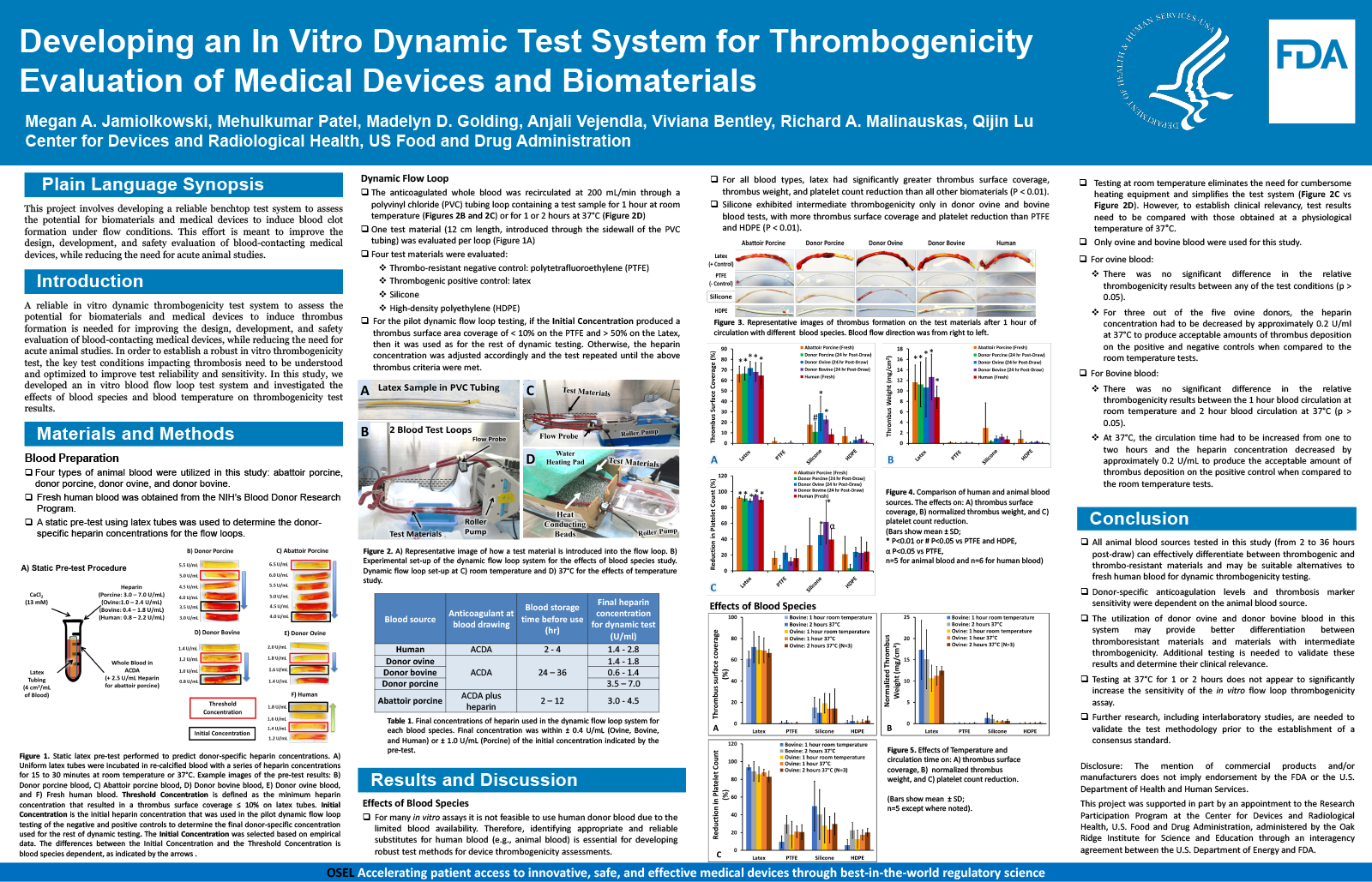
A reliable in vitro dynamic thrombogenicity test system to assess the potential for biomaterials and medical devices to induce thrombus formation would be helpful for improving the design, development, and safety evaluation of blood-contacting medical devices, while reducing the need for acute animal studies. In order to establish a reliable thrombogenicity test, the key test conditions impacting thrombosis need to be understood. In this study, we developed an in vitro blood flow loop test system and investigated the effects of blood species and blood temperature on thrombogenicity test results.
Five blood sources were examined: abattoir pig blood and live donor blood from humans, pigs, sheep, and cows. Immediately before each dynamic flow test, the blood was recalcified and heparinized to a donor-specific heparin concentration. The target heparinization level was based on a static pre-test, where latex tubes were incubated in recalcified blood to assess thrombus coverage using a series of heparin concentrations. For dynamic loop testing, the anticoagulated whole blood was recirculated at 200 mL/min through a polyvinyl chloride tubing loop for 1 hour at room temperature. Additionally, bovine blood was circulated for two hours at 37°C. The circulation time had to be increased and the heparin concentration decreased to produce a similar amount of thrombus deposition on the positive control material at 37°C when compared to testing at room temperature. Four materials with varying thrombogenicity potentials were investigated: negative control polytetrafluoroethylene (PTFE), positive control latex, silicone, and high-density polyethylene (HDPE). At the end of the tests, the thrombus surface area coverage, thrombus weight, and reduction in platelet count were measured.
The results demonstrate that donor-specific anticoagulation levels and thrombosis marker sensitivity were dependent on the blood source and temperature conditions. For example, silicone exhibited intermediate thrombogenicity only for ovine and bovine blood tested at room temperature, with more thrombus surface coverage and platelet reduction than PTFE and HDPE but less than latex (P < 0.01). However, for all blood sources and temperature conditions, the test loop system is able to effectively differentiate between thrombogenic and thrombo-resistant materials when appropriate control materials and donor-specific anticoagulation levels are used.