2023 FDA Science Forum
Determination of Fluticasone Furoate in serum-free media using LC-MS/MS to support Lung Microphysiological System Assessment of inhaled Drugs
- Authors:
- Center:
-
Contributing OfficeCenter for Drug Evaluation and Research
Abstract
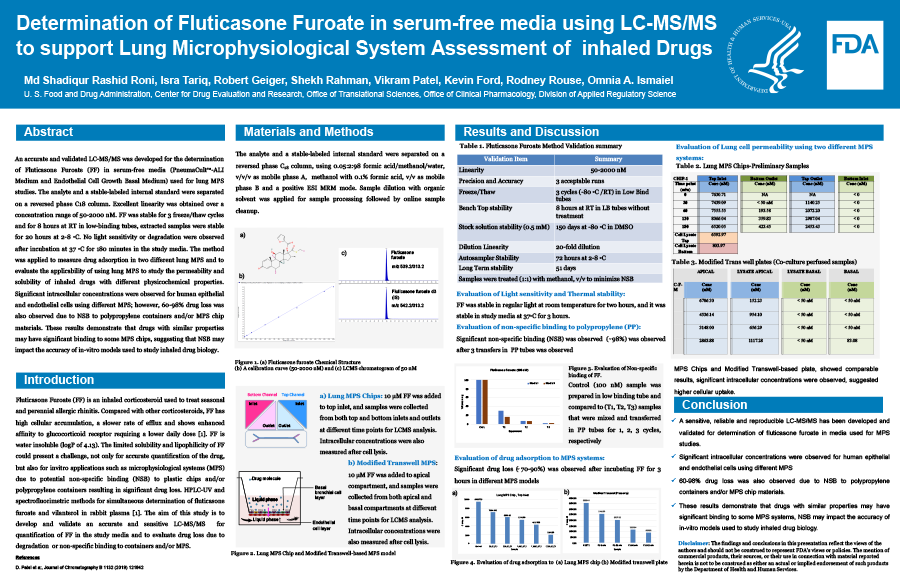
Fluticasone Furoate (FF) is an inhaled corticosteroid used to treat seasonal and perennial allergic rhinitis. Compared with other corticosteroids, FF has high cellular accumulation, a slower rate of efflux and shows enhanced affinity to glucocorticoid receptor requiring a lower daily dose. FF is water insoluble (logP of 4.13). The limited solubility and lipophilicity of FF could present a challenge, not only for accurate quantification of the drug, but also for invitro applications such as microphysiological systems (MPS) due to potential non-specific binding (NSB) to plastic chips and/or polypropylene containers resulting in significant drug loss. An accurate and validated LC-MS/MS was developed for the determination of FF in serum-free media (PneumaCult™-ALI Medium and Endothelial Cell Growth Basal Medium) used for lung MPS studies. The analyte and a stable-labeled internal standard were separated on a reversed phase C18 column, using 0.05:2:98 formic acid/methanol/water, v/v/v as mobile phase A, methanol with 0.1% formic acid, v/v as mobile phase B and a positive ESI MRM mode. Sample dilution with organic solvent was applied for sample processing followed by online sample cleanup. Excellent linearity was obtained over a concentration range of 50-2000 nM. FF was stable for 3 freeze/thaw cycles and for 8 hours at RT in low-binding tubes, extracted samples were stable for 20 hours at 2-8 ◦C. No light sensitivity or degradation were observed after incubation at 37 ◦C for 180 minutes in the study media. The method was applied to measure drug adsorption in two different lung MPS and to evaluate the applicability of using lung MPS to study the permeability and solubility of inhaled drugs with different physicochemical properties. Significant intracellular concentrations were observed for human epithelial and endothelial cells using different MPS; however, 60-98% drug loss was also observed due to NSB to polypropylene containers and/or MPS chip materials. These results demonstrate that drugs with similar properties may have significant binding to some MPS chips, suggesting that NSB may impact the accuracy of in-vitro models used to study inhaled drug biology.