2021 FDA Science Forum
Detection of Shiga Toxin-Producing Escherichia Coli from Ready-to-Eat Romaine Lettuce Using Targeted Amplicon Sequencing Approach
- Authors:
- Center:
-
Contributing OfficeCenter for Food Safety and Applied Nutrition
Abstract
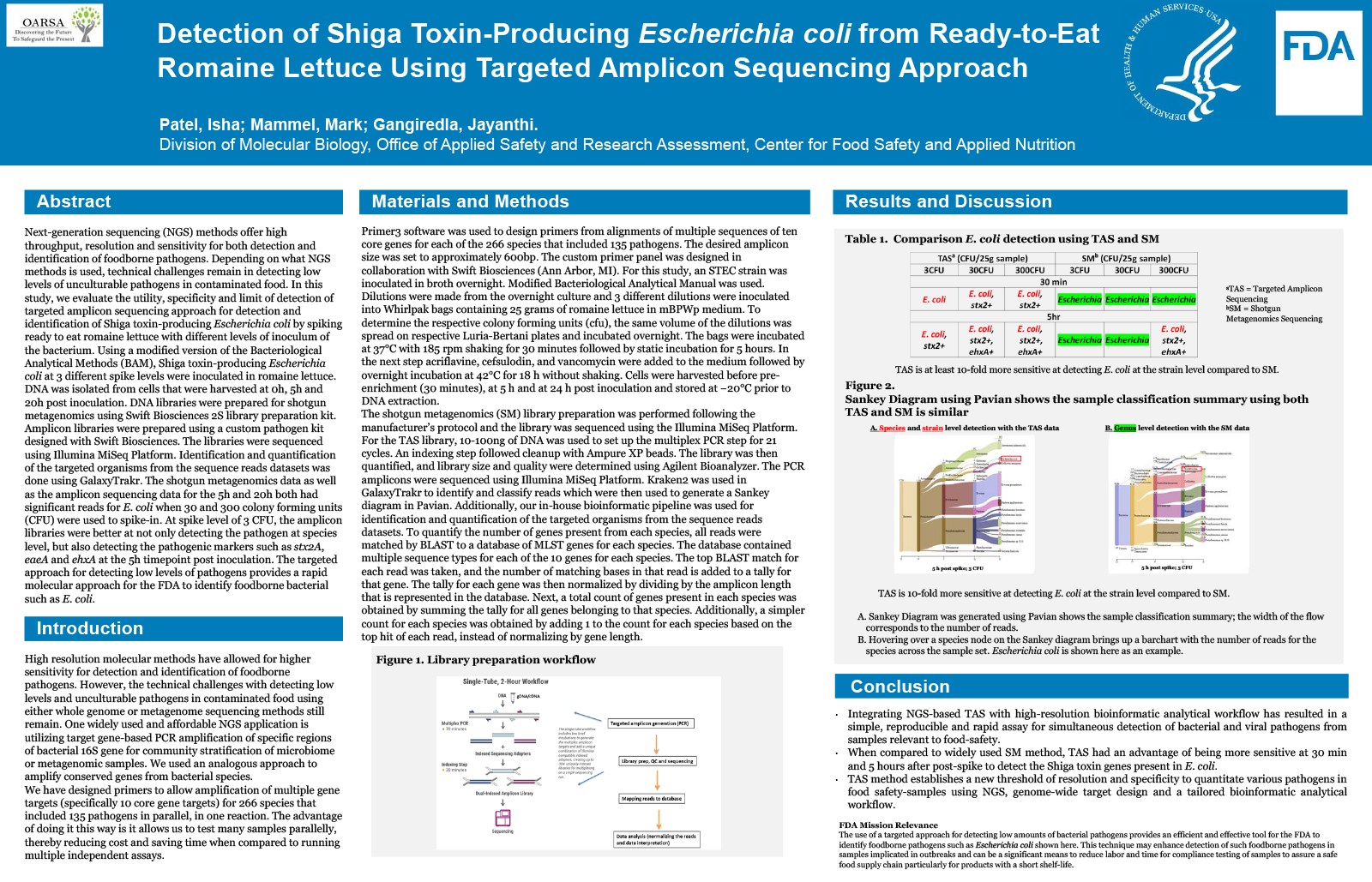
Next-generation sequencing (NGS) methods offer high throughput, resolution and sensitivity for both detection and identification of foodborne pathogens. Depending on what NGS methods is used, technical challenges remain in detecting low levels of unculturable pathogens in contaminated food. In this study, we evaluate the utility, specificity and limit of detection of targeted amplicon sequencing approach for detection and identification of Shiga toxin-producing Escherichia coli by spiking ready to eat romaine lettuce with different levels of inoculum of the bacterium. Using a modified version of the Bacteriological Analytical Methods (BAM), Shiga toxin-producing Escherichia coli at 3 different spike levels were inoculated in romaine lettuce. DNA was isolated from cells that were harvested at 0h, 5h and 20h post inoculation. DNA libraries were prepared for shotgun metagenomics using Swift Biosciences 2S library preparation kit. Amplicon libraries were prepared using a custom pathogen kit designed with Swift Biosciences. The libraries were sequenced using Illumina MiSeq Platform. Identification and quantification of the targeted organisms from the sequence reads datasets was done using GalaxyTrakr. The shotgun metagenomics data as well as the amplicon sequencing data for the 5h and 20h both had significant reads for E. coli when 30 and 300 colony forming units (CFU) were used to spike-in. At spike level of 3 CFU, the amplicon libraries were better at not only detecting the pathogen at species level, but also detecting the pathogenic markers such as stx2A, eaeA and ehxA at the 5h timepoint post inocluation. The targeted approach for detecting low levels of pathogens provides a rapid molecular approach for the FDA to identify foodborne bacterial such as E. coli.