2023 FDA Science Forum
Detection of Fluorescent Brightening Agents in Food Matrices using UPLC with PDA/FLR Detectors
- Authors:
- Center:
-
Contributing OfficeOffice of Regulatory Affairs
Abstract
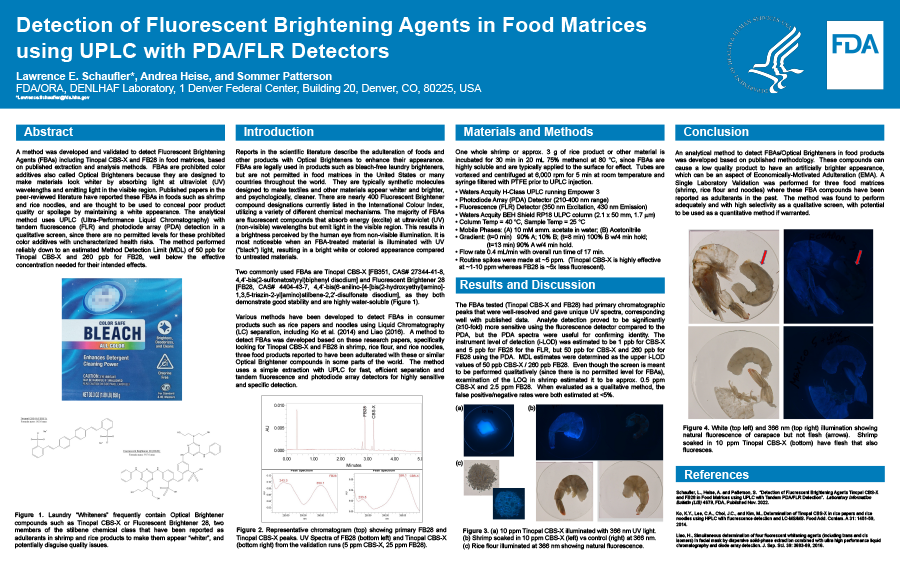
A method was developed and validated to detect Fluorescent Brightening Agents (FBAs) including Tinopal CBS-X and FB28 in food matrices, based on published extraction and analysis methods. FBAs are prohibited color additives also called Optical Brighteners because they are designed to make materials look whiter by absorbing light at ultraviolet (UV) wavelengths and emitting light in the visible region. Published papers in the peer-reviewed literature have reported these FBAs in foods such as shrimp and rice noodles, and are thought to be used to conceal poor product quality or spoilage by maintaining a white appearance. The analytical method uses UPLC (Ultra-Performance Liquid Chromatrography) with tandem fluorescence and PDA (Photo-Diode Array) detection in a qualitative screen, since there are no permitted levels for these prohibited color additives with uncharacterized health risks. The method performed reliably down to an estimated Method Detection Limit (MDL) of 50 ppb for Tinopal CBS-X and 260 ppb for FB28, well below the effective concentration needed for their intended effects.