2023 FDA Science Forum
Culture Dependent vs. Culture Independent 16S Sequencing for Bacterial Communities during Decomposition of Shrimp
- Authors:
- Center:
-
Contributing OfficeCenter for Food Safety and Applied Nutrition
Abstract
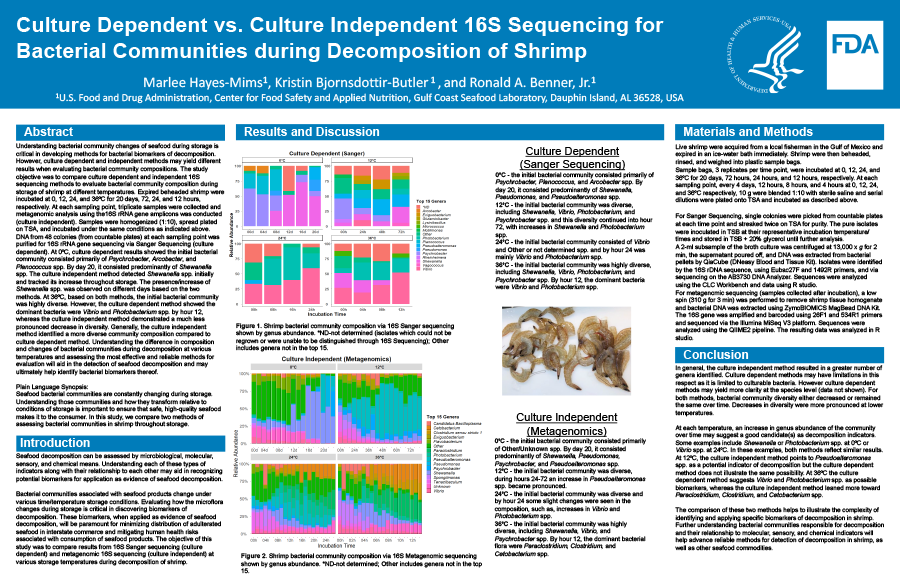
Understanding bacterial community changes of seafood during storage is critical in developing methods for bacterial biomarkers of decomposition. However, culture dependent and independent methods may yield different results when evaluating bacterial community compositions.
The study objective was to compare culture dependent and independent 16S sequencing methods to evaluate bacterial community composition during storage of shrimp at different temperatures.
Expired beheaded shrimp were incubated at 0, 12, 24, and 36⁰C for 20 days, 72, 24, and 12 hours, respectively. At each sampling point, triplicate samples were collected and metagenomic analysis using the16S rRNA gene amplicons was conducted (culture independent). Samples were homogenized (1:10), spread plated on TSA, and incubated under the same conditions as indicated above. DNA from 48 colonies at each sampling point was purified for 16S rRNA gene sequencing via Sanger Sequencing (culture dependent).
At 0°C, culture dependent results showed the initial bacterial community consisted primarily of Psychrobacter, Arcobacter, and Planococcus spp. By day 20, it consisted predominantly of Shewanella spp. The culture independent method detected Shewanella spp. initially and tracked its increase throughout storage. The presence/increase of Shewanella spp. would be observed on different days based on the two methods. At 36°C, based on both methods, the initial bacterial community was highly diverse. However, the culture dependent method showed the dominant bacteria were Vibrio and Photobacterium spp. by hour 12, whereas the culture independent method demonstrated a much less pronounced decrease in diversity. Generally, the culture independent method identified different species, compared to culture dependent, and showed a more diverse community composition.
Understanding the difference in composition and changes of bacterial communities during decomposition at various temperatures and assessing the most effective and reliable methods for evaluation will aid in the detection of seafood decomposition and may ultimately help identify bacterial biomarkers thereof.