2021 FDA Science Forum
Cross-Study Analysis of SEND Datasets Using an R Package: sendigR
- Authors:
- Center:
-
Contributing OfficeCenter for Drug Evaluation and Research
Abstract
Background:
The CDISC-SEND data standard has created new opportunities for collaborative development of open source software solutions to facilitate cross-study analyses of toxicology study data. FDA/CDER has established collaborative partnerships with PHUSE and BioCelerate Inc. to develop and publicize novel methods of extracting value from SEND datasets.
Purpose:
An R package, sendigR, was developed to enable end users to easily construct a relational database from any collection of SEND datasets and then query that database to derive insights from the entire collection of studies.
Methodology:
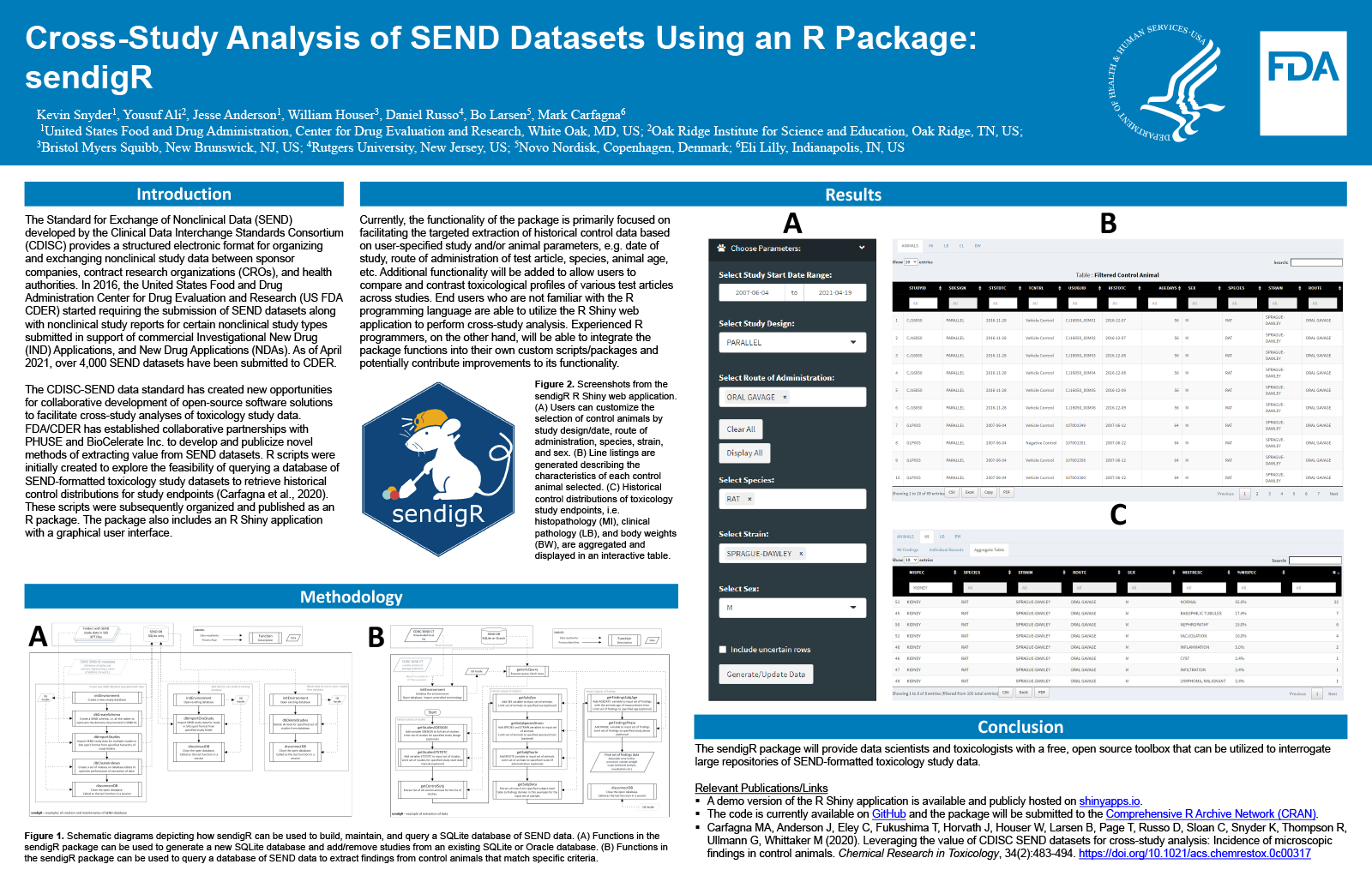
R scripts were initially created to explore the feasibility of querying a database of SEND-formatted toxicology study datasets to retrieve historical control distributions for study endpoints. These scripts were subsequently organized and published as an R package. The package includes an R Shiny application with a graphical user interface.
Results:
Currently, the functionality of the package is primarily focused on facilitating the targeted extraction of historical control data based on user-specified study and/or animal parameters, e.g. date of study, route of administration of test article, species, animal age, etc. Additional functionality will be added to allow users to compare and contrast toxicological profiles of various test articles across studies. End users who are not familiar with the R programming language are able to utilize the R Shiny web application to perform cross-study analysis. Experienced R programmers, on the other hand, will be able to integrate the package functions into their own custom scripts/packages and potentially contribute improvements to its functionality.
Conclusion:
The sendigR package will provide data scientists and toxicologists with a free, open source toolbox that can be utilized to interrogate large repositories of SEND-formatted toxicology study data.