2021 FDA Science Forum
Correlation of Physico-Structural (Q3) Properties of Lidocaine/Prilocaine Topical Products with Product Performance In Vitro and In Vivo
- Authors:
- Center:
-
Contributing OfficeOffice of the Commissioner
Abstract
Background and Purpose
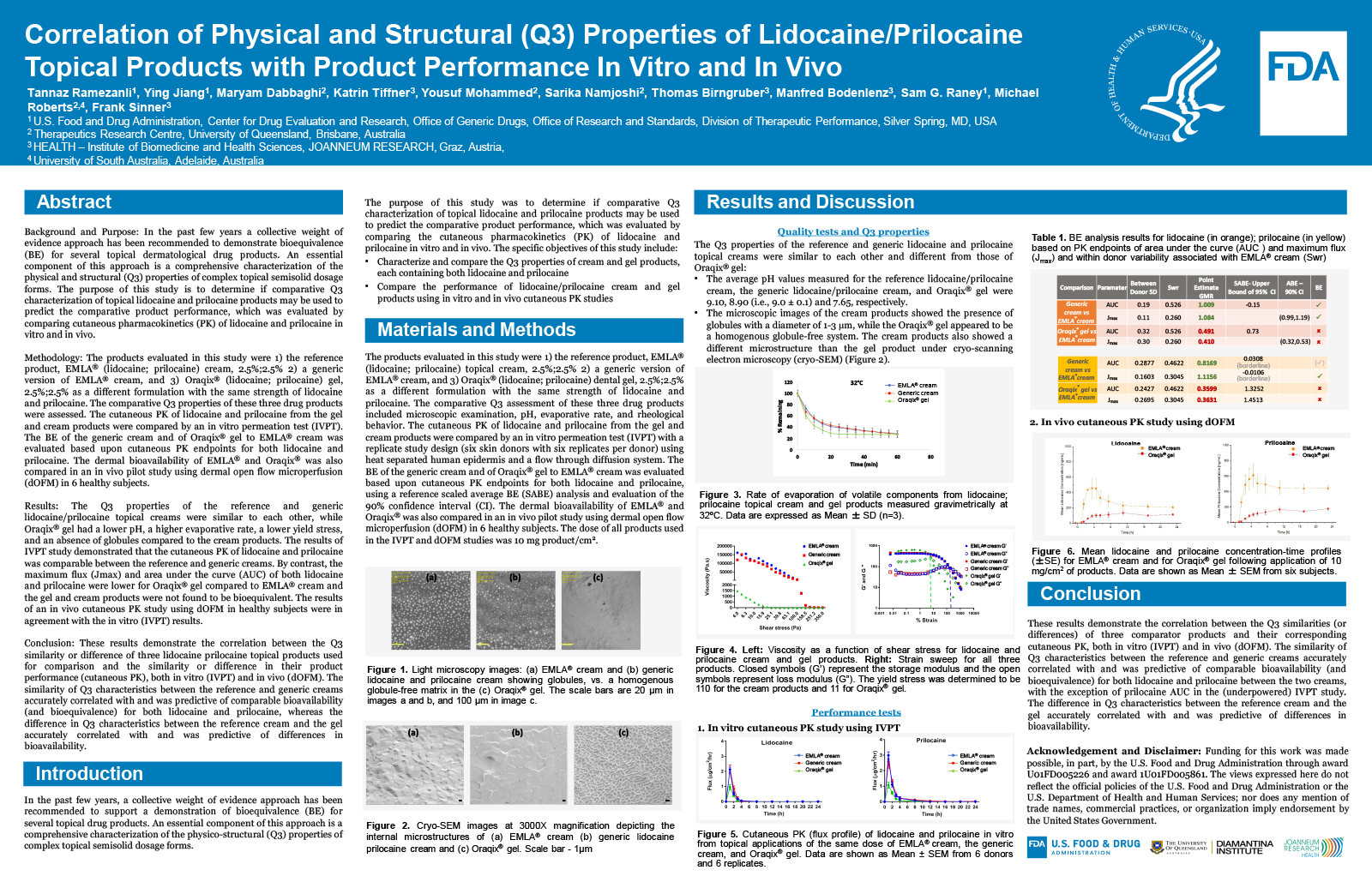
In the past few years a collective weight of evidence approach has been recommended to demonstrate bioequivalence (BE) for several topical dermatological drug products. An essential component of this approach is a comprehensive characterization of the physical and structural (Q3) properties of complex topical semisolid dosage forms. The purpose of this study is to determine if comparative Q3 characterization of topical lidocaine and prilocaine products may be used to predict the comparative product performance, which was evaluated by comparing cutaneous pharmacokinetics (PK) of lidocaine and prilocaine in vitro and in vivo.
Methodology
The products evaluated in this study were 1) the reference product, EMLA® (lidocaine; prilocaine) cream, 2.5%;2.5% 2) a generic version of EMLA® cream, and 3) Oraqix® (lidocaine; prilocaine) gel, 2.5%;2.5% as a different formulation with the same strength of lidocaine and prilocaine. The comparative Q3 properties of these three drug products were assessed. The cutaneous PK of lidocaine and prilocaine from the gel and cream products were compared by an in vitro permeation test (IVPT). The BE of the generic cream and of Oraqix® gel to EMLA® cream was evaluated based upon cutaneous PK endpoints for both lidocaine and prilocaine. The dermal bioavailability of EMLA® and Oraqix® was also compared in an in vivo pilot study using dermal open flow microperfusion (dOFM) in 6 healthy subjects.
Results
The Q3 properties of the reference and generic lidocaine/prilocaine topical creams were similar to each other, while Oraqix® gel had a lower pH, a higher evaporative rate, a lower yield stress, and an absence of globules compared to the cream products. The results of IVPT study demonstrated that the cutaneous PK of lidocaine and prilocaine was comparable between the reference and generic creams. By contrast, the maximum flux (Jmax) and area under the curve (AUC) of both lidocaine and prilocaine were lower for Oraqix® gel compared to EMLA® cream and the gel and cream products were not found to be bioequivalent. The results of an in vivo cutaneous PK study using dOFM in healthy subjects were in agreement with the in vitro (IVPT) results.
Conclusion
These results demonstrate the correlation between the Q3 similarity or difference of three three lidocaine prilocaine topical products used for comparison and the similarity or difference in their product performance (cutaneous PK), both in vitro (IVPT) and in vivo (dOFM). The similarity of Q3 characteristics between the reference and generic creams accurately correlated with and was predictive of comparable bioavailability (and bioequivalence) for both lidocaine and prilocaine, whereas the difference in Q3 characteristics between the reference cream and the gel accurately correlated with and was predictive of differences in bioavailability.